Get Full Government Meeting Transcripts, Videos, & Alerts Forever!
Get email alerts on the Education Mission Statement topic
No spam. Unsubscribe anytime.
Residents, advocacy groups press board after removal of 'inclusive' from CCPS mission
Summary
Dozens of speakers told the Calvert County Board of Education that removing language such as “inclusive” and “supportive” from the district mission would harm special-education students and undermine community input. Board members and legal questions about state policy were also raised during the public-comment period.
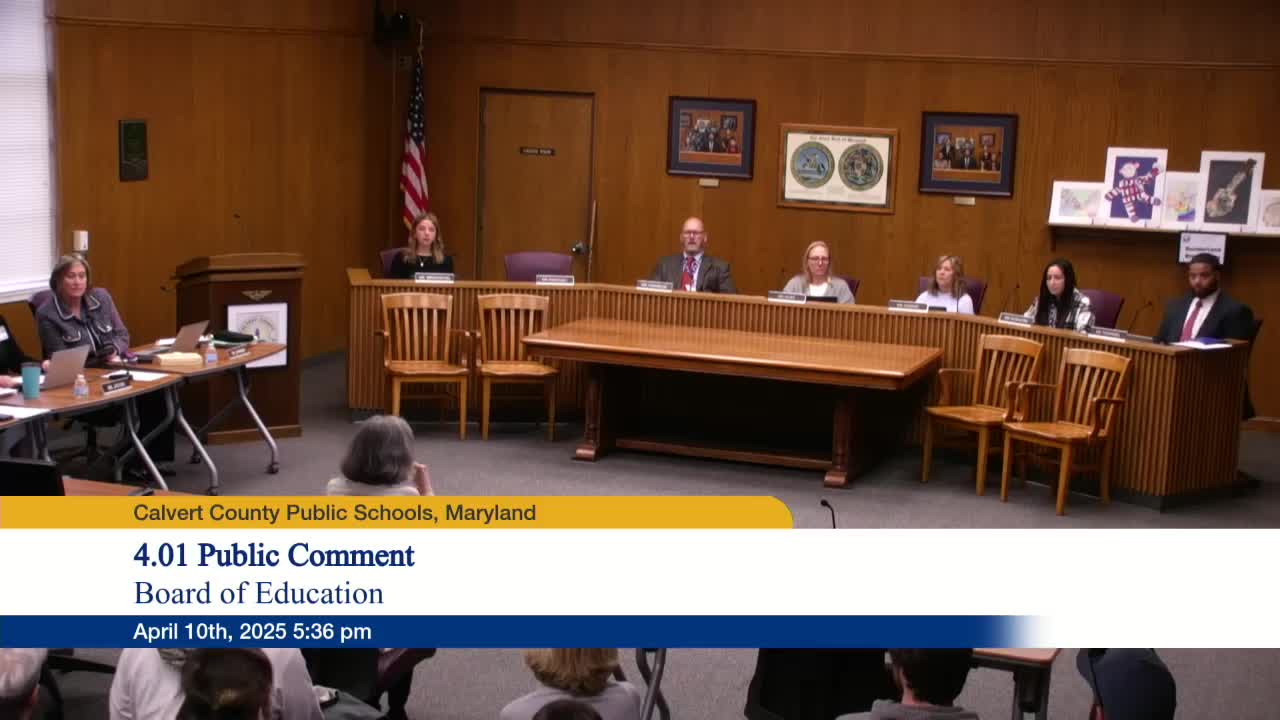
Dozens of residents, teachers and advocacy groups urged the Calvert County Board of Education on Tuesday to reverse a recent vote to remove the words “inclusive” and “supportive” from the district’s mission statement, saying the change signals diminished commitment to special education and equity.
Speakers said the revision, adopted at a prior meeting, came without adequate community involvement and could conflict with state guidance and existing district policy. “Removing these principles from our mission could exacerbate the challenges faced by students with disabilities,” said Peter Sinclair, representing CBW of Calvert. “Inclusion and equity are essential components of a well-rounded education.”
Public commenters included parents of children who receive early intervention services, special education advocates, and the Calvert County branch of the NAACP. Multiple speakers cited the Individuals with Disabilities Education Act when describing obligations to provide a free appropriate public education; others raised concerns about alignment with state administrative rules and district policy 10-15. “Inclusion is not just a buzzword. It is the foundation for equitable education,” said Danielle Park, a Huntingtown parent whose son received services from the Infants and Toddlers program.
Several speakers described firsthand reliance on programs and services that they said would be undermined if the board diminished its language on inclusion. Abigail Stevens, a CCPS graduate and mother of two children in special-needs programs, said the removed language carried real meaning for families who depend on additional staff and specialists. “This run-of-the-mill morning would be a miracle for my family,” she said, describing daily routines that many parents of children with disabilities must manage.
Opposition came from multiple organized groups. The NAACP of Calvert and the League of Women Voters delivered a joint appeal to “reconsider your vote” and asked how the board would determine which students might be deprioritized if the mission’s language is narrowed. Several speakers urged the board to consult its attorney about the action and to clarify whether the change aligns with Maryland administrative rules referenced by commenters.
Board members heard a mix of views. Some residents and veteran educators supported the board’s intent to tighten the mission around academic achievement and career readiness, saying a focused mission supports measurable outcomes. Others said the strategic-plan process that produced the mission involved thousands of community inputs and questioned spending on outside consultants if the board would then alter the product quickly.
The public-comment period ended with appeals for more dialogue and clearer explanations of how the board’s action will affect policy and day-to-day services. Multiple speakers urged the board to restore language or to hold a formal review with community participation. The board did not take a new vote on the mission during the public-comment period; speakers said they expect follow-up and asked for written answers to several legal and procedural questions.
Several speakers referenced recent local events and awards—such as the CCAC awards and inclusive track-and-field events—to illustrate how the district currently supports students with disabilities. “We saw students, both with and without special education needs, grow, learn, find community, and most of all, have fun,” said Joseph Cormier, who praised staff and volunteers who coordinate district inclusive events.
The board did not respond to individual requests during public comment but members later heard other agenda items, including administrative appointments and presentations. Several speakers asked for explicit follow-up on three questions: whether the mission revision reflects the intent of the participants in the strategic-plan process, whether it aligns with policy and state guidance, and whether the board will open a formal process for additional public input.
The district’s legal and policy implications were raised repeatedly but no formal legal citations or rulings were provided during the meeting. Board members were asked to circulate answers in writing and to consider additional community engagement before finalizing changes that commenters said affect vulnerable students.