Get Full Government Meeting Transcripts, Videos, & Alerts Forever!
Get email alerts on the Flood Risk Management topic
No spam. Unsubscribe anytime.
U.S. Army Corps says Freeport flood-protection work suspended; Velasco Drainage District outlines local upgrades
Summary
The U.S. Army Corps of Engineers told the Clute City Council the federally authorized Freeport portion of the Sabine Basin Coastal Storm Risk Management project is being closed out at the request of the non‑federal sponsor; the Velasco Drainage District said it will continue upgrades to pumps and levees without federal construction.
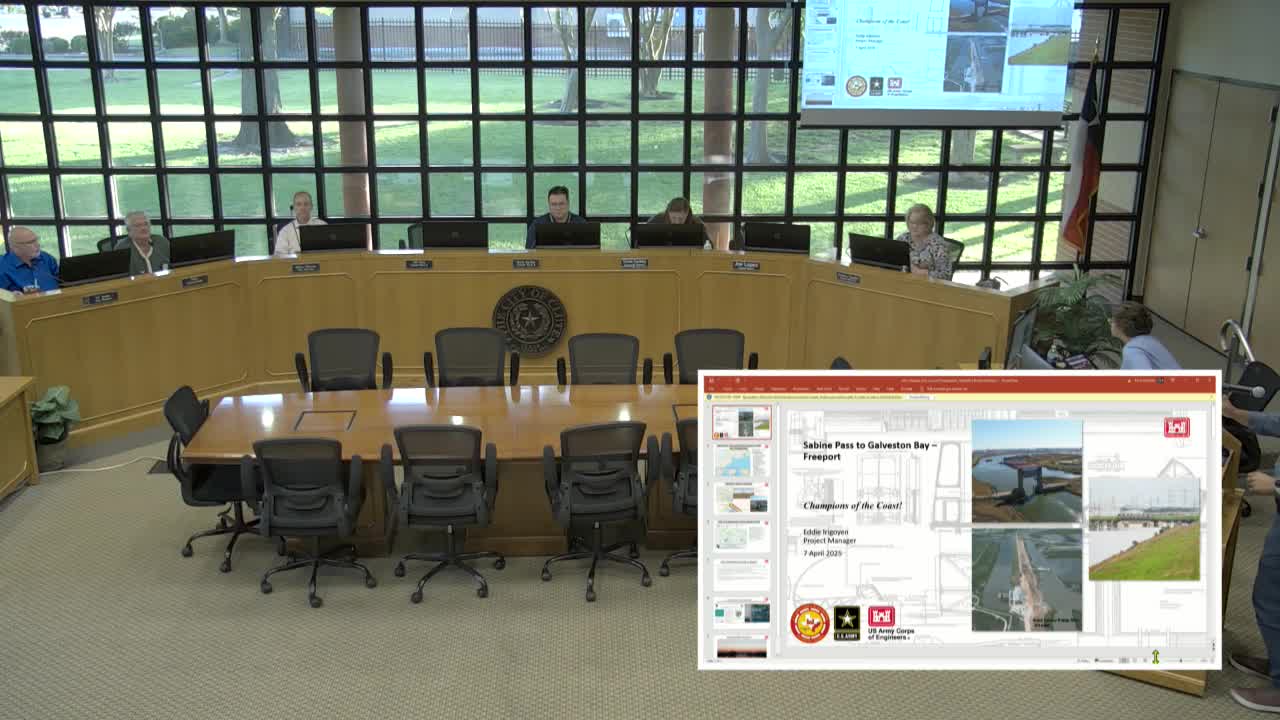
The U.S. Army Corps of Engineers told the Clute City Council the federally authorized Freeport portion of the Sabine Basin Coastal Storm Risk Management (CSRM) project is being placed into closeout and will not be constructed through the Corps’ current federal program.
Project manager Eddie Rigoyan, with the U.S. Army Corps’ Galveston District, said the Freeport project has been on suspension since April 2024 and that the Corps is finalizing closeout work at the request of the non‑federal sponsor, the Velasco Drainage District (VDD). Rigoyan said the project will remain authorized by Congress but that future work would require a new Project Partnership Agreement and new funding.
“The project has currently been on a suspension status since last April of 2024, and we are moving to finalizing and closing the project,” Rigoyan said. He described the original 2018 authorized plan as including roughly 13.1 miles of levee raising and 5.5 miles of flood wall plus a floodgate in the Dow Barge Canal; a later scope reduced those quantities.
Rigoyan said the Corps spent roughly $77.5 million on design and related activities for the three‑area CSRM project (Freeport, Port Arthur and Orange), with about 65% federal and 35% non‑federal cost share. He described work completed to various design percentages and said recent work produced a Post‑Authorization Change Report to document scope changes and costs.
Velasco Drainage District assistant superintendent David Youngblood told council members VDD intends to continue its own resilience work independent of Corps construction. Youngblood said VDD is upgrading the East Levee Frontal Pump Station by adding three engines, gearboxes and pumps to raise capacity from about 1,240,000 gallons per minute to about 2,050,000 gpm. He said the district’s overall pumping capacity will increase to about 5,000,000 gpm as other stations receive upgrades.
Youngblood said VDD is also replacing aging engines whose parts are no longer manufactured, raising levees to meet FEMA requirements and pursuing FEMA certification for the federal portion of the system. He described levee raises ranging from “four‑tenths of an inch to a foot and a half” in places to address subsidence and said VDD has already raised about 1.37 miles in the Oyster Creek levee system.
Both speakers emphasized that, though the Corps project is being closed out, the authorization remains in law and the non‑federal sponsor or another non‑federal sponsor could restart the process under a new partnership and seek funding in future federal budgets.
Council members asked for clarification about who would pay for any future work, whether state partners were participating in nearby efforts, and the status of data the Corps has collected. Rigoyan said the Corps will provide data gathered (survey, geotechnical and design work) to the non‑federal sponsor for its use. Youngblood said VDD is budgeting current funds to carry out its local work without additional federal dollars and will continue to use the Corps’ 404/408 coordination process for modifications that affect federally regulated structures.
The presentations left several practical matters for local officials: what VDD would fund directly, how much of the original Corps‑authorized scope would be needed to achieve local risk‑reduction goals, and how FEMA certification actions would proceed without Corps construction. Council members also asked whether state programs (for example, the Gulf Coast Protection District partnership referenced for other areas) were available to VDD; Youngblood said the district’s area is not part of that program without broader county participation.
The Corps and VDD encouraged the public to consult the Corps’ project web pages and story maps for updates and to contact agency staff with technical questions.