Get Full Government Meeting Transcripts, Videos, & Alerts Forever!
Get email alerts on the Board Policy Updates topic
No spam. Unsubscribe anytime.
Santa Rosa board reviews wide-ranging policy updates on meetings, library materials and grant rules
Summary
The Santa Rosa County School Board discussed proposed revisions to policies on meeting procedures, library-materials access and grant management at an April 10 workshop, focusing debate on who may attend closed sessions, public-comment rules and an opt-in process for certain library materials.
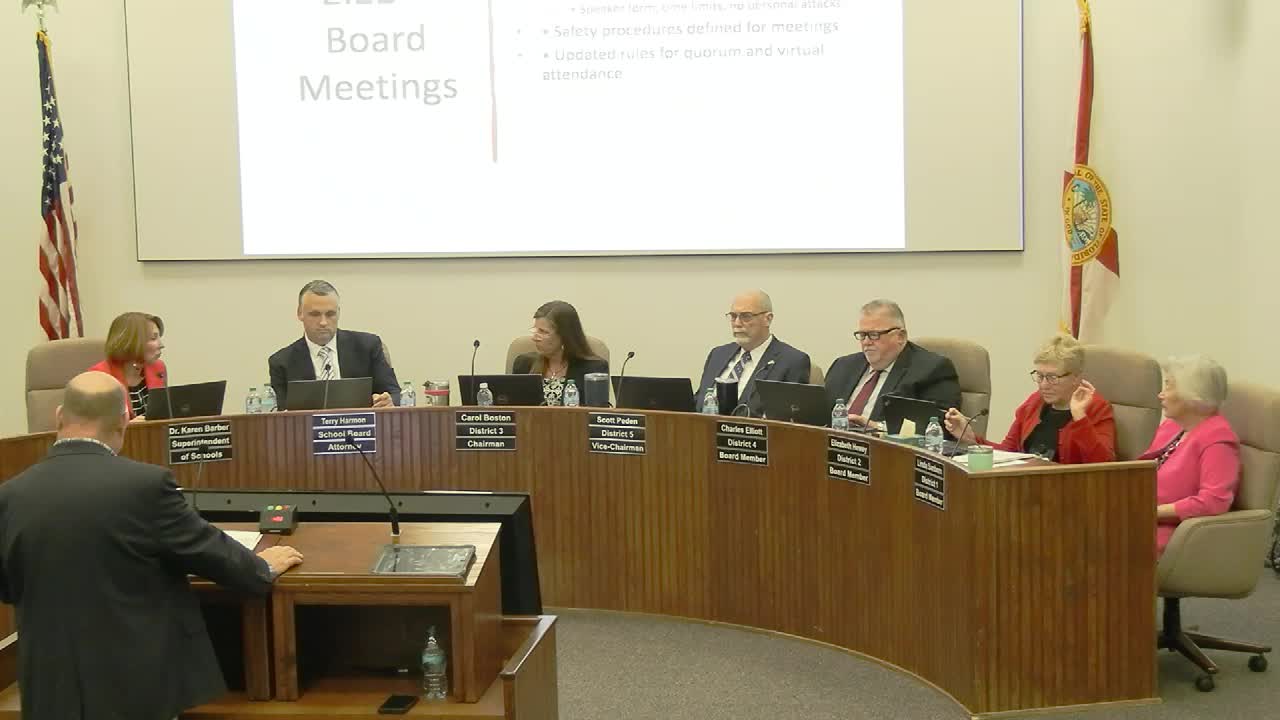
The Santa Rosa County School Board discussed proposed revisions to several district policies during its April 10 workshop, focusing on a rewritten meetings policy (2.22), updated guidance for educational media materials (4.22), and clarifications to grant-management rules (7.7 and 7.25). No adoption votes were taken; staff said the board will consider the policies at public hearings and a later adoption meeting.
Board members and district counsel spent the longest portion of discussion on 2.22, a rewrite that expands a three-page policy into nine pages to codify meeting types, quorum rules, public-comment procedures, safety guidance and virtual attendance. Trustees pressed staff to define the phrase "appropriate staff members" in the section on closed executive sessions and asked for clearer limits on who may attend bargaining-related closed sessions. The board’s attorney said state law permits a superintendent-selected bargaining team to attend closed collective-bargaining meetings but advised the district to align policy language with Chapter 447 and guidance from the Attorney General and relevant case law.
The draft places stricter procedural language around public participation: speakers may fill out forms, time limits are clarified for agenda and non-agenda items, and rules of decorum (including a prohibition on personal attacks) are now explicitly written into policy. Trustees raised free-speech concerns tied to a recent Eleventh Circuit decision involving Brevard County and asked staff to recheck the policy against that ruling before final adoption.
Policy 4.22, governing educational-media materials, adds definitions for "young adult" and "beyond young adult" material and establishes that parents or guardians must sign a district permission form before a student may check out materials classified as young adult (advanced middle-school readers) or beyond young adult (advanced high-school readers). The draft also revises the composition and procedure of the Material Objection Review Committee, adds a virtual-meeting option for committee hearings, and standardizes appeal schedules by setting a 10-calendar-day deadline for filing a written appeal after the committee posts its decision. Staff said the district has been using a 30-day deadline in practice where the draft contained conflicting timelines; the new 10-day alignment is intended to remove that inconsistency.
The board briefly reviewed updates to 7.7 and 7.25, which align district grant and procurement procedures with 2 CFR 200 (Uniform Administrative Requirements, Cost Principles, and Audit Requirements for Federal Awards) and clarify financial-management and grant-administration responsibilities. Staff said the changes mostly reflect existing practice and are intended to put long-standing operational rules into written policy.
Next steps: staff will incorporate board feedback, confirm conformity with the Eleventh Circuit guidance cited in session, and return a revised draft for notice and a May public hearing where formal votes are expected.