Get Full Government Meeting Transcripts, Videos, & Alerts Forever!
Get email alerts on the Land Use And Development topic
No spam. Unsubscribe anytime.
Lakeway officials outline city center redevelopment: three adjacent projects to add housing, townhomes and retail
Summary
Mayor Tom Kilgore and City Manager Joseph Molise outlined three adjoining City Center developments — the Square (Legends Community), The Oaks Phase 2 and Tuscan Village Phase 2 — describing unit counts, parking limits and an expected road connection completion date.
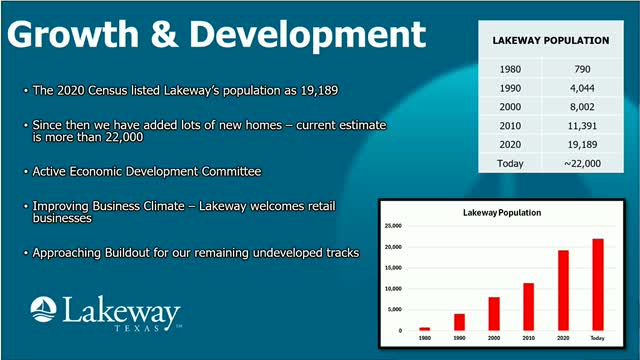
City officials described three adjoining developments that together form the Lakeway City Center and said the projects are intended to increase residential density to support local retail.
Mayor Tom Kilgore and City Manager Joseph Molise outlined the three parcels and their owners during the April 8 State of the City briefing. Kilgore described the project components as (1) the Square, developed by Legends Community Development and featuring a mix of single-family homes, apartments, townhomes and businesses; (2) The Oaks Phase 2, a project that requires a bridge to connect a dead-end road across a creek to the Square’s main street and is scheduled for zoning commission final approval, and (3) Tuscan Village Phase 2, a large apartment complex overlooking the police department.
Officials provided the following details drawn from the presentation and Q&A: Tuscan Village Phase 2 was described as having about 210 apartment units plus townhouses and multifamily units; city staff said the apartments are not age-restricted and that the city limited apartment parking to one space per unit and capped apartments at two bedrooms to limit household parking demand. Kilgore said The Oaks Phase 2 road connection that will join the Square is expected to be completed in May or June 2026.
Kilgore and Molise described the projects as a deliberate effort to create a retail-supporting population near the city core. Kilgore said the residential projects would provide “a density of a few thousand residents to support the businesses and retail there,” and city staff framed the parking and bedroom limits as tools to shape household size and parking demand.
Officials acknowledged community concerns raised in the question-and-answer session: residents asked about increased vehicle traffic, water supply capacity and neighborhood buffering. City staff reiterated that Lakeway does not itself provide water utility service in all areas and that water and wastewater capacity for new developments is determined by the local water-control and improvement district (WCID 17) or other providers. Officials also noted existing landscaping and buffering requirements for new commercial frontage while explaining that private landscaping and some tree species are subject to state law and landowner decisions.
Staff said the mixed-use and denser development in the City Center is intended to shift some tax revenue generation toward retail to relieve pressure on residential property tax burden; council members and staff said they view the City Center as the designated core area for higher-intensity development rather than spreading similar projects across other residential parts of Lakeway.