Get Full Government Meeting Transcripts, Videos, & Alerts Forever!
Get email alerts on the Building Safety topic
No spam. Unsubscribe anytime.
Burke County affirms vacate order for Marshallese New Beginnings but gives 30 days to produce financing and contractor plans
Summary
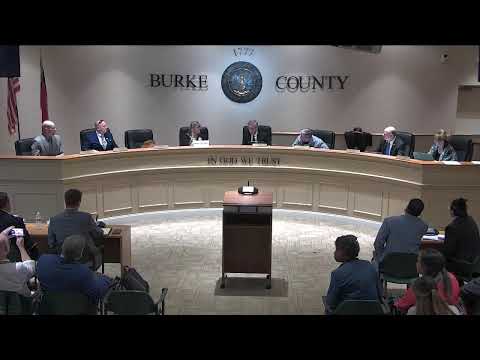
The Burke County Board of Commissioners on April 10 affirmed a building‑inspection order to vacate residential occupancy at 8123 George Hildebrand School Road — the site used by Marshallese New Beginnings Church — but modified the order to grant the church 30 days to submit written contractor estimates, proof of financing or grant documentation.
The Burke County Board of Commissioners on April 10 affirmed a building‑inspection order to vacate residential occupancy at 8123 George Hildebrand School Road — the site used by Marshallese New Beginnings Church — but modified the order to grant the church 30 days to submit written contractor estimates, proof of financing or a line of credit, or documentation of grant applications for repairs.
The board’s action came after a quasi‑judicial evidentiary hearing during which county staff testified the property contains multiple life‑safety and sanitation hazards. County attorneys and inspectors urged the commissioners to uphold the order after hearing testimony they said showed “exposed live wiring and overloaded electrical system[s],” sewage leaks and structural deterioration.
County attorney Dylan Laws, representing professional staff, told the panel: “This is a quasi judicial evidentiary hearing. … Your discretion is limited. Your decision can rest only upon the competent, relevant, and substantial evidence that is entered into the record today.” Laws argued the church had not met the burden of proof to show the prior order was incorrect.
Building inspector (identified in the record as) Holden described repeated inspections beginning in September 2022, a November 2022 order giving the owner 60 days to remedy unsafe conditions, a permit issued in December 2022 that expired a year later without inspections, and a room‑by‑room inspection in January 2024. Holden testified to multiple electrical violations, including uncovered panels and exposed Romex wiring, and said of an open panel: “All your bus bars and electrical is open to for anyone subject to just walk up to it and touch it and be electrocuted.” Holden said inspectors found evidence of overloaded circuits, kerosene heaters placed near beds and roof leaks causing wood rot.
Burke County Chief Fire Marshal Robert Bishop, accepted by the board as an expert witness, summarized fire‑safety problems and means‑of‑egress issues and testified the building was not safe for residential occupancy. Bishop said emergency exits had been blocked or altered, that some exit doors were difficult to operate, and that the combined problems created “a high amount of potential for fires” and “inability to safely exit the building” in a fire. He answered explicitly: “Would you consider this building to be safe? No. Would you consider it dangerous to life and safety? Yes.”
Pastor Tommy, representing Marshallese New Beginnings Church and speaking through an interpreter, told the board the congregation purchased the property without knowledge of the full scope of the code and safety issues. He said the church had completed some repairs, sought outside help and was trying to raise funds; he asked for a grace period and time to secure financing or grant support. Pastor Tommy provided a package of photographs and said members of the congregation and several people living at the property were seeking stable housing if a vacate order were enforced.
A legal question arose during the hearing about whether a corporate officer may represent the church without counsel in this administrative, quasi‑judicial forum. Dylan Laws argued the corporation must be represented by an attorney; outside counsel Martha Thompson advised the board that North Carolina precedent left the question unclear and said administrative proceedings have been treated differently by courts. The board allowed the church’s representative to proceed without counsel but noted continuing objections from county counsel as to where pro‑se representation might cross into the unauthorized practice of law.
After hearing testimony and argument from both sides, the commissioners voted to affirm the inspector’s order but amended it to allow a 30‑day continuance. The board directed the church to provide written documentation within that period — specifically: (1) a written estimate from a state‑approved contractor or licensed contractor showing the scope and cost of repairs; (2) proof of financing such as a line‑of‑credit commitment or verifiable bank documentation; or (3) documentation of submitted grant applications or other third‑party funding commitments. The county stated the evidence must be delivered to the clerk’s office within 30 days (the board specified May 12, 2025, when accounting for a weekend) and that the board would reconvene after that submission to consider the materials. The board emphasized the modification preserved the underlying vacate order: residential occupancy remains prohibited until corrective measures are verified. The board voted 4‑0 on the motion to modify and continue.
Commissioners and county witnesses repeatedly described the decision as constrained by law. Laws told commissioners that their role was not political: “It is a decision constrained by the standards in the law and based on the facts presented.” Commissioner comments showed a tension between compassion and statutory duty; several commissioners noted sympathy for the congregation but said the legal duty to protect public safety limited their options.
Key dates and procedural details introduced at the hearing included the initial inspection documented in September 2022, an order dated Nov. 9, 2022 giving 60 days for remedy, a permit issued in December 2022 that later expired, a room‑by‑room inspection in January 2024, and recent inspections through March–April 2025. County witnesses reported estimates from an April 2024 contractor review that were discussed informally during the hearing, with an approximate figure cited in testimony of $500,000 for full remediation, which the board used as a reference point when discussing feasibility and timelines.
The board also authorized the chair to sign the written order memorializing the decision. The meeting concluded with commissioners confirming the procedural steps: the church must submit the requested written documentation within 30 days, the county will schedule a reconvened date after that submission, and the vacate order remains in effect for residential use unless the board later modifies it again based on the evidence presented.
Votes at a glance: - Approve agenda as presented: adopted 4‑0. - Motion to affirm the inspector’s order with a 30‑day continuance for submission of contractor estimates, proof of financing or grant documentation: adopted 4‑0. The continuation preserves the prohibition on residential occupancy; the congregation may continue assembly for worship. - Motion authorizing the chair to sign the board’s order: adopted 4‑0.
Ending: The board closed testimony and set procedures for verifying whether the church can present feasible repair and funding plans within the 30‑day window. The written order will be prepared and signed as authorized; the church retains rights of administrative appeal consistent with state law.