
Committee hears broad support for apprenticeships and refers summer‑works/pre‑apprenticeship resolution to full council
Get AI-powered insights, summaries, and transcripts
Sign Up Free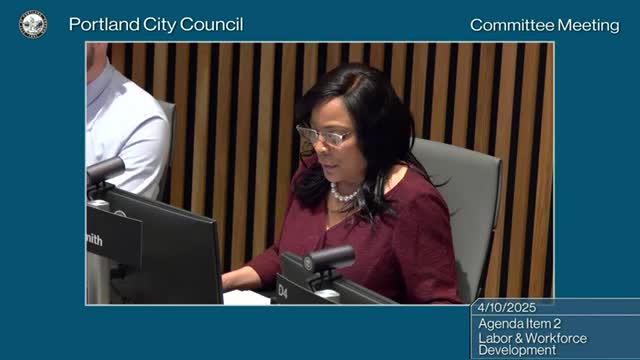
Summary
A broad group of workforce providers, union and city staff told a Portland City Council committee that pre‑apprenticeship programs and summer youth employment are critical to building a diverse local construction workforce; the committee amended and referred a resolution to full council to prioritize funding and reporting.
Portland's Labor and Workforce Development Committee on Tuesday heard testimony from workforce boards, trade unions, pre‑apprenticeship programs and city staff about the need to preserve and expand funding for pre‑apprenticeship training and youth employment. The committee then amended and forwarded a resolution that calls for prioritizing summer work and apprenticeship navigation funding in the city budget and requests annual reporting on program outcomes.
Workforce leaders urged continued investment. Andrew McGough, executive director of Work Systems Inc., described registered pre‑apprenticeship programs and subsidized work for low‑income youth as essential building blocks to meeting regional construction demand and improving long‑term earnings for participants. McGough said construction is a regional labor market and that a 'graying' workforce and large upcoming projects will increase demand for trained workers. He recommended protecting pre‑apprenticeship and youth employment funding through the upcoming budget cycle.
Project administrators and trades supported stronger pipelines. Greg Johnson, administrator for the Interstate Bridge Replacement Program (IBR), described outreach with regional partners and said the project will generate thousands of construction jobs over time, creating opportunity for local apprentices if a pipeline exists. Representatives from the Columbia Pacific Building Trades Council, Ironworkers Local 29, AFSCME and other unions outlined the role of registered apprenticeship in producing family‑wage jobs and emphasized the importance of curriculum alignment, wraparound supports and direct connections from pre‑apprenticeship into state‑registered apprenticeship programs.
Pre‑apprenticeship providers described barriers faced by applicants. Rona Usaman of Portland YouthBuilders and Anoa Kone of Constructing Hope explained that many prospective participants lack prerequisites the trades expect, such as a GED/high‑school equivalent, a valid driver's license, reliable transportation and the ability to pass pre‑employment drug screens. The providers said wraparound services (transportation, childcare, tools, short stipends and case management) are often decisive in whether participants complete training and enter apprenticeships.
City staff described contracting and workforce data. Priyadana Paul, Deputy City Administrator for Public Works, said the Public Works service area initiated roughly $1.76 billion in design and construction contracts in the past 12 months. She said COVID‑certified (disadvantaged) firms accounted for about 3% of total contract dollars as prime contractors (approximately $45 million) but made up about 50% of subcontracting dollar value, suggesting strong sub‑tier participation but persistent barriers to prime contracts. Paul also reported that roughly 17–18% of work hours on recent contracts were logged by people of color and about 4% by women.
Resolution, amendment and committee action: Councilor Loretta Smith introduced a resolution that would (among other items) call for continued funding of summer work programs, establish Work Systems Inc. as a city partner for program delivery and request annual reporting on outcomes. Committee members proposed and approved a suite of amendments that clarified language and changed a commitment from "expects to allocate" to a less prescriptive word ("hopes to allocate") regarding future budget commitments. The committee voted to forward the amended resolution to full council for consideration.
Why it matters: Panelists said that public and private infrastructure projects, including large regional projects, will create demand for thousands of trained construction workers in coming years and that local pre‑apprenticeship and youth employment programs are the pipeline to those jobs. Committee members and workforce providers emphasized that cuts to summer work and navigation programs would reduce that pipeline and could disproportionately affect BIPOC and low‑income youth.
What remained unresolved: Committee members asked staff and the City Attorney to clarify administrative questions raised by the resolution, including whether elements of operational delivery are appropriately housed in a council office or should be part of a bureau budget and how ongoing staffing and reporting would be sustained from year to year. The committee asked staff to provide more detail on funding sources and timelines before the full council vote.
Voices from the record: "Registered pre‑apprenticeships provide hands‑on training and direct pipelines into good‑paying jobs," said Andrew McGough of Work Systems Inc. "There's a major return for these kinds of investments."
"These programs have a proven track record of retention when connected with registered apprenticeship and wraparound supports," said the Columbia Pacific Building Trades Council representative, who urged direct connections to state‑registered apprenticeship programs.
Next steps: The amended resolution will appear on a future full council agenda for consideration; committee members signaled they will continue to refine budgetary and administrative language before that hearing.