Get Full Government Meeting Transcripts, Videos, & Alerts Forever!
Get email alerts on the Higher Education Finance topic
No spam. Unsubscribe anytime.
Senate committee advances higher-education omnibus bill after amendments clarifying state grant rationing and surplus rules
Summary
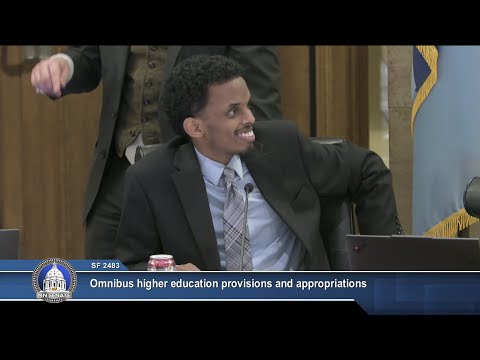
The Senate Higher Education Committee voted to recommend passage of an omnibus higher-education budget bill (Senate File 2,483) after adopting multiple amendments that officials said will stabilize the state grant program, clarify how the Office of Higher Education (OHE) applies rationing and handle surpluses.
The Senate Higher Education Committee voted to recommend passage of an omnibus higher-education budget bill (Senate File 2,483) after adopting multiple amendments that officials said will stabilize the state grant program, clarify how the Office of Higher Education (OHE) applies rationing and handle surpluses.
Committee chair (presiding officer) opened debate, saying, "I'm proud to be carrying this budget bill which takes responsible steps, to balance our financial aid programs in the face of a challenging budgetary landscape," and summarized provisions intended to preserve student-aid parameters and avoid deep cuts to other state programs.
The committee adopted a package of changes and technical fixes, including: - The A4 “delete everything” amendment (moved by Senator Kupek), adopted early in the hearing and incorporated into the bill before later amendments. - The A8 amendment, described by committee staff Mr. Watson as technical fixes that, among other items, clarify that a $50,000 administrative appropriation to the Office of Higher Education is annual and that members of an enrollment-fraud working group receive no additional compensation; members adopted A8. - The A7 amendment (offered by Senator Umu Vervein) clarified how a surcharge applied during rationing must be calculated. The amendment specifies that any surcharge applied when appropriations are insufficient cannot vary by student status (dependent, independent, independent with dependents) and therefore must preserve the program's existing modifiers. Senator Vervein said the change reflected the committee's intent that "a student is a student" and urged equal treatment across categories; the committee adopted A7. - The A9 amendment (offered by Senator O'Malley Behn) instructs OHE about the order in which it may apply surplus-driven adjustments: if there is a surplus in the second year of the biennium, OHE should prioritize expanding recognition of the negative student aid index up to a federal cap before making changes to other parameters such as living and miscellaneous expense (LME). OHE testimony from Megan Flores, manager of State Financial Programs at the Office of Higher Education, warned that the federal FAFSA simplification law sets the minimum student contribution at negative $1,500 and does not set a federal floor for parental contribution; Flores said the parental contribution for the upcoming aid year could be lower (reported in committee as negative $1,826) and explained how dependent and independent students are affected differently under federal needs analysis. After discussion and member questions about the risk of "draining the bucket" of state grant funds, the committee adopted A9. - The A12 clarifying amendment (moved by Senator Rarick and explained by Ms. Burrows) limits OHE's authority to apply surplus procedures in fiscal years 2026–2028 so that any appropriation balance can be carried forward and remain available through the end of fiscal year 2029. Ms. Burrows summarized the problem as a timing conflict between surplus procedures and a deliberate decision in the bill to allow the state grant appropriation balance to remain available through FY2029; the committee adopted A12.
Members debated and rejected several other amendments. Senator Farnsworth's A5 proposal to expand PSEO coverage for coursework so a student could complete an associate degree at the same time as high school graduation was not adopted after the chair said the item lies in education committee jurisdiction. Senator Otke's A6 amendment to restore funding to the Large-Animal Veterinary Loan Forgiveness Program did not pass; Otke described the shortage of large-animal veterinarians in rural Minnesota and proposed reinstating $162,000 for FY2026 and increasing to roughly $328,000 in later years, but the committee did not adopt the change. Senator Otke also brought forward an A10 amendment to restore funding for the United Family Medicine Residency Program; an A11 amendment that showed a funding offset (taking $1 million from an increase previously proposed for Minitex to pay for a $500,000-per-year restoration) was adopted, but the underlying A10 restoration of the residency funding was not adopted by the committee.
Committee members repeatedly balanced policy goals for students, workforce programs in Greater Minnesota and statewide services. Senator Duckworth cautioned members to avoid changes that could quickly deplete the state grant appropriation by expanding eligibility or modifiers without securing sustainable funding, saying the committee should "be mindful" of prior episodes when funds were drawn down.
The chair noted that OHE projects the bill amendments would leave approximately $25,000,000 in the state grant balance at the end of fiscal year 2027 under the bill's parameters and that the committee had deliberately allowed any balance to remain available through FY2029 to mitigate future rationing.
After the amendment votes, the chair moved that Senate File 2,483 as amended be recommended to pass and be re-referred to the Committee on Finance, with staff directed to make technical and conforming changes. The committee approved that motion and referred the bill to finance.
The committee adjourned after completing action on the omnibus higher-education budget bill.