Get Full Government Meeting Transcripts, Videos, & Alerts Forever!
Get email alerts on the State Budget Labor topic
No spam. Unsubscribe anytime.
Senate Labor Committee advances chair's omnibus Labor budget with construction fee changes, break-time rules and new mental-health funding
Summary
The Senate Labor Committee on April 10 advanced the committee's chair's omnibus Labor budget, Senate File 2373, approving technical and policy amendments that would adjust construction code fees, clarify meal and rest break requirements for workers, and fund construction‑industry mental‑health initiatives.
The Senate Labor Committee on April 10 advanced the committee's chair's omnibus Labor budget, Senate File 2373, approving technical and policy amendments that would adjust construction code fees, clarify meal and rest break requirements for workers, and fund construction‑industry mental‑health initiatives.
The chair moved and the committee adopted the A3 and A13 amendments to place the bill in its working form and to make technical and clarifying edits. Nonpartisan staff and the Department of Labor and Industry (DLI) then walked members through the proposal's appropriation and policy provisions.
Why it matters: The package would provide the Department of Labor and Industry ongoing operating resources for plan review and inspections, adjust fee schedules in the construction codes and licensing division, and add a $1,000,000 one‑time general fund appropriation (split evenly across fiscal years 2026 and 2027) for construction‑industry mental‑health and suicide‑prevention initiatives. The bill also contains clarified statutory language on employee meal and rest breaks and adds a reporting requirement to the helmets‑to‑hard‑hats appropriation.
Key details - Budget totals: The A3 shows a general fund direct appropriation recommendation for DLI of $15,919,000 in the 2026-27 biennium (an increase of $1,476,000 over base) and $15,086,000 in 2028-29 (an increase over base). The committee's labor target was met by the A3. - Construction code fund: The amendment proposes statutory fee adjustments that the fiscal spreadsheet ties to a projected construction code fund revenue increase of about $25.25 million in 2026-27 and $25.36 million in 2028-29 and expense increases in the $4.16 million range for the construction codes and licensing division. The A3 retains the underlying fee structure but the nonpartisan analyst said a new fiscal note has been requested to reflect changes in the A3 language. - Construction‑industry mental‑health: The chair's amendment moves a one‑time $1,000,000 general fund appropriation for construction industry mental‑health initiatives (Senate File 2744) into the construction codes and licensing division; staff said the amount is split evenly between fiscal years 2026 and 2027. - Meal and rest breaks: Article 3 tightens and clarifies meal and restroom break timeframes and enforcement remedies. DLI testified the changes are intended to make rest‑break obligations clear and enforceable for all Minnesota workers. - Program consolidations: The A3 consolidates multiple labor standards line items into a single labor standards operating appropriation, including funding for wage theft prevention, nursing/lactation accommodations outreach, safe workplace enforcement and other statutorily required activities; staff said the consolidation does not eliminate the work but moves funding into an operating line. - Reporting and other policy provisions: The A3 adds a reporting requirement tied to the helmets‑to‑hard‑hats appropriation (language from Senate File 1756) and includes provisions from Senate File 908 related to underground/broadband installer training in Article 4 to ensure continuity if floor time runs short.
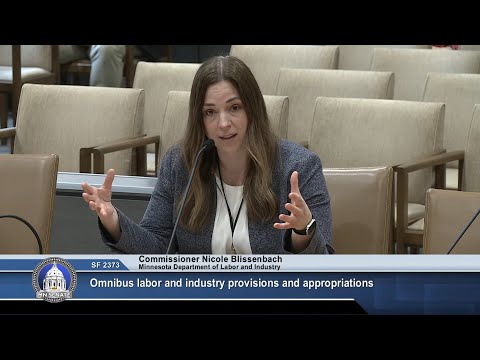
What supporters said DLI Commissioner Nicole Blisenbach testified in support of Senate File 2373, thanking the chair and stakeholders for work on the construction‑code fee alignment and saying the changes will "enable the department to continue to provide timely and high quality plan review and inspection services for electrical systems, elevators, plumbing, boilers, and manufactured structures." She also said the bill's break‑time language "will help ensure that employers understand their obligations and employees understand their rights regarding rest and meal breaks."
Mark Brunner of the Manufactured and Modular Home Association told the committee his group negotiated with the department and, though they opposed some specific fee increases, preferred to keep HUD program administration local in Minnesota.
Melissa Heising, legislative director for the Minnesota AFL-CIO, urged the committee to restore separate enforcement funding for worker misclassification, saying the governor's budget included positions to handle increased misclassification complaints that would generate penalty revenue and inform enforcement.
John Thorson, representing union construction interests, thanked the committee for including helmets‑to‑hard‑hats, high school pathways and the mental‑health appropriation.
How enforcement would work Commissioner Blisenbach described DLI's enforcement process for alleged break violations: the department typically begins with an "inform and educate" letter to employers outlining the allegation and the employer's obligations; many matters are resolved at that stage. If complaints continue or multiple employees complain, DLI may open an investigation, request documentation and pursue administrative remedies; warning letters and opportunities to cure are common before formal compliance orders.
Amendments and votes - A3 amendment: adopted (voice). - A13 amendment (technical/cleanup): adopted (voice). - A4 amendment (agriculture exemption to earned‑sick‑and‑safe‑time language): failed on roll call (tally 4 ayes, 6 nays). - A11 amendment (would have removed specified civil penalties for break violations): did not pass (voice). - The chair laid SF2373 as amended on the table to proceed with the policy bill, and later the committee recommended SF2373 as amended to pass and re‑refer to the Finance Committee (voice vote).
Outstanding items and next steps Staff told members the construction code fee estimates in the A3 reflect the governor's fee proposal and that a new fiscal note is pending for the updated A3 language; that fiscal note will replace the current estimates when available. The committee also moved related broadband training language into the bill to "dual track" it in case floor time is limited. Several department priorities were not funded in this package, including statewide teacher apprenticeship funding, expanded misclassification enforcement funding and certified worker organization grants; DLI testified it hopes those items can be addressed later in the session.
Ending The committee's action advances the chair's Labor budget with negotiated technical changes, a one‑time appropriation for construction‑industry mental‑health work and clarified break‑time rules; the bill will now move to further fiscal review and to the Finance Committee.