Get Full Government Meeting Transcripts, Videos, & Alerts Forever!
Get email alerts on the Federal Workers Relief topic
No spam. Unsubscribe anytime.
Minnesota lawmakers introduce benefits extension, veteran relocation bonus and tariff study to aid workers and small businesses
Summary
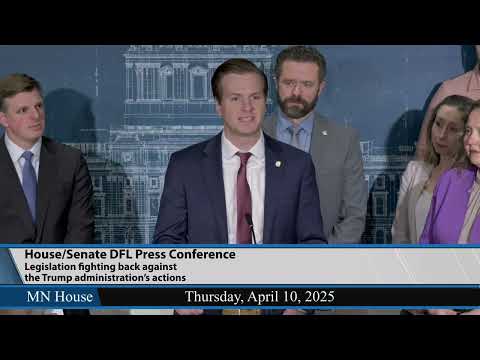
Representative Emma Greenman, DFL of south Minneapolis, introduced several bills and speakers at a Capitol news event on Thursday aimed at cushioning Minnesota workers and small businesses from recent federal actions and tariff changes.
Representative Emma Greenman, DFL of south Minneapolis, introduced several bills and speakers at a Capitol news event on Thursday aimed at cushioning Minnesota workers and small businesses from recent federal actions and tariff changes.
Greenman said the measures respond to what she described as “chaos” from the White House and private-sector directives affecting federal employees and contractors. “For the 18,031 federal workers in Minnesota… the last 80 days must have felt like a betrayal,” she said.
The measures discussed were: House File 3078, which would allow a 13-week extension of state unemployment benefits for affected public employees beyond Minnesota’s standard 26 weeks; House File 3164, a proposed $10,000 relocation bonus for veterans fired at the federal level who move to Minnesota for new employment; and a proposed study and action plan to marshal state resources in response to tariff-driven economic disruption and federal contract freezes.
Supporters said the proposals are designed to provide immediate breathing room for workers while state agencies and employers adjust. Representative Johnson (identified only by last name in the transcript), describing an amendment to HF3078, said the “13 week extension for government workers once their unemployment benefits run out” would give displaced public servants and the state’s dislocated worker program additional time to place people into new employment.
Jake Romans, president of the American Federation of Government Employees (AFGE) Local 3669 at the Minneapolis VA, described the human consequences of the federal deferred resignation program (DRP), also referred to in public testimony as the “fork in the road.” Romans said his local represents more than 2,300 employees and warned that employees who accepted early separation offers or were placed on probation have faced termination, reinstatement, and renewed legal uncertainty.
Representative Matt Norris described HF3164 as a recruitment tool for Minnesota employers, saying the bill would pay $10,000 relocation bonuses to veterans who lost federal jobs and take new work in the state. “When you talk to businesses in our state… there’s no one I would rather hire than a veteran,” Norris said, urging the state to view the scale of federal separations as an opportunity to fill local labor needs.
Small-business owner Dan Marshall, co-owner of Mischief Toy Store on Grand Avenue in Saint Paul, told lawmakers the tariff swings and rapid changes in duties have raised costs and uncertainty for Main Street retailers. “A toy that we’re selling right now for $10… is gonna be $25,” he said, describing recent tariff fluctuations and the effect on suppliers and suppliers’ suppliers.
Representative Mike Howard urged the Legislature to marshal state power to protect workers and local employers, and to press Minnesota’s congressional delegation to act on tariffs. Lawmakers and witnesses repeatedly mentioned difficulties contacting federal agencies and uncertainty about whether federal contracts and benefits will be honored, prompting proponents to argue for state action as a backstop.
Legislators discussed funding sources. Representatives said extensions of unemployment benefits would draw from the Minnesota UI trust fund; HF3164 would be administered through the Minnesota Department of Employment and Economic Development (DEED) and would require a new appropriation. One questioner referenced a potential $6,000,000 appropriation for the veteran relocation program; sponsors said final cost and appropriation targets would be settled in budget discussions and conference negotiations.
No formal votes were recorded at the event. Lawmakers described the measures as introduced or proposed and said further work in committee and in conference on budget priorities would determine whether the bills advance.
Ending: Sponsors said they intend to move the proposals through the legislative process and to work with state agencies (DEED, Minnesota Management and Budget) to identify funding and implementation details if the bills receive committee hearings and appropriations.