Get Full Government Meeting Transcripts, Videos, & Alerts Forever!
Get email alerts on the State Budget Environment topic
No spam. Unsubscribe anytime.
Committee adopts DE1 for House File 2439 and refers omnibus environment budget to Ways and Means
Summary
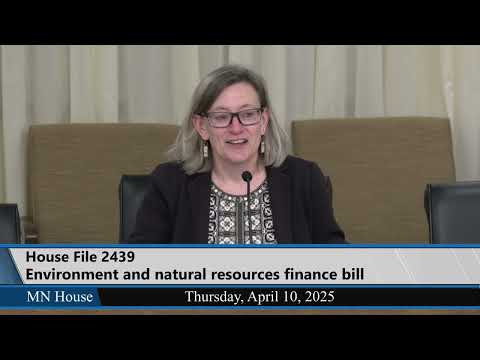
The Environment and Natural Resources Finance and Policy Committee adopted the DE1 amendment to House File 2439 and voted to re‑refer the bill to the House Ways and Means Committee at a committee meeting on April 8, 2025.
The Environment and Natural Resources Finance and Policy Committee adopted the DE1 amendment to House File 2439 and voted to re‑refer the bill to the House Ways and Means Committee at a committee meeting on April 8, 2025.
House File 2439, presented by Co‑Chair Josh Heintzeman, is a “keep the lights on” omnibus environment and natural resources budget that extends current appropriations into the 2026–27 biennium while omitting the governor’s proposed operating adjustments. After adopting the DE1 amendment, the committee re‑referred the bill with instructions for nonpartisan staff to make technical corrections.
The bill maintains baseline funding for many agency programs but implements $10 million in targeted reductions to meet a committee fiscal target. Nonpartisan staff identified the reductions on the spreadsheet as: a $3 million cut to local climate action grants, a $5 million cut to enhanced grasslands and wetland restoration on wildlife management areas (WMAs) for carbon capture and resiliency, and a $2 million cut to climate private‑land/working‑land restoration easements. The spreadsheet presented by nonpartisan staff shows total direct appropriations from all funds just under $1,150,000,000 and total all‑fund spending, including statutory and open appropriations, of about $2,280,000,000. The general fund appropriation line shown in the bill is $435,907,000 for the committee’s scope.
Agency leaders and stakeholder advocates who testified urged restoration of operating adjustments and specific program funding. Sarah Stroman, commissioner of the Minnesota Department of Natural Resources, said the bill “continues DNR’s existing budget into fiscal year 26, 27 largely untouched and does not include any of the governor’s budget recommendations,” and warned that without the governor’s operating adjustment, “Minnesotans will experience service erosion in the coming years.” Stroman said omitted fee increases — including water‑use fees and the aquatic invasive species surcharge — would limit permitting responsiveness and program capacity and that omitted park permit fee increases could force “reduced upkeep and cleaning of campgrounds and visitor centers,” shorter camping seasons and reduced customer‑service hours.
Katrina Kessler, commissioner of the Minnesota Pollution Control Agency, thanked the committee for the “keeping the lights on” approach but urged continuing discussions about where to restore funding to preserve core services such as permitting, monitoring and cleanup. John Jasky, executive director of the Board of Water and Soil Resources, said removal of funds for grassland easements would diminish the agency’s ability to leverage federal funding under a recently signed Conservation Reserve Enhancement Program (CREP) agreement.
Other witnesses detailed agency and program impacts. John Farley, director of the Minnesota Zoo, said the zoo receives about 37% of its funding from the state and without added state support it faces an estimated $7 million shortfall that could lead to staffing reductions, higher admission or program fees, reduced hours, closed exhibits and fewer community access programs. Lisa Barajas of the Metropolitan Council thanked the committee for inclusion of the governor’s recommendation to fund regional parks and trails operations and maintenance, noting the funds flow through to regional implementing agencies.
Stakeholder groups pressed to restore line items removed from the bill. Aurora Vautrin, legislative director for 100%, opposed the $3 million cut to the Resilient Communities Assistance program at the MPCA and said the program’s grants have been “used to make roads safer, property more secure and energy systems more efficient.” Jeff Anderson of ATV Minnesota urged restoration of ATV account appropriations and noted those funds are supported by registration fees and designated gas‑tax revenue and are statutorily dedicated for trail acquisition, development, maintenance and enforcement.
Committee members emphasized the bill is a starting point in a difficult budget environment. Chair Ben Lien Fisher (referred to in the transcript as Chair Fisher) and Co‑Chair Josh Heintzeman both described the measure as the committee’s baseline proposal amid a tight state fiscal situation and said further negotiation would follow as the bill moves toward Ways and Means.
Votes at a glance: The committee approved the minutes for the prior meeting, adopted the DE1 amendment to House File 2439, and voted to re‑refer House File 2439 as amended to the Ways and Means Committee with direction that nonpartisan staff make technical corrections. All motions were approved by voice vote; the transcript records the motions passing but does not record individual member tallies.
The committee also included a four‑year extension of a provision governing distributions from the Closed Landfill Investment Fund within the DE1 amendment (listed in the bill as Article 2). Nonpartisan staff indicated a related transfer between the Environmental and Remediation Fund is necessary to implement the air permitting appropriation changes included in the bill.
The committee adjourned after the referral vote; co‑chairs said any additional meetings would be scheduled by call of the co‑chairs.