Get Full Government Meeting Transcripts, Videos, & Alerts Forever!
Get email alerts on the Transportation Infrastructure topic
No spam. Unsubscribe anytime.
Capital investment committee hears more than a dozen city and county bonding requests, no votes taken
Summary
The Minnesota House Capital Investment Committee heard presentations April 10 from cities and counties seeking funding for roads, bridges, water and sewer projects, school-area safety improvements, and a permanent campus for a program serving adults with autism; lawmakers did not take votes.
The Minnesota House Capital Investment Committee met April 10 in St. Paul to hear more than a dozen local requests for capital investment funding, including road and interchange work, lift-station and sewer replacements, and a proposal to build a permanent campus for Minnesota Independence College & Community (MICC). No formal votes were taken during the hearing; presenters explained project scope, costs, and local support and answered members’ questions.
Why it matters: the projects presented — ranging from multi-million-dollar highway interchanges to small-city sewer upgrades and a school for autistic adults — affect public safety, local economic development and flood resilience, and many require matching funds or federal approvals before construction can begin. Committee members and local officials repeatedly emphasized safety, phasing, and the competitive nature of available state dollars.
Overview of requests and presenters
- Mayhew Lake Road Safety and Improvement (Benton County): Benton County Commissioner Jared Gapinski and Commissioner Steve Heine testified in support of a corridor safety project that county officials estimate at about $21,000,000 in total. The county has identified five intersections with crash rates above expected norms and plans roundabouts, multimodal paths and stormwater treatment; officials described a phased approach with an initial phase estimated at roughly $8,750,000 for near-school work and said federal grant applications (including multiple past RAISE attempts) are ongoing. (Sponsor: Rep. O'Driscoll.)
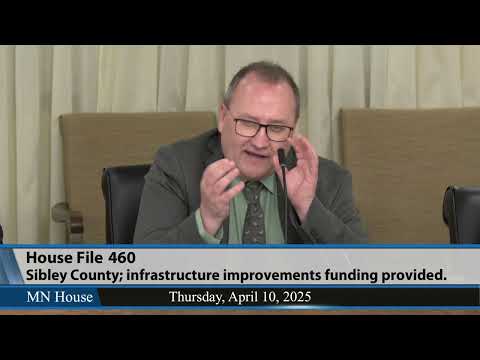
- Gaylord / Sibley County street reconstruction: Sibley County Public Works Director Tim Becker and City Administrator Steve Hilgert requested $1,000,000 to reconstruct and pave a gravel road (Casa 21) and extend utilities, plus reconfigure nearby local roads to relieve a skewed intersection near a new elementary school and a large food-processing facility that the witnesses said generates heavy truck traffic.
- Spicer lift station (House File 852): Mayor Robin DeCapellino and Rep. Baker asked for $2,100,000 to replace an aging lift station serving the city of Spicer and to support anticipated growth and seasonal population surges around Green Lake. Officials said the current lift station, installed in 2006, sits on private property and is beyond its typical service life; failure could cause sewage backups and environmental risk.
- Sturgeon Lake road reconstruction (House File 831): Mayor Scott Helfman and City Engineer Tim Corby described a request (bill text listed $2,500,000; witnesses said the need has grown to about $2,700,000) to reconstruct roughly 3.5 miles of local road used heavily by tourism and recreational traffic. The city plans a 10% local match, witnesses said.
- Crosby First Street North: Rep. Davis and Mayor Diane Cash requested $1,800,000 to rebuild a long, heavily used road in Crosby that supports tourism related to the Cuyuna Lakes recreation area. Officials said the city is carrying a larger road program and this project would cover a key parallel artery.
- Hornsby Street / Columbus: Mayor Ron Hanegraaff presented a funding gap for improvements to Hornsby Street (local estimate shown as $762,000 for a particular section); the city sought state support to complete a missing link of roadway that has not been improved in decades.
- Trunk Highway 14 interchanges (Olmsted County; House File 2272 referenced): Olmsted County Commissioner Michelle Rossman described a corridor plan to add grade-separated interchanges and remove multiple at-grade intersections and a railroad crossing on TH 14 between Rochester and Mankato. The county is pursuing environmental analysis and design funding to pursue larger federal construction grants; presenters cited crash histories including several fatalities at specific intersections.
- Freeport I‑94 overpass (House File 959): Mayor Mike Evaslagi and Rep. Anderson requested $6,000,000 to replace an aging overpass in Freeport, citing safety concerns for agricultural equipment, pedestrians, and local businesses and noting prior outreach to MnDOT and state senators.
- Wabasha Trunk Highway 60 reroute realignment (House File 365): Mayor Emily Duran and Rep. Altendorf described a $12,300,000 realignment project intended to move truck traffic out of downtown, reduce flooding closures and improve safety; they noted a $5,000,000 federal congressional allocation that must be matched and spent by 2027 and requested roughly $2.9 million in state funding to keep the project on schedule.
- Lake Park road work: Mayor John Bedine and Rep. Joy sought $2,000,000 in state support to reconstruct town streets; the city reported it has budgeted $2,000,000 locally and Becker County plans additional work.
- Slayton 30 Fourth Street reconstruction (House File 866): City representatives requested a $5,000,000 reconstruction estimated at a 50–50 state/local partnership and explained the routing history and disproportionate local burden if the city must cover full costs.
- MICC permanent campus (House File 2652): Amy Goodmstead, CEO of Minnesota Independence College & Community, requested $11,000,000 in state funds toward a $18,000,000 permanent, accessible campus in Richfield to serve autistic and neurodivergent young adults. MICC reported $3.5 million in pledges toward a $7 million campaign and said the campus would expand program capacity and local services.
- Dakota County / Lakeville interchange improvements (authored by Rep. Kosnick): Dakota County Commissioner Mary Liz Holberg sought state aid (county-requested portion shown at $10,800,000 in handouts) to widen an interchange where local traffic congestion is contributing to a high crash rate and emergency-service access issues; county and city officials reported substantial prior local investments and a proposed 50% local match for this phase.
- Butterfield sewer and lift-station upgrades (House File 885): Vice Chair Fogelman presented testimony from Jim Warwick and Mayor Warner seeking phased funding for sewer collection, lift-station replacement and aeration-pond repairs. Witnesses discussed a phased request (packet showed $7.9 million for phase work, earlier total estimates were higher).
- North Branch interchange (House File 1788): Mayor Kevin Scheiber and Rep. Max Reimer requested $4,000,000 for predesign and right-of-way work for an interchange and northbound access to divert heavy truck traffic away from a downtown intersection that handles high daily volumes and serves adjoining industrial parks.
How committee members framed the discussion
Members repeatedly pressed presenters on whether projects were phased, whether local matches were committed, and whether the sponsors had pursued federal funding (for example, Olmsted County said design funding would position it to apply for RAISE and other federal grants). Several presenters described prior local investments or acquired right-of-way to show local commitment. Committee members also sought specificity on project costs (multiple witnesses noted increased construction costs or updated estimates since bill drafting).
What did not happen
The hearing was informational: there were no motions or votes recorded. Committee chairs reminded presenters that time was limited and encouraged phasing and local partnerships where possible.
Next steps and outlook
Most presenters asked the committee to consider their projects for inclusion in future bonding or capital investment bills or to provide design and preconstruction funding that would allow them to pursue larger federal or competitive grants. Several witnesses emphasized time-sensitive matches (notably Wabasha’s $5,000,000 federal allocation that officials said expires in 2027) and the local public-safety consequences of delayed work.
Ending: The committee adjourned after hearing all scheduled presenters and indicated members would reconvene at a later posted meeting to continue capital investment considerations.