Get Full Government Meeting Transcripts, Videos, & Alerts Forever!
Get email alerts on the Private Letter Rulings topic
No spam. Unsubscribe anytime.
Committee hears bill to create confidential state private letter rulings; Department of Revenue raises concerns about timing and cost
Summary
House File 912 would create a Minnesota private letter ruling program to provide confidential written rulings to taxpayers; the Department of Revenue warned the required start date and staffing levels in the bill are impracticable without an appropriation.
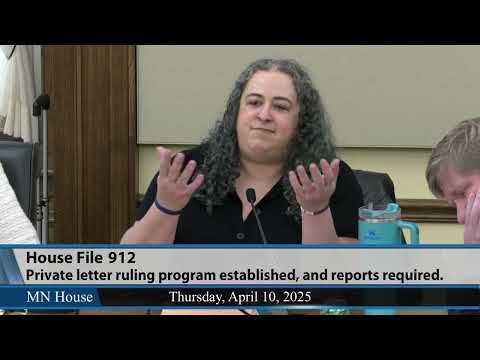
A bill to create a confidential private letter ruling program for Minnesota taxes was considered by the House Tax Committee April 9. Representative Quam introduced House File 912 and said the proposal would make Minnesota the 49th state to offer the process; she said it would provide certainty in complex tax situations, such as business transactions or inheritance matters.
Melissa Tappe, Director of Appeals, Legal Services and Disclosure at the Minnesota Department of Revenue, testified in opposition or with concerns about the draft. Tappe said the bill's statutory deadline to stand up the program by Jan. 1, 2026, "is not practicable," noting that the IRSwhich she said has over 50 pages of proceduresand states have complex rule sets that will take time to research, draft and circulate. Tappe also told the committee the program would be expensive for both taxpayers and the Department and that the bill contains no appropriation to staff the unit. She urged an appropriation and raised concerns that the fee structure and capped timelines could be unsustainable for the Department.
Chris Martin, a director at accounting firm Ide Bailey, and Gino Fragnito of the Minnesota CPA Society testified in support. Martin described how letter rulings in other states provide clarity to taxpayers and tax practitioners and said the program could reduce audits, appeals and litigation over time. Fragnito said Minnesotaby joining other states and federal practicewould improve tax administration and provide additional guidance to taxpayers who try to voluntarily comply.
Committee members asked clarifying questions. Chair Gomez pointed to the Department of Revenue's public contact number for routine sales-tax questions and suggested that some questions might be addressed without a private letter ruling. Other members said the program can benefit small businesses and taxpayers seeking certainty. Representative Quam renewed her motion to lay House File 912 over for possible inclusion in the omnibus tax bill.
Why it matters: Supporters said a private letter ruling program provides certainty in complex tax matters and can reduce administrative litigation; the Department of Revenue flagged staffing, timeline and funding concerns that could impede implementation and recommended an appropriation and careful rule development.
Next steps: House File 912 was laid over for possible inclusion in the omnibus tax bill. Committee staff and the Department of Revenue would need to work on rulemaking timelines, fee structures and appropriations if the program advances.