Lifetime Citizen Portal Access — AI Briefings, Alerts & Unlimited Follows
House Ethics Committee votes to take no further action after hearing on lost ballots in HD 54A contest
Loading...
Summary
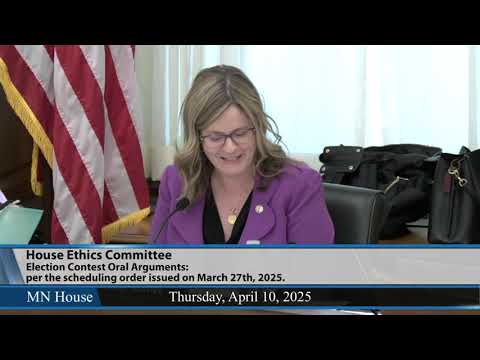
After a hearing on an election contest in House District 54A over roughly 20 absentee ballots that were discarded, the Minnesota House Ethics Committee voted 4-0 to recommend the House take no further action; an earlier motion to declare the seat vacant failed on a 2-2 tie.
The Minnesota House Ethics Committee voted to recommend that the House take no further action regarding the election returns for House District 54A after a hearing on a contested result involving about 20 absentee ballots that were discarded.
The committee first considered a motion to recommend the House reject the returns and declare a vacancy for District 54A; that motion failed on a 2-2 roll call. Later, a motion that the House take no further action passed 4-0.
The petitioner, Representative Harry Niska, told the committee that the matter is “purely about the House's constitutional role to be the final judge of the returns and eligibility of its members” and emphasized that “20, at least, voters in Shakopee were disenfranchised because, someone in the election process threw away their ballots.” Niska argued that those voters had been deprived of the opportunity to have their votes counted and said the proper remedy would be a new election.
David Zoll, attorney for Representative Brad Tabke, countered that Tabke won the election and that the district court’s findings and the manual recount support that result. “Brad Tabke is the duly elected representative for House District 54 A,” Zoll told the committee, noting the court concluded the failure to count the 20 ballots did not affect the outcome.
Nut graf: The hearing centered on competing legal views about how to treat ballots that were cast but later lost or discarded and on whether testimony from voters whose ballots were not counted can reliably determine an election’s outcome. The committee’s rules require a petitioner to prove by clear and convincing evidence that returns should not be accepted; the district court in the underlying case made written findings that the court and some committee members said the committee should defer to.
Key facts and evidence
- The dispute involves roughly 20 absentee ballots tied to Shakopee Precinct 10 that, according to the court record, were discarded before being counted.
- The district court identified the 20 voters and found 12 of those voters testified at trial; testimony reported in the record showed six testified they voted for Tabke and six testified they voted for Aaron Paul. The record and counsel’s summaries reported a 14-vote margin remaining after testimony.
- The petitioner relied on an 1895 Minnesota Supreme Court decision, Pennington v. Hair, to argue voter testimony about how a discarded ballot would have been cast is unreliable and creates incentives that could undermine the secret ballot.
- Counsel for Tabke pointed to the district court’s fact-finding, the manual recount, and Scott County’s investigation — which the court described in written findings — and argued the evidence “clearly and convincingly” shows Tabke won.
Committee discussion and concerns
Members pressed both sides on legal standards, precedent, and the practical consequences of different remedies. Representative Myers expressed concern about precedent and voter privacy, saying, “voting is a right... it should also be something that's private.” Chair Davids said she found the situation “quite troubling” given missing ballots and testimony, but the committee majority concluded the petitioner had not met the burden required under the committee rules and statutory procedure.
Votes at a glance
- Motion (moved by Chair Davids): Recommend that the House reject the election returns and declare a vacancy for House District 54A. Roll call recorded: Chair Mueller — No; Chair Davids — Aye; Representative Cleburne — No; Representative Myers — Aye. Tally: 2 Aye, 2 No. Outcome: failed.
- Motion (moved by Representative Cleburne): Recommend that the House take no further action regarding the election returns for House District 54A. Roll call recorded: Chair Mueller — Aye; Chair Davids — Aye; Representative Cleburne — Aye; Representative Myers — Aye. Tally: 4 Aye, 0 No. Outcome: approved.
What the committee did and did not decide
The committee did not reverse the district court’s findings or otherwise unseat Representative Brad Tabke. Instead, after debate and the two roll calls, it recommended that the House take no further action on the contest. The committee explicitly limited its review to the materials in the court record provided to it and applied the evidentiary standards set in the committee’s election-contest rules.
Next steps and context
The Ethics Committee’s recommendation goes to the full House for any further consideration the House may choose to take. The dispute highlighted tensions between remedies for disenfranchisement, protections for secret ballots, and deference to trial-court factfinding in election contests under Minnesota law, including Article IV, Section 6 of the Minnesota Constitution and the statutory procedures governing contests.
The committee adjourned after approving the recommendation that the House take no further action regarding House District 54A.