Get Full Government Meeting Transcripts, Videos, & Alerts Forever!
Get email alerts on the Higher Education Governance topic
No spam. Unsubscribe anytime.
Committee approves amended higher-education governance bill setting minimum presidential finalist group and other board changes
Summary
Chair Harrell put CS for SB 17 26 on the table and Senator Kalatiuh presented a delete-all amendment and a late-filed amendment that together reshaped the bill's provisions.
Chair Harrell put CS for SB 17 26 on the table and Senator Kalatiuh presented a delete-all amendment and a late-filed amendment that together reshaped the bill's provisions.
Senator Kalatiuh said the delete-all amendment "refines Senate Bill 17 26 to better balance transparency, flexibility, [and] institutional autonomy," and described several deletions and additions. Among the changes he listed: removing a search-committee requirement for interim president appointments, removing a repeal of the public-records exemption for presidential applications, allowing trustees to serve until successors are appointed, authorizing presidential contracts to be renewed for longer than one year (but no longer than the original term), and requiring the Board of Governors to review admission criteria and academic programs during university mission reviews. The amendment also removed escrow-account requirements for PECO project funds, clarified textbook/material list requirements to include open-access materials with unique identifiers if available, and required course syllabi to be posted at least 10 days before term start.
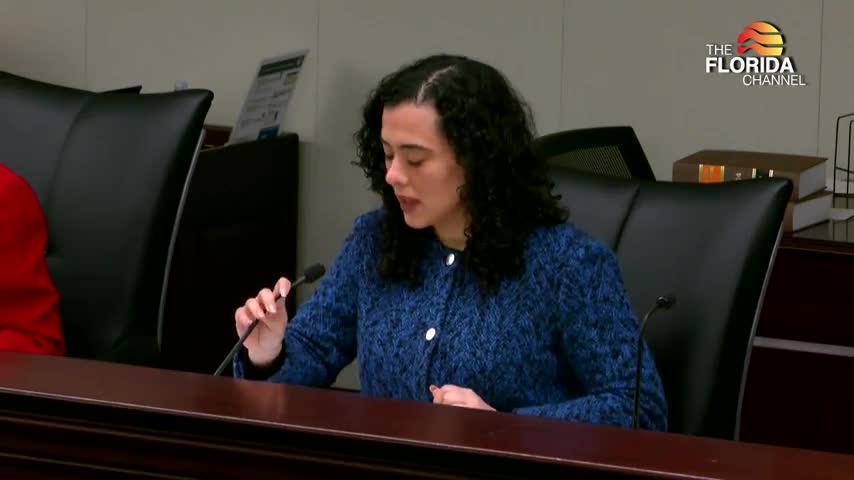
The committee also considered a late-filed amendment that, on the record, defined the "final group of applicants" for president searches as "no fewer than 3 applicants who will receive final consideration for president of a state university or a Florida College System institution." Senator Collado presented that change and the panel adopted the amendment to the amendment by voice vote.
Committee members asked clarifying questions on the record. A senator asked whether the final group language "means ... they would always need to have at least 3" candidates; Senator Kalatiuh confirmed "that is correct." Kalatiuh also described a required succession plan identifying an individual employed by the institution "who would serve as interim president in the need for such occasion." The bill as amended also requires State University Boards of Trustees and the Board of Governors members to be U.S. citizens, with a residency exemption for members who graduated from a Florida public university, and prohibits state universities from conducting public polling "related to candidates for any federal, state, or local office." Kalatiuh said the Board of Governors would be required to adopt regulations to implement that restriction.
Several senators debated the measure. Senator Leake voiced concerns about the practical effect of the minimum-three-finalists rule, saying candidates sometimes withdraw late and the bill should address that possibility. Senator Smith supported the bill's overall direction, saying the measure "seeks to de-politicize the process" and that narrowing trustee eligibility to Florida residents or state-system alumni will "ensure these Florida institutions are going to be led by Floridians or folks that are the product of Florida's higher education institution." Senator Smith also expressed reservations about the polling prohibition, citing the quality of university polling for public affairs.
After discussion there was no public testimony recorded on the amendment as amended. The committee voted by roll call to report CS for CS for SB 17 26 favorably.
Why it matters: The bill targets several aspects of how state universities and Florida College System institutions choose leadership and how trustees are selected and authorized to act. The final-group provision aims to ensure a minimum pool of finalists for presidential searches; other changes modify trustee qualifications and require additional transparency or procedural requirements for institutions.
What to watch next: The bill moves forward to additional committees and floor consideration. Several items flagged in committee (polling restrictions, succession-plan details, and the minimum-finalists contingency if candidates withdraw) were discussed as topics for further refinement.
Ending: The sponsor asked for favorable support and the committee reported the bill favorably for further consideration.