Get Full Government Meeting Transcripts, Videos, & Alerts Forever!
Get email alerts on the Biometric Privacy topic
No spam. Unsubscribe anytime.
ACLU warns commissioners about facial-recognition bias and urges biometric privacy law
Summary
The ACLU of Massachusetts urged the commission to consider demographic bias and privacy gaps in facial-recognition technologies and recommended several pending state bills to protect biometric data before any policy relying on biometrics is advanced.
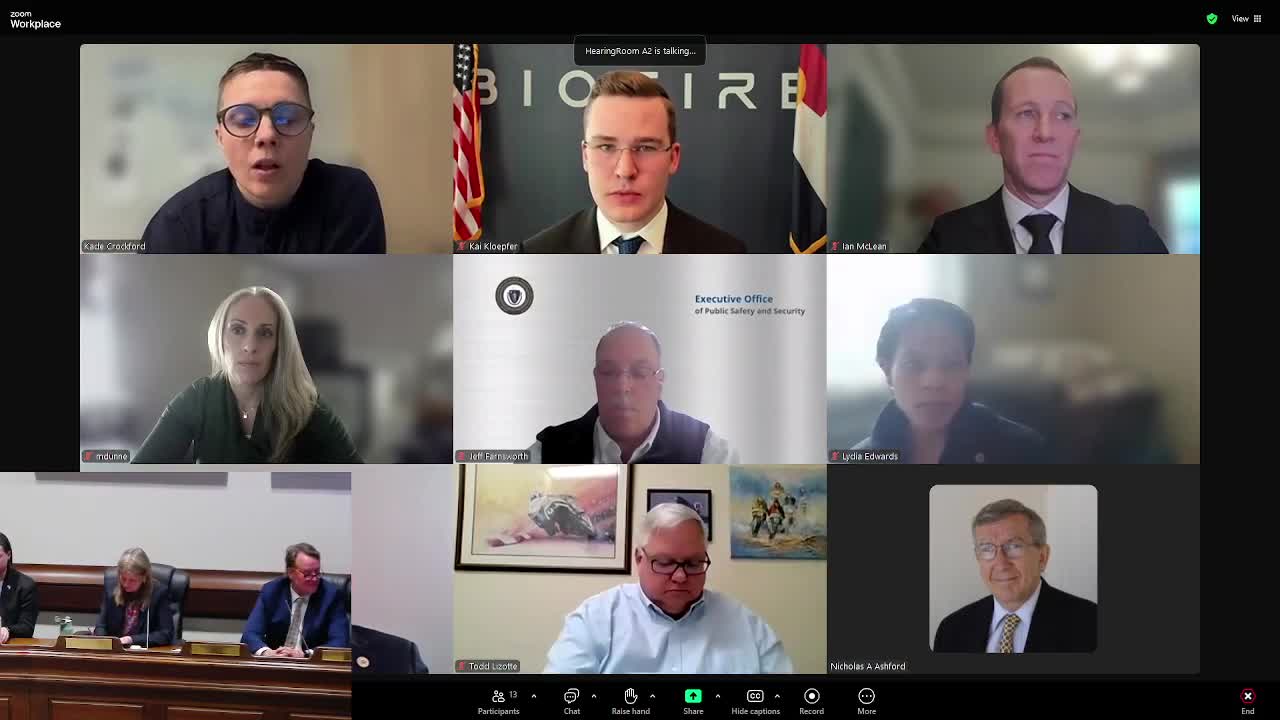
Cade Crockford, director of technology and the Liberty program at the ACLU of Massachusetts, told the commission that commercially available facial-recognition systems show significant variability in accuracy and documented bias across demographic groups, and that Massachusetts law lacks comprehensive biometric privacy protections.
Crockford cited a 2019 National Institute of Standards and Technology (NIST) study, saying the research found wide differences in algorithm performance and higher false-match rates for some demographic groups: “Most algorithms gave significantly higher, false match rates for women than for men. The highest false match rate was for American Indian women with a rate 68 times that of white men.” He told commissioners the technology typically performs worse for young people (ages 12–20) and older people (65+), and that false non-match rates also vary significantly among algorithms.
Crockford said Massachusetts presently has no statute requiring consent before a company collects a person’s biometric data, no law limiting how firms may process or transfer biometric information, and that the state’s data-breach statute does not include biometric data among the records defined as personal information. He asked the commission to recommend state privacy legislation before advancing personalized‑firearm mandates that rely on biometric systems.
Specifically, Crockford urged support for pending bills including the Massachusetts State Privacy Act (House 104 / Senate 29 / Senate 45), the Mass Consumer Data Privacy Act (House 78), and measures to add biometric data to the state data-breach law (House 93 / Senate 39) and to impose basic protections on private-sector biometric collection (Senate 36 / Senate 43). He told the commission those bills would impose data-minimization rules, require privacy policies, create consumer rights to access, correct and delete biometric data, limit processing and transfers, and provide a private right of action.
Commission members said the ACLU testimony raised important privacy considerations they had not fully considered and that independent vetting of any biometric system would be relevant. BioFire’s CEO said his company’s design stores biometric data locally on the firearm and that the firm would generally support biometric-privacy guardrails consistent with its zero-knowledge approach.
Crockford concluded by requesting the commission recommend the listed privacy bills to establish statutory protections that would apply to biometric systems used in personalized firearms.