
California Hospital Association urges distinct rules for hospital pharmacies and asks board to form a hospital pharmacy committee
Get AI-powered insights, summaries, and transcripts
Sign Up Free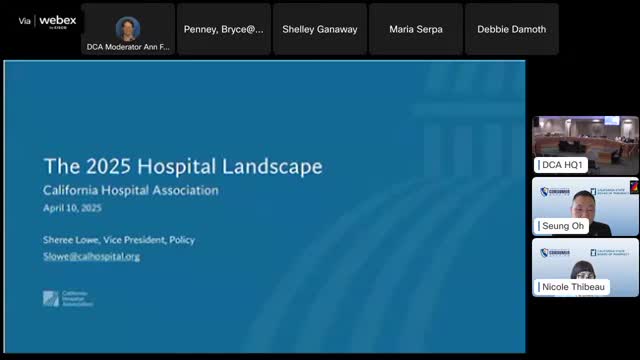
Summary
The California Hospital Association told the California State Board of Pharmacy on April 22, 2025, that hospitals face constrained capacity, rising costs and new statewide spending targets from the Office of Health Care Affordability, and urged the board to distinguish hospital pharmacy practice from retail practice and to form a hospital pharmacy committee to advise regulation and inspection guidance.
Sherry Low, vice president for policy at the California Hospital Association (CHA), told the California State Board of Pharmacy on April 22 that California hospitals are operating under intense financial and operational strain and said that pharmacy regulations should reflect differences between hospital and community pharmacy practice.
Low summarized CHA’s view of the hospital landscape: higher occupancy since the COVID‑19 pandemic, rising acuity and length of stay, labor costs up sharply and many hospitals operating in the red. She told the board that hospitals face a complex mix of state and federal regulators, mounting costs from seismic compliance and other mandates, and growing patient demand for behavioral health services. Low said emergency departments had expanded to hold patients for days and weeks because downstream placements (skilled nursing, board and care, etc.) are unavailable, creating throughput and ambulance offload problems.
Low highlighted the new Office of Health Care Affordability (OCA), created by 2022 legislation, which will set sector‑specific spending targets. CHA said the hospital sector was identified first and that OCA’s targets could pressure hospitals to lower spending, which CHA argues might reduce services or staff. She urged the board to recognize the unusual policy environment and the potential for unintended effects on hospital pharmacy operations.
On pharmacy practice, Low said hospitals are data driven, integrate pharmacy into interdisciplinary clinical teams, use electronic medical records to support decision making, and rely on pharmacy services for emergency response and complex inpatient medication management. She told board members that a one‑size‑fits‑all regulatory approach risks disrupting hospital operations and patient safety.
CHA proposed two principal actions: (1) create a hospital pharmacy committee within the Board of Pharmacy so hospital clinicians can advise rule‑making and inspection protocols, and (2) require that any public reports (for example, inspection summaries or top violations) be bifurcated so hospital results are reported separately from community/retail pharmacies. Low and attendees argued that this would help avoid policy decisions based on mixed data and better align oversight to distinct practice settings.
Board members acknowledged the concerns and discussed options. Several members supported exploring ways to clarify regulations and inspection protocols that account for setting‑specific workflows and patient acuity. Some members recommended targeted listening sessions or a licensure‑committee briefing to collect hospital‑practice detail before any structural board change. CHA said it would supply additional materials and emphasized the association’s availability to help devising hospital‑specific guidance.
The Board did not create a formal committee at the meeting but invited further engagement. Low left contact information and asked the board to consider hospital expertise in future committee work or guidance.