Get Full Government Meeting Transcripts, Videos, & Alerts Forever!
Get email alerts on the Funding Review Advisory Committee Frac 2 topic
No spam. Unsubscribe anytime.
City, county convene FRAC 2 to reassess funding for human services, arts and tourism amid federal cuts
Summary
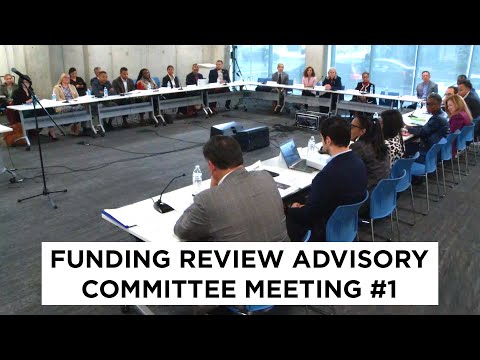
Columbus and Franklin County officials on April 1 convened the Funding Review Advisory Committee’s second iteration, known as FRAC 2, asking a panel of civic, business and nonprofit leaders to reassess how public resources support human services, cultural arts and travel and tourism as federal and state funding streams shift.
Columbus and Franklin County officials on April 1 convened the Funding Review Advisory Committee’s second iteration, known as FRAC 2, asking a panel of civic, business and nonprofit leaders to reassess how public resources support human services, cultural arts and travel and tourism as federal and state funding streams shift.
The committee, co-convened by the city and the county, will meet roughly every four weeks from April through November and is charged with producing recommendations and a road map for sustainable funding. Mayor Andrew J. Ginther said the panel’s work is urgent given recent federal actions: "I've agreed to be the storm cloud so that my colleagues, president Crowley and president Harden can be the sunshine," and warned that a federal blueprint adopted in Washington will "demand at least $1,500,000,000,000 in reduced spending and spending cuts over the next 10 years." He added that a revoked pandemic preparedness grant forced the city to let 11 employees go and flagged that roughly $7,500,000 in Community Development Block Grant funding and about $22,000,000 to the Department of Development could be at risk.
Why it matters: The committee’s remit covers programs that provide food, shelter, public health and cultural amenities relied on by residents and visitors. Council President Shannon G. Harden urged members to avoid a scarcity mindset and "be bold in your thinking," telling the panel to take a long-term view and ask what the region will need by 2035 and beyond. Franklin County Board of Commissioners President Bridal C. Crawley described the work as "monumental" and urged the group to pursue strategies that expand and stabilize revenue aligned with community values.
City and county staff briefed the panel on the original FRAC, which convened in 2011–2012 and recommended non-income tax revenue options (admission surcharge, auto rental surcharge, parking surcharge, casino allocations and hotel-motel bed tax reallocation) while declining others at the time. City staff said FRAC 1 focused on a needs assessment rather than deep sector studies and provided operational recommendations to improve efficiency and diversify revenue by partnering with private philanthropy. Committee staff said some revenue sources not recommended in 2011–2012 could be revisited under current conditions.
Members emphasized that the committee should do more than inventory revenue options. Several called for a shared fact base tracking both investments and outcomes so the group can assess whether current funding levels align with community priorities. "We have to do the big thing and the hard thing of defining what our priorities are and also harnessing the political will to unapologetically invest in those," Council Member Nick Bankson said.
Committee staff outlined upcoming meeting topics: the next meeting will present a city- and county-level financial snapshot, including public and private funding for the target sectors; a later meeting will discuss evaluation criteria for tax proposals and how peer cities handle similar funding decisions; subsequent meetings will hear presentations from sector stakeholders. Presenters and a fuller schedule are to be circulated to the committee within about a week.
The committee will hold some meetings publicly, record sessions and provide opportunities for testimony; staff said certain meetings may not be public and that those dates would be communicated. Marshall Troxell, project administrator for the effort, said staff will collect documents in a shared OneDrive and circulate minutes and materials in advance. The next meeting is scheduled for Friday, May 2 at 8:30 a.m. in the Coleman Building hearing room on the second floor.
The convening drew roughly three dozen civic, business and nonprofit leaders, including members of the original FRAC, local government staff and representatives from philanthropy and private sector partners. Speakers repeatedly stressed the region’s rapid growth and the need to balance innovation with fiscal responsibility.
Looking ahead, committee members asked staff to present (1) an inventory of current public and philanthropic funding across the targeted sectors, (2) outcome measures or KPIs tied to those investments, and (3) an analysis of implementation constraints and lessons from FRAC 1, including which prior recommendations were implemented and any barriers encountered. Several members also suggested reviewing policies and statutory constraints that attach conditions to certain funding streams as the committee considers options.
The meeting concluded with a request that committee members bring their questions and evidence-based priorities to future sessions and that staff return with a proposed speaker list and materials for the next meeting. The committee’s final recommendations will be framed as a multi-year roadmap for funding and accountability.
Next meeting: May 2, 8:30 a.m., Coleman Building Hearing Room, 2nd floor, Columbus.