Get Full Government Meeting Transcripts, Videos, & Alerts Forever!
Get email alerts on the Mining Regulation topic
No spam. Unsubscribe anytime.
Cochise County staff: sand-and-gravel operations are state-regulated; county zoning does not apply
Summary
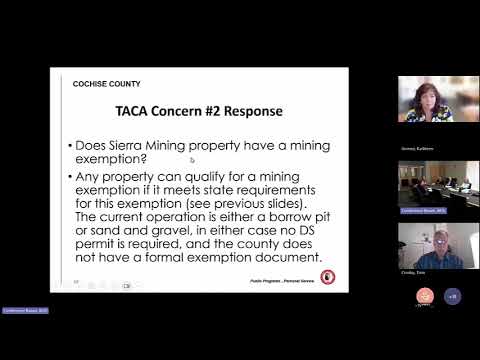
County planning and engineering staff told the Board of Supervisors that the site near Ocotillo Road appears to be a sand-and-gravel pit or borrow pit and is regulated by state agencies rather than by Cochise County zoning; staff found no county permits for the site and said the county does not issue business licenses.
Cochise County staff told the Board of Supervisors at a work session that the gravel operation near Ocotillo Road appears to be either a state-regulated sand-and-gravel mine or an unregulated borrow pit and that the county has no zoning permit authority over mining operations.
Kristine McLaughlin, interim director and planning manager for Development Services, summarized zoning history for the parcel and said the county had no current development services permits for the site. “We do not have any current development services permits for the property,” McLaughlin said, and she noted that an earlier rezoning request to heavy industry to accommodate a recycling center had been withdrawn in April 2024.
Jackie Watkins, director of engineering and natural resources and the county engineer, said state law preempts county regulation of sand-and-gravel mining and pointed supervisors to state enforcement channels. “In Arizona, the regulation of sand and gravel mining operations involves compliance with various environmental safety standards enforced by multiple state agencies,” Watkins said. She told the board that citizens can report suspected mining operations to the state mine inspector and environmental concerns to the Arizona Department of Environmental Quality (ADEQ).
Staff and supervisors discussed the distinction between a borrow pit and a sand-and-gravel mine. Watkins said borrow pits are typically unregulated and not included in county zoning, while a commercial sand-and-gravel operation with processing would require state permits. “If the borrow pit were to take on a larger scale commercial operation or processing, then these state permits would be required,” Watkins said.
McLaughlin said the original application had described a recycling center that would handle aggregates, biomass and other materials, but that particular rezoning request had been withdrawn and “that specific use for a recycling center was not permitted.” She also clarified that Cochise County does not issue general business licenses (those are typically issued by cities), and that development services’ permits are limited to specified building and engineering activities such as new buildings, additions, significant renovations, right-of-way work and floodplain uses.
The board asked whether county staff had inspected the site; staff said they had visited the parcel, flown a drone to collect imagery and walked adjacent properties to check the facts. Watkins said she personally visited the site on March 20 and that the state mining inspector had a similar impression about the operation’s classification.
Staff told the board they would meet again with the parties and hold another public meeting to allow affected residents to comment on staff’s findings.
Ending: The board did not take formal action at the work session; staff said follow-up visits and at least one additional public meeting are likely.