Get Full Government Meeting Transcripts, Videos, & Alerts Forever!
Get email alerts on the Landlord Liability Dogs topic
No spam. Unsubscribe anytime.
Utah Supreme Court hears argument on whether landlords owe duty for tenant’s vicious dog after off‑property attack
Summary
In Tesh v. Bonneville Investment Properties, counsel debated whether landlords can owe a duty of reasonable care for a tenant’s dog that attacked a child off the rental property, focusing on Restatement provisions and whether landlords had knowledge or retained control of the risk.
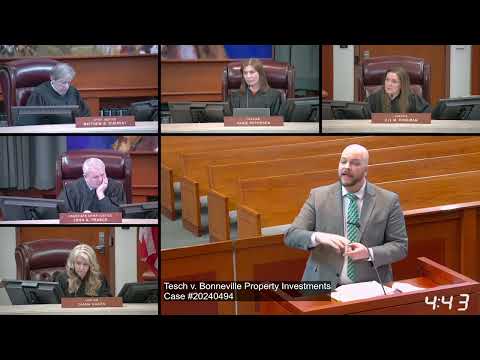
SALT LAKE CITY — The Utah Supreme Court on Tuesday heard arguments in Tesh v. Bonneville Investment Properties over whether a landlord can owe a duty of reasonable care when a tenant’s dog attacks someone off the rental property.
Robert Gibbons, counsel for the plaintiff, argued the general rule that “landlords have a duty to act with reasonable care” applies when a tenant keeps a dog with vicious tendencies. Gibbons told the court the issue should go to a jury because a landlord may have known — or should have known — about the dog’s behavior and retained enough control over the premises to take steps to prevent injury.
That argument framed both factual questions and legal doctrine. Gibbons invoked Utah cases he said establish a landlord’s duty of reasonable care and asked the court to treat the dispute either as a premises condition question under principles like those in Restatement Second of Torts Section 360 or as an activities‑based claim under Restatement Second of Torts Section 379(a). He said the record includes neighbor affidavits, evidence that the landlord visited the property repeatedly, and earlier animal‑control calls, and that those facts could let a jury infer knowledge of the dogs’ dangerous propensities.
Defense counsel disputed that evidence is sufficient to survive summary judgment and pushed back on expanding landlord liability. Counsel emphasized long‑standing rules limiting landlord responsibility for conditions that develop only after a tenant takes possession. At oral argument the defense highlighted precedent treating landlord duties as tied to control over specific parts of the property (for example, common areas) and argued that neighbor statements that the dogs were “very scary” do not establish that the landlord knew the dogs had vicious propensities.
The justices pressed both sides about doctrinal limits. Several justices questioned whether the right to set lease terms or to enter the property would convert ordinary landlord leasing powers into the kind of possession or control that supports premises‑liability duties. A justice framed the difference succinctly during questioning: Section 360 typically addresses dangerous physical conditions on land that the landlord controls, while Section 379(a) addresses activities on the land that cause harm off the land. Counsel and the bench discussed whether a dog kept on a leased residential lot should be characterized as a “condition” or as an “activity,” and whether a dog that chased and then attacked the child off the property fits within the Restatement language.
Counsel for the plaintiff pointed to cases in other jurisdictions (including decisions from Oklahoma, California and Maryland cited in briefing) that applied Restatement 379(a) in similar dog‑attack fact patterns and allowed liability where landlords knew or had reason to know of a dangerous animal and failed to act. Defense counsel and at least one justice noted disagreement among jurisdictions about whether liability requires actual knowledge by the landlord or whether constructive knowledge suffices; one panelist observed that at least one Colorado case reads the rule narrowly to require actual notice.
The parties also disputed factual findings from the district court. Gibbons argued the district court erroneously treated as undisputed both (1) that the lease forbade dogs and (2) that the landlords did not know dogs were present. He said the record includes four affidavits from neighbors, evidence the lease was month‑to‑month and subject to renewal, and testimony that animal control had been called earlier — facts that, he argued, create an issue for a jury on knowledge and constructive notice.
Defense counsel countered that the affidavits, when read closely, show only the dogs’ presence, not documented incidents of viciousness, and emphasized that prior bites by another dog were not communicated to the landlord. The defense argued the district court’s rulings rested on lack of control or lack of knowledge and that, under existing Utah precedent, the landlord’s liability is limited when a condition arises solely from tenant conduct after possession.
Justices returned repeatedly to practical limits and policy: how to draw a line that holds landlords responsible for dangerous instrumentalities on property they control, without imposing a general duty to police tenants’ personal behavior; whether imposing a duty based on constructive knowledge would require landlords to run background checks; and whether lease terms that reserve limited rights (for example, the right to repair or exclude certain animals) should be read as conferring the kind of control that creates a landlord duty.
The court took the matter under advisement after roughly an hour of argument. No decision was announced at argument’s end.