Get Full Government Meeting Transcripts, Videos, & Alerts Forever!
Get email alerts on the Civic Process topic
No spam. Unsubscribe anytime.
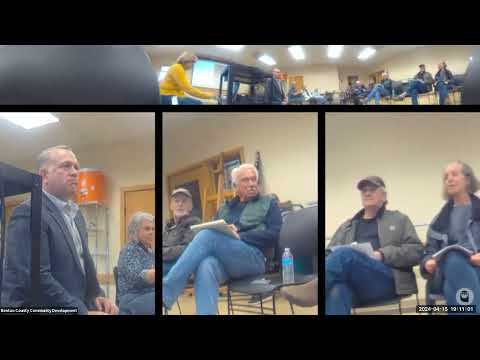
Benton County moves to revive LC citizen advisory committee ahead of comprehensive-plan update
Summary
Benton County Community Development staff told residents of the unincorporated LC area that the county will revitalize the local Citizen Advisory Committee (CAC) and begin a countywide comprehensive-plan update this spring and summer, with dedicated outreach funding and code updates to follow.
Benton County Community Development staff told residents at a community meeting that the county intends to revive the local Citizen Advisory Committee and begin an update of the county comprehensive plan, part of a multi-year effort to refresh zoning maps, development code and community outreach.
County planner Darren Nichols said Benton County will use a recently awarded outreach grant and internal funds to restart the LC CAC and gather community priorities ahead of a broader comprehensive-plan update. "It's your community; it's not our community — it's your community, and it's our responsibility and privilege to help you think about the options," Nichols said at the meeting.
The county plans to fold the LC conversations into a larger countywide work plan. Staff said they have obtained about $50,000 in state grant funding to support initial outreach and that Benton County has set aside funds for an initial development-code cleanup (staff referenced a $75,000 allocation for an early phase). Staff also described a parallel zoning-map refresh and mapping improvements using newer aerial and lidar data.
Why it matters: The CAC is the formal channel the county uses to collect local input from unincorporated communities that lack city governments. Reviving the CAC would give LC residents a standing, public forum to review conditional-use requests, zoning-map corrections, infrastructure proposals and draft policy changes before those items reach the planning commission or board of commissioners.
What the CAC revival would look like: Staff described a seven-member CAC structure (five regular seats and two alternates), appointed by the Benton County Board of Commissioners but selected by community consensus. The county said CAC meetings will be subject to Oregon public meetings law and public-records requirements, including open-access provisions and options for remote participation. Nichols told the group the committee could meet as often as monthly during an intensive phase and then more sporadically as issues arise.
Policy and code work tied to the outreach: County staff said the comprehensive-plan refresh will examine housing, water, economic development and agricultural flexibility countywide. Staff emphasized several near-term technical tasks: (1) a development-code cleanup to align with current state law and to create objective standards for siting rural housing (staff noted a state-driven requirement to adopt objective standards by 07/01/2025); (2) a zoning-map update to correct stream layers and other mapping errors; and (3) use of lidar and refreshed aerial datasets to improve map accuracy.
Public-process rules: Staff repeated that CAC deliberations must be open and documented. "You can't have a conversation one at a time and then come back and magically have a policy decision put together," Nichols said, summarizing Oregon's transparency rules and the county's intent to build a trustworthy record for any recommendations the CAC makes to the board.
Next steps and timeline: Staff said LC is likely to be scheduled for more in-depth outreach this spring or early summer and that the planning commission expects to return to LC for a facilitated policy conversation. Staff asked the community to help recruit CAC members and to identify community priorities and data corrections (for example, incorrect stream lines or other map data) that can be batched and sent to the county's GIS coordinator.
Residents at the meeting suggested forming subcommittees for focused work (transportation, sewer, agriculture/economic development) to gather detail before formal CAC review. County staff encouraged that approach and said the CAC could receive recommendations from such volunteer subgroups.
Ending: Benton County staff and local residents set a near-term goal of consolidating previously gathered community input, recruiting new CAC members to fill vacancies and preparing for a summer series of outreach sessions that will feed into a broader county comprehensive-plan update.