Get Full Government Meeting Transcripts, Videos, & Alerts Forever!
Get email alerts on the Landfill Host Fee Monitoring topic
No spam. Unsubscribe anytime.
DSAC members propose quarterly ODEQ-based monitoring to verify Coffin Butte host fee and revenue
Summary
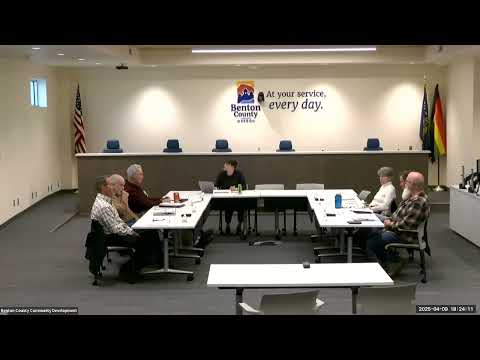
Paul Neufeld, a DSAC member and retired engineer, presented a proposal to give Benton County and DSAC earlier, more granular visibility into Coffin Butte's intake so the county can verify and project host‑fee revenue.
Paul Neufeld, a DSAC member and retired engineer, presented a proposal to give Benton County and the Disposal Site Advisory Committee (DSAC) earlier, more granular visibility into solid‑waste intake at the Coffin Butte landfill so the county can verify and project host‑fee revenue.
Neufeld told the committee he expects the county's total revenue from the site this calendar year "to be on the order of $3,600,000," and said that because the franchise fee has dropped from about $3,500,000 last year to $2,500,000 this year, the host fee portion paid in January could be "on the order of $1,100,000." He said the problem is a timing and visibility gap: county accounting receives host‑fee figures only after the landfill's annual report is released, typically in the second quarter of the following year.
Neufeld said the Oregon Department of Environmental Quality (ODEQ) quarterly solid‑waste disposal reports could be used as an independent channel to estimate the tonnage that determines the host fee. He described a simplified calculation he used to approximate host‑fee tonnage: total tons received in the reporting period plus sewage sludge, minus alternate daily cover qualified waste. Using that approach on past ODEQ reports, he said his estimates tracked closely with actual payouts for most years he tested.
"We're expecting total revenue for this calendar year to be on the order of $3,600,000," Neufeld said. "That means the size of the host fee expected in January would be on the order of $1,100,000." He added that his projected margin of error for the simplified calculation is small: "so far, we think it will be within 1%."
County staff and the franchisee raised caveats. A representative who described the franchisee's internal checks said the company has multiple categories of material reported at the scales that are not counted toward the host‑fee tonnage: "we stand by our numbers" and noted wood waste and other noncounting categories that would be missed by a back‑calculation from gross scale totals.
Neufeld said one of his formal recommendations, suggested by county counsel, is that DSAC request the franchisee provide a strict, comprehensive definition of "solid waste" as reported to ODEQ and what must be subtracted from gross intake to derive the figure used to calculate the host fee. He proposed that DSAC or county staff run the ODEQ quarterly reports through the simplified equation and report the results to DSAC and county finance on a quarterly basis.
The committee discussed next steps and follow‑ups already on the agenda: Bailey (county staff) was named as the contact to analyze ODEQ reports and to coordinate with finance; Neufeld said he had been working with a subcommittee and that county council had already been consulted on some wording. Committee members noted that the 2020 landfill franchise agreement sets an intake tonnage cap of 1,100,000 tons and that, if the pending expansion is approved, "the intake tonnage cap is eliminated," a point Neufeld repeated during the meeting.
Clarifying details captured during the discussion: - Franchise fee payments dropped from about $3,500,000 to $2,500,000 year over year, per Neufeld's presentation. - Neufeld's simplified estimation method: (ODEQ reported gross tons) + (sewage sludge) - (alternate daily cover qualified waste). - Intake tonnage cap in the 2020 franchise agreement: 1,100,000 tons. - Projected total revenue for the calendar year (Neufeld's estimate): ~$3,600,000; expected host‑fee portion due in January: ~$1,100,000. - Estimated accuracy of the simplified calculation as reported in the meeting: within 1% in recent tests.
The meeting record shows no formal vote on policy changes; instead DSAC discussed asking the franchisee for clarified reporting definitions and agreed that Bailey would analyze ODEQ quarterly reports and return with results. Neufeld and other members said that if the quarterly approach produced surprising results, it would trigger further dialogue with the franchisee and county finance.
Ending: Committee members agreed the approach merits follow‑up. Bailey and Neufeld will continue coordinating with county finance and the franchisee; DSAC will revisit the analysis when quarterly ODEQ data are available or if projections diverge materially from actual payouts.