Get Full Government Meeting Transcripts, Videos, & Alerts Forever!
Get email alerts on the State Insurance Policy topic
No spam. Unsubscribe anytime.
Senate committee adopts technical and policy amendments to omnibus insurance bill, forwards SF 2216 to finance
Summary
The Minnesota Senate Commerce and Consumer Protection Committee on April 10, 2025, adopted multiple technical and policy amendments to Senate File 2216 and recommended the bill as amended be referred to the Senate Finance Committee.
The Minnesota Senate Commerce and Consumer Protection Committee on April 10, 2025, adopted multiple technical and policy amendments to Senate File 2216 and recommended the bill as amended be referred to the Senate Finance Committee.
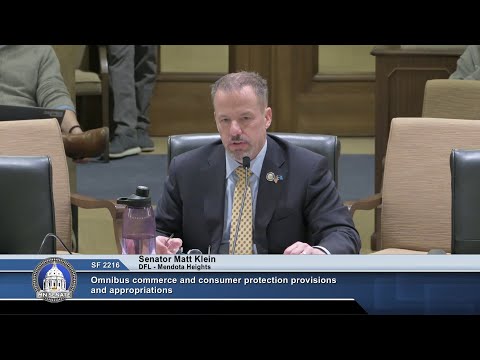
The committee chair convened the meeting and opened consideration of Senate File 2216; Senator Klein offered a package of amendments described as a set of “small policy adjustments” that he said were "non controversial and agreed upon by all parties." The panel worked through individual amendments offered by multiple senators, adopted most by voice vote, and recorded several withdrawals and one failed motion.
Why it matters: SF 2216 is an omnibus Commerce Committee vehicle that touches insurance market rules, consumer protections for homeowners associations (HOAs), surplus-lines eligibility for homeowners, some telecommunications transition language and appropriations tied to cannabis taxes; changes approved in committee will shape negotiations in finance and on the Senate floor.
Most significant actions and debate
Medigap (Medicare supplement) rules: Committee counsel and panel speakers described multiple technical edits in the A28 amendment affecting Medicare supplement (Medigap) language, including reformatting language at the reviser’s request and aligning application/fee language. Senator Ron Rasmussen (Senator Rasmussen) pressed whether language in the amendment would allow the Department of Commerce to set the late-enrollment penalty below 10 percent; Department staff (Mr. Hidalgo) answered directly: "Yes, your reading is correct. It would allow them to set at a rate lower than 10%." Rasmussen said he had planned an amendment because "we're hearing estimates that having at the 10% could increase premiums up to 90% for these Minnesotans." Several amendments about the 62J mandate-review process and a later A18 addressing Medigap were discussed and then withdrawn after authors and the bill sponsor said they would continue negotiations.
HOA registry and privacy: Amendments offered by Senator Latz narrowed the bill’s HOA provisions to apply to residential homeowners associations and expanded privacy protections for data maintained by the Department of Commerce, the ombudsman’s office and private management companies. Mr. Carlson, who said he has worked on these issues, warned that certain registry fields include "very sensitive public data...including our federal tax ID numbers, which I don't think anyone wants to make put on a searchable database." He added the amendment "only applies to the registry information that commerce collects. Everything else in your declarations that go along with your real estate transaction, this doesn't touch any of that." Committee members adopted the privacy and scope amendments by voice vote.
Surplus-lines and fair-plan threshold: Senator Dames offered and the committee adopted an amendment (A24) to change how the state’s Fair Plan and the surplus-lines market interact. Members described the change as removing a multiplier so the Fair Plan threshold would effectively move back toward $500,000, allowing surplus-lines carriers to insure some homes that the Fair Plan will not accept at higher values. Supporters characterized the change as providing another avenue for homeowners who otherwise lack coverage; proponents said the department supports the approach and that further committee education on surplus lines will follow.
Telecom carrier-of-last-resort language: Senator Rasmussen offered an amendment (A23) tied to carrier-of-last-resort obligations and transition to newer technologies; the amendment was described as a technical fix negotiated with the telco sector, cable companies, the Department of Commerce and the Public Utilities Commission. The amendment was adopted by voice vote and was described as having no formal opposition after stakeholder review.
Cannabis-related appropriations and CANRenew: Senator Rasmussen offered an amendment (A29) to redirect some CANRenew grant funding toward local and tribal public-health grants and programs targeted at pregnant and breastfeeding individuals; he said roughly $3,600,000 per year and other line items had been trimmed from earlier budgets. Senator Klein said he wanted to consult the Office of Cannabis Management and other stakeholders before agreeing to the change; Rasmussen withdrew the amendment after discussion. Health committee chair Senator Wicklund said the items identified were important public-health programs and that the department is watching federal funding reductions.
Electric-vehicle charging and municipal utilities: Senator Frentz (appearing as Friendz in the transcript) offered an amendment (A25) clarifying that a retail seller of electricity used to recharge a battery is not a public utility under the chapter when the electricity is generated on site — language requested by municipal utilities and co-ops. The amendment was adopted by voice vote.
Other committee-level procedural and 62J process items: Senator Rasmussen moved an A20 amendment that would have required additional legislative oversight when the Department of Commerce changes the state benchmarking plan for health mandates; after discussion the author withdrew A20 to continue conversations with the bill sponsor. A separate A17 proposal addressing 62J process forms and first-term legislators failed on a recorded voice vote after the bill sponsor said the amendment went "too far."
Votes at a glance
- A28 (Klein): Adopted (technical and Medigap/other clarifying edits). - A27 (Klein): Adopted (technical deletion). - A26 (Klein): Adopted (HOA compromise language). - A7 (Dames): Adopted (terminology change: "association" replacing "board of directors" in one provision). - A24 (Dames): Adopted (surplus-lines / fair plan threshold adjustments). - A23 (Rasmussen): Adopted (carrier-of-last-resort/telecom technical fixes). - A20 (Rasmussen): Withdrawn (benchmarking/62J oversight; to be negotiated). - A29 (Rasmussen): Withdrawn (redirect CANRenew funding; sponsor to consult OCM). - A17 (Rasmussen): Not adopted (62J process/form changes). - A21 (Latz): Adopted (HOA scope/privacy; removes Attorney General from enforcement role per amendment text). - A22 (Latz): Adopted (privacy classification for ombudsman-held data). - A18 (Rasmussen): Withdrawn (Medigap protection amendment). - A25 (Frentz): Adopted (clarify municipal/co-op EV charging sales). - Final motion: Senator Klein moved that "Senate file 2,216, as amended, be recommended to pass and be referred to the Committee on Finance"; the motion carried and the bill was recommended to the Finance Committee.
What the committee did not decide or left for later
Several disputed or unsettled policy matters were left for further negotiation: the precise Medigap late-enrollment penalty and whether Commerce should have discretion below a 10% penalty; exact reallocation of CANRenew appropriations; and whether the 62J mandate-review process needs additional statutory protections. Sponsors repeatedly said they would continue conversations with relevant agencies and stakeholders as the bill advances to finance and conference.
Meeting context and next steps
The committee handled many amendments in a single hearing, using counsel and agency staff walkthroughs for technical language. Most changes were adopted by voice vote; a few were withdrawn or defeated. With the committee’s recommendation, SF 2216 will advance to the Senate Finance Committee for further consideration where budgetary and appropriation-level choices will be the focus.
Ending note: The committee’s record shows a mix of adopted technical fixes and negotiated policy compromises; several substantive disagreements were deferred for later negotiation between sponsors, agencies and stakeholders.