Get Full Government Meeting Transcripts, Videos, & Alerts Forever!
Get email alerts on the State Local Omnibus topic
No spam. Unsubscribe anytime.
Senate State & Local Government Committee advances omnibus bill to finance, debates NDAs for data centers and local-news advertising
Summary
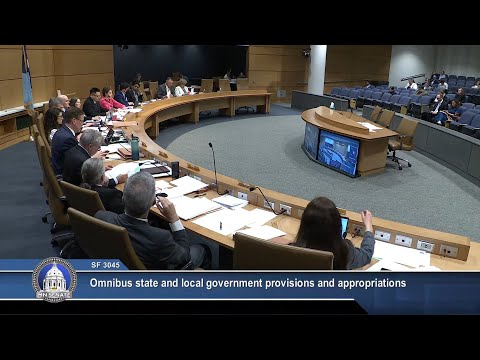
The Minnesota Senate Committee on State and Local Government voted 7–4 on April 10, 2025, to recommend Senate File 3045, the state and local government omnibus bill, to the Finance Committee after adopting multiple technical and policy amendments.
The Minnesota Senate Committee on State and Local Government advanced Senate File 3045 as amended to the Finance Committee on April 10, 2025, voting 7–4 to recommend the bill for further consideration.
Committee members spent the markup approving a series of technical fixes and policy changes to the omnibus bill and debating several standalone amendments. Among the most substantive discussions were a provision to prohibit municipalities from negotiating data‑center deals under nondisclosure agreements, language directing state advertising dollars toward local news organizations, proposed changes to cultural and arts funding, and multiple votes on fee and appropriation adjustments.
A staff presenter described one of the early amendments as technical. “This amounts to a technical amendment to bring the language of the bill into conformity with the spreadsheet,” the staff member told the committee while summarizing the A19 amendment, which fixed line‑item and fund source language in agency and grant lines.
The committee extensively debated A18, an amendment that would prohibit municipalities from entering nondisclosure agreements (NDAs) as part of negotiations over data centers. The sponsor said the amendment responded to a local example in which a city negotiated an NDA with a private company and residents did not have a public opportunity to comment on the project. Committee members raised constitutional and jurisdictional questions; one member asked whether the Contracts Clause could be implicated.
Senate counsel advised the committee that judiciary has jurisdiction for contracting matters, and the counsel said the proposal could be routed there for further review. “Judiciary would have jurisdiction because they have jurisdiction over contracting,” the counsel told the committee. The A18 amendment was adopted on the floor of the committee and later the committee moved to reconsider that adoption so the issue could be referred or further vetted.
Members also debated and revised provisions that encourage agencies to direct advertising spending to local news organizations. The A20 amendment, described by its sponsor as reflecting conversations between agencies and local papers, was adopted. A later attempt to delete the bill’s section encouraging local advertising (A9) failed.
Arts funding drew brief attention: A21, which made a technical change related to notices and included an allocation for the Minnesota Orchestra, was adopted on a roll call (9–3). A separate amendment (A22) that would have increased the Minnesota Orchestra allocation from $250,000 to $300,000 over the next two years was introduced and then withdrawn by its sponsor after questions about a funding source.
Budget and fee items drew repeated votes. Senator Drazkowski offered an amendment (A13) to keep article 1 appropriations at current‑biennium levels — the sponsor framed it as a fiscal‑restraint measure; the amendment failed on a roll call (7 noes, 5 ayes). An amendment (A12) to delete the article that raised several Secretary of State fees failed on a 7–5 roll call. Multiple other amendments to adjust funding for ethnic councils, the Asian Pacific Council, and a local bag‑ban repealer were considered and did not pass.
Committee members repeatedly asked staff for data about where proposed increases would come from and whether the bill’s spreadsheets reflected all‑funds impacts. Fiscal staff directed members to the detailed spreadsheet in the bill packet and noted some calculations that needed verification.
Votes at a glance
- A19 (technical conformity/fund‑source corrections): adopted (voice vote; no roll call recorded). Sponsor: staff member. Purpose: technical corrections to appropriations and fund sources. - A17 (lottery background‑check technical amendment): adopted (voice vote; no roll call recorded). Mover: Senator Lang. - A6 (qualified newspaper/public notice language): adopted (voice vote; no roll call recorded). Mover: Senator Lang. - A20 (updates directing state advertising toward local news organizations; reporting): adopted (voice vote; no roll call recorded). Mover: Senator Maquade. - A18 (prohibits municipal NDAs in data‑center negotiations): adopted on initial vote; committee later moved to reconsider the adoption for additional review and possible referral to Judiciary; sponsor said she would pursue further work before floor/finance. Mover: Senator Maquade. - A21 (technical / Minnesota Orchestra notice language): adopted by roll call, 9 ayes, 3 noes. - A22 (increase Minnesota Orchestra allocation from $250,000 to $300,000 in the first year): withdrawn by sponsor. - A3 (wording correction to reference CFR Title 49 for small business regulation): adopted (voice vote; no roll call recorded). Mover: Senator Johnson Stewart. - A14 (clarification allowing rural water districts right‑of‑way authority and liability cap alignment): adopted (voice vote; no roll call recorded). Mover: Senator Lang. - A9 (deletes section encouraging agencies to advertise with local news — sponsor argued against carveouts): not adopted (voice vote/committee decision recorded as failed). - A13 (move appropriations back to current biennium to cut biennial increases; sponsor framed as fiscal restraint): not adopted — roll call: 7 noes, 5 ayes. Mover: Senator Drazkowski. - A12 (deletes Article 6 — Secretary of State fee increases): not adopted — roll call: 7 noes, 5 ayes. Mover: Senator Barr. - A8 (normalize percentage increases for ethnic councils to 2.2% across the board): not adopted — roll call: 7 noes, 4 ayes. Mover: Senator Koren. - A15 (additional funding for the Asian Pacific Council): not adopted — roll call: 7 noes, 4 ayes. Mover: Senator Moran. - A5 (repealer restoring local authority over bag bans): not adopted — roll call: 7 noes, 4 ayes. Mover: Senator Moran. - Final motion: Recommend Senate File 3045, as amended, to the Finance Committee — adopted by roll call, 7 ayes, 4 noes.
What the committee did not do
The committee did not adopt several proposals to reduce or reallocate appropriations (A13, A12) and several increases requested by some councils or community groups remained unchanged after roll‑call defeats. Committee counsel advised that questions raising contract or data‑practice issues would be routed to Judiciary for a jurisdictional review rather than resolved in this markup.
Why this matters
The bill moves next to the Finance Committee, where the spending and fund‑source choices in the omnibus package will receive further scrutiny. The committee’s actions on NDAs, advertising guidance and fee language set the scope for future negotiations: whether municipalities can use NDAs in large‑scale private‑public negotiations, how state advertising dollars are tracked and steered toward local outlets, and whether fee increases or targeted increases for boards and councils survive conference committee are all now open questions for upcoming deliberations.
Meeting context and next steps
Committee members asked staff to check and correct spreadsheet formulas and to provide clearer all‑funds impacts before the bill reaches Finance. Sponsors of contested amendments said they would continue work with colleagues, counsel and affected stakeholders. The Committee’s recommendation sends the amended Senate File 3045 to Finance for further action.
Ending note: Senate File 3045 was recommended to pass and referred to the Finance Committee (roll call 7–4).