Get Full Government Meeting Transcripts, Videos, & Alerts Forever!
Get email alerts on the Medical Debt topic
No spam. Unsubscribe anytime.
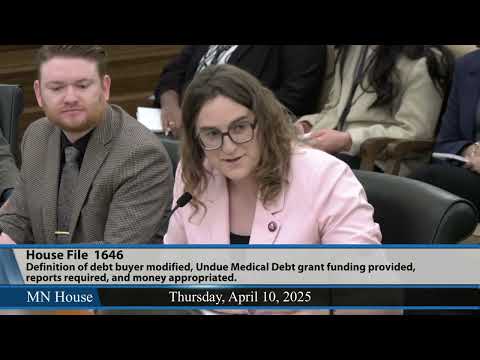
House commerce committee lays over Minnesota Medical Debt Reset Act after testimony from patients, providers and officials
Summary
The House Commerce Finance and Policy Committee laid over House File 1646, a bill to authorize state support for municipal-style medical debt purchase-and-forgiveness programs, after a hearing featuring patients, a city official, the attorney general and physicians who urged passage.
The House Commerce Finance and Policy Committee on March 1 laid over House File 1646, the Minnesota Medical Debt Reset Act, after testimony from city officials, patients and physicians who described how medical debt has affected Minnesotans.
The bill would authorize the state to invest in partnerships with nonprofit debt‑abolition organizations to buy bundled, uncollected hospital debt from providers and cancel it at a fraction of face value. Representative Reyer moved the bill to be laid over for further consideration.
Supporters said the program can deliver large amounts of relief for a modest public investment. Casey Weidrick, financial capability manager for the City of St. Paul, said the city committed $1,100,000 to an Undue Medical Debt initiative that his office estimates relieved roughly $110,000,000 of debt for St. Paul residents. "The City and Undue Medical Debt are still working to cancel the debt of additional St. Paul residents," Weidrick said, and he described residents' responses when they were notified that debts had been eliminated.
Jen Schultz, a four‑time cancer survivor and volunteer with the American Cancer Society Cancer Action Network, told the committee she remains insured but continued to accrue bills that she could not fully pay. "I was one of the Saint Paul residents that received a letter in the mail ... showing that a portion of my medical debt had been erased. I am so grateful," Schultz said.
Attorney General Keith Ellison spoke in support of the bill and praised last year's Debt Fairness Act, saying it reduced several harms created by medical bills. "No Minnesotan will be denied medical treatment because of old hospital bills," Ellison said of the prior law, and he argued House File 1646 would further help people who cannot repay outstanding medical bills.
Dr. Angelica Willis, speaking for Minnesota Doctors for Health Equity, described clinical consequences she has seen when patients avoid or delay care because of cost. "Medical debt is one of the leading causes of personal bankruptcy in the U.S.," Willis said, and she testified that the bill could help an estimated 250,000 to 400,000 Minnesotans regain financial stability.
Committee members asked how Undue Medical Debt verifies that relief benefits current Minnesota residents and how the nonprofit charges for its services. Courtney Storey, vice president of government initiatives at Undue Medical Debt, told the committee the organization verifies residency and income before applying relief and that it charges a 15% indirect cost rate for overhead; the remainder is used to purchase and abolish debt. "Our invoices are very transparent. You will be able to see exactly how every dollar is spent," Storey said.
Several legislators described the program as a high-return use of state funds if implemented at scale. Representative Finke told the committee the bill's proposed $5,000,000 appropriation could abolish roughly $500,000,000 in medical debt if the model performs as proponents say.
Representative Reyer said the $5,000,000 figure in the bill is scalable and that the measure remains "a pathway" for further action as negotiations continue between the House and Senate.
Action: the committee laid over House File 1646 for possible inclusion in the final Commerce omnibus bill; no roll‑call vote was recorded on the motion.
Next steps: Because the bill was laid over, it will be available for further amendment and potential inclusion in the committee's omnibus package and conference negotiations.