Get Full Government Meeting Transcripts, Videos, & Alerts Forever!
Get email alerts on the Ihss Workforce And Bargaining topic
No spam. Unsubscribe anytime.
Debate over statewide IHSS bargaining highlights cost trade‑offs and consumer control concerns
Summary
State officials, unions, counties and consumer advocates discussed a draft AB 102 work product on transitioning IHSS collective bargaining from 58 counties to a statewide model, with stakeholders divided over costs, local consumer control, and projected budgetary impacts.
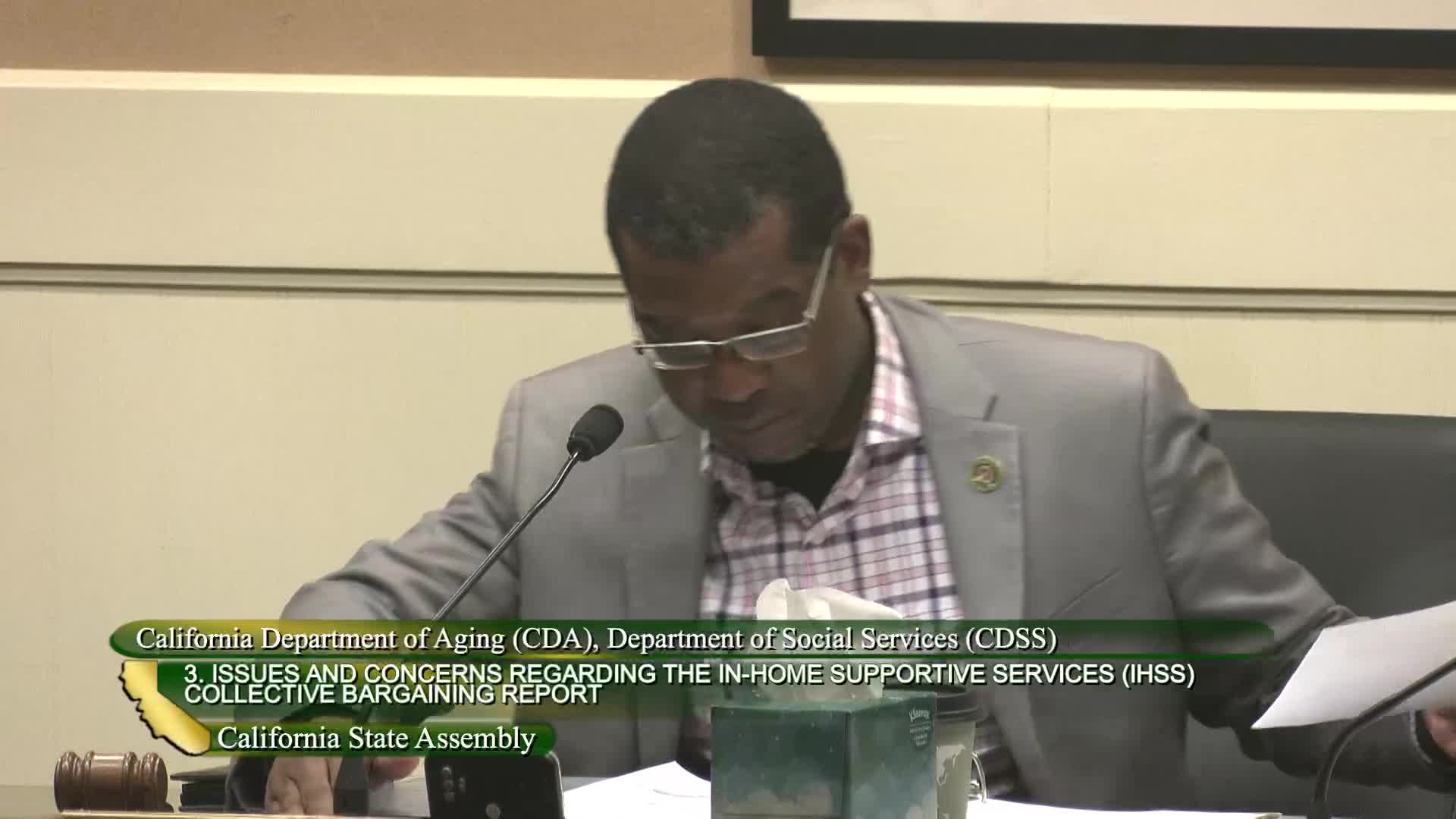
The Assembly hearing reviewed the AB 102 mandated work group analysis of whether collective bargaining for In‑Home Supportive Services (IHSS) providers should move from a county model to statewide or regional bargaining.
Leora Felicina, deputy director of adult programs at the Department of Social Services (CDSS), summarized the AB 102 process: CDSS convened a multi‑stakeholder work group, contracted facilitation and research (including UC Berkeley labor center), and produced a report estimating fiscal impacts. CDSS’s point‑in‑time cost model estimated that each $1.00 hourly statewide wage increase would add roughly $1.3 billion to $1.5 billion per year in program costs, split among federal, state and county shares depending on federal match and county maintenance‑of‑effort rules.
Unions said statewide bargaining is necessary to stabilize wages and benefits for an essential workforce. Tiffany Whiting of SEIU California and Christina Boss Hamilton of United Domestic Workers urged a statewide model to standardize wages, benefits and training; SEIU proposed an initial $1 million ongoing appropriation to CDSS and CalHR to staff a transition. They argued counties’ fragmented approach leaves providers “winners and losers” depending on location.
County representatives and consumer advocates warned of trade‑offs. Justin Garrett of the California State Association of Counties (CSAC) and several consumer advisory committee chairs said local public authorities and county advisory boards provide consumer‑driven oversight, registry services, payroll and other local functions that could be disrupted by a central bargaining model. Several consumer witnesses insisted that “nothing about us without us” requires consumers have a seat at any bargaining table.
Consumer groups and the Department highlighted potential legal, fiscal and administrative implications for county realignment funds. CDSS said ongoing county survey work on administrative funding and public authority costs will be provided to the Legislature by May 14, 2025. Lawmakers pressed for further cost refinement from the Legislative Analyst’s Office and the administration before recommending legislative changes.
The hearing surfaced broad agreement that the IHSS workforce is stressed, that turnover and low wages undermine continuity of care, and that policymakers must balance statewide wage and benefit goals against county fiscal constraints and the consumer‑employer model that distinguishes IHSS.