Get Full Government Meeting Transcripts, Videos, & Alerts Forever!
Get email alerts on the Long Term Care Financing topic
No spam. Unsubscribe anytime.
State officials press need for long‑term care financing as aging population grows
Summary
Department of Health Care Services and the California Department of Aging outlined ongoing state studies and a working definition of the “overlooked middle” — middle‑income older adults who do not qualify for Medi‑Cal yet cannot afford long‑term services — and urged lawmakers to consider a range of financing and program options.
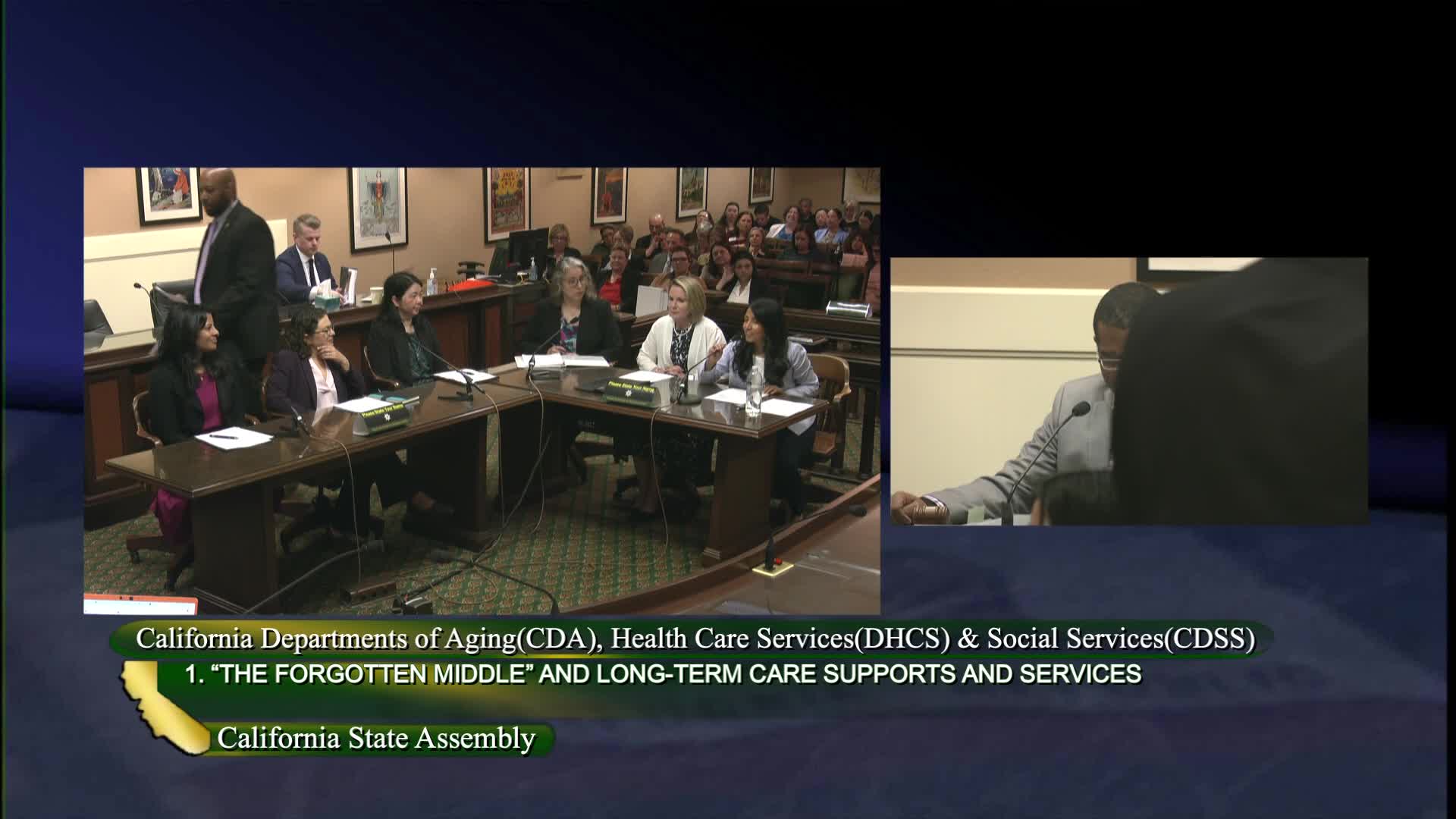
Assembly Budget Subcommittees 1 and 2 convened a joint hearing April 2025 to examine long‑term services and supports (LTSS) financing and the growing number of middle‑income older Californians who lack coverage for in‑home and community‑based care.
At the hearing, Susan Philip, deputy director for Healthcare Delivery Systems at the Department of Health Care Services (DHCS), said Medicare covers only limited short‑term skilled nursing care and that Medi‑Cal remains the primary payer for LTSS in California. Philip noted prior state efforts to study financing options, citing a DHCS actuarial study produced with Milliman in September 2020 and a California Department of Insurance analysis completed in 2022–2023.
Sarah Steenhausen, deputy director for Policy, Research and Equity at the California Department of Aging (CDA), described a new “LTSS Financing Initiative” launched in March 2024 to analyze who falls into the state’s working definition of the “overlooked middle,” their projected needs, and policy options. CDA’s working benchmark defines the overlooked middle as adults 60 and older with household incomes roughly between 139% and 500% of the federal poverty level — about $21,600 to $78,000 for a single household — who would need approximately $50,000 a year in LTSS to avoid impoverishment (about four hours of paid home care daily).
Advocates and researchers at the panel portrayed the issue as urgent. Trinh Phan of Justice in Aging recounted that roughly 4.4 million older adults and people with disabilities are outside Medi‑Cal eligibility and unable to afford LTSS; she urged near‑term reforms such as Medi‑Cal share‑of‑cost changes that advocates estimate would immediately improve access for about 100,000 people. Sarita Mohanty of The SCAN Foundation and Margaret Kushel of UCSF emphasized that unaffordable care contributes to homelessness and poor health among older adults.
CDA said it is working with the Urban Institute and UMass Boston on population projections and expects to deliver a final LTSS financing report to the Legislature in June 2026. Panelists stressed there is no single solution: they recommended a mix of system navigation improvements, workforce investments, protective rate policies for assisted living, and a sustained policy discussion about new financing models.
Lawmakers pressed for two near‑term priorities: (1) share‑of‑cost reform to reduce barriers for people just above Medi‑Cal income thresholds, and (2) targeted protections for assisted‑living residents who do not receive Supplemental Security Income (SSI) but face steep rent or board increases. Officials cautioned that federal policy changes to Medicaid could pose additional fiscal risk to state LTSS budgets.
The joint subcommittees requested continued interagency coordination and public outreach as CDA, DHCS and their consultants refine cost and coverage options over the coming year.