Get Full Government Meeting Transcripts, Videos, & Alerts Forever!
Get email alerts on the Sustainability Incentives topic
No spam. Unsubscribe anytime.
Draft incentives would reward reuse, solar and dark‑sky measures; BAR asks to extend program to mixed‑use and commercial projects
Summary
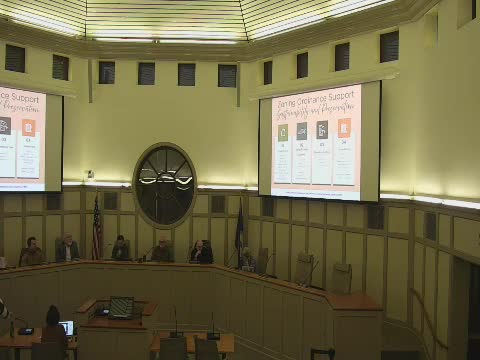
At its April 9 work session, the Leesburg Board of Architectural Review reviewed a draft sustainability-incentive scheme that would award points for reuse, deconstruction, dark‑sky lighting and solar, and make those points redeemable for limited density, height and parking relief.
At its April 9 work session, the Leesburg BAR reviewed a draft sustainability-incentive scheme in the zoning-ordinance rewrite that would award points for reuse of historic materials, deconstruction, dark‑sky lighting, rooftop solar and other measures, and that would make those points redeemable for limited development incentives.
Staff explained the draft point system uses fractional credits (0.25 to 1 point per measure, up to a stated maximum in the draft) and is intended to be applied primarily to multiunit residential projects; several BAR members asked that mixed‑use and commercial projects also qualify. Deb Moran, the town’s sustainability manager (referenced in the meeting), was identified as the staff contact who would review submitted project documentation when an applicant claims points.
The draft text includes proposed development incentives tied to earning points: a density bonus of up to one additional dwelling unit per acre beyond the maximum allowed in the applicable zoning district; an increase in allowable height by up to one story or 10 feet for nonresidential and mixed‑use development (except in the downtown zoning district) subject to approval of the Loudoun County Fire Marshal; and a reduction in off‑street parking requirements of up to 10 percent. Staff and board members agreed enforcement and verification would be needed if points become the basis for regulatory relief.
Board members asked staff to add deconstruction explicitly to the incentives table and to clarify what qualifies as historic material for reuse credits; one suggested a 50‑year age threshold for historic materials as a working definition. Members also asked who would verify claims that materials were reused or diverted from landfills; staff said the sustainability manager would review documentation but that more formal verification procedures (and whether points would be proffered through legislative agreements) must be developed.
On solar and lighting, the BAR supported administrative approvals for rooftop panels on side and rear elevations and asked staff to research dark‑sky lighting standards (Kelvin and fixture cutoff types) for a proposed ordinance section.
Members noted that many incentive elements would be easiest to enforce if they were proffered through legislative approvals (rezoning or proffered conditions) rather than arising from by‑right submittals; staff acknowledged the draft is intended to create an aspirational program that would operate more effectively when paired with legislative entitlements.
Staff will work with the sustainability manager to produce draft language adding deconstruction to the incentives table, define historic materials for credits, and suggest verification steps for point claims. The BAR will consider the proposed language at a subsequent meeting.