Get Full Government Meeting Transcripts, Videos, & Alerts Forever!
Get email alerts on the Zoning Ordinance Rewrite topic
No spam. Unsubscribe anytime.
Leesburg BAR considers paint palette, exemptions and requiring site plans before architectural review
Summary
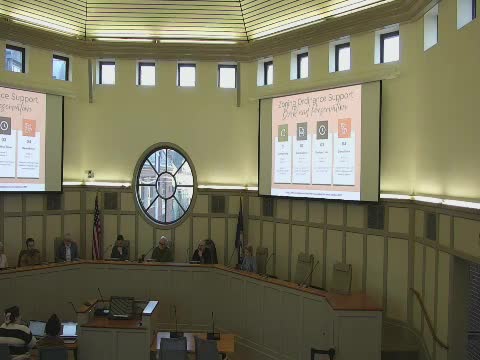
At a April 9 work session the Leesburg Board of Architectural Review discussed proposed zoning ordinance rewrite language that would create exemptions (including paint, cameras and small fixtures), introduce a paint-color policy, and ask for early site-plan submissions for larger projects to avoid ‘‘cart before the horse’’ reviews.
The Leesburg Board of Architectural Review (BAR) on April 9 reviewed draft zoning-ordinance rewrite language proposing a new paint-color policy, expanded exemptions for small exterior items, and a requirement that larger projects submit a site plan before the BAR conducts architectural review.
The proposed changes aim to clarify what items require a certificate of appropriateness (COA) and to reduce situations where the BAR reviews building design before the town’s legislative or site-plan processes are complete. Staff and multiple board members said those circumstances have created public confusion in recent projects.
Staff member Lauren said the rewrite would explicitly exempt small, nonstructural items such as doorbells and security cameras and suggested adopting an approved paint palette so homeowners could repaint from a list of colors without applying for an administrative COA. “Paint is paint when it comes to the historic district,” Lauren said, adding that a palette would reduce repetitive administrative review while preserving oversight for atypical color choices.
Board members debated whether paint changes should remain an administrative approval or be fully exempted. Some members favored keeping color changes as an administrative review so staff can counsel owners and reject clearly inappropriate colors; others suggested a default palette but leaving the option for residents to request a full BAR review. Staff noted the town currently requires an administrative COA to change house color and that no comprehensive town palette currently exists.
On exemptions, the draft would also address signage rules inside the historic district (board members noted the current zoning text applies only to nonhistoric areas) and allow small security cameras to be exempt up to a defined maximum dimension; staff offered to research common device sizes and propose a numeric threshold. The draft sign guidance also currently includes a two-color limit in the sign guidelines, a provision several BAR members criticized as overly restrictive because it counts black or white as one of the two colors.
Members also discussed bollards, mechanical cabinets and other streetscape elements that sometimes appear in the public right-of-way. Staff and several members pointed out limits on the town’s authority where state or utility standards apply (for example, Dominion Power-required protections around gas meters). Board members agreed the BAR could offer advisory guidance on town-owned installations but has limited ability to impose requirements on state or utility installations.
Separately, BAR members raised a procedural change: for larger commercial or multiunit projects, require an initial site-plan submission before the BAR issues a COA so the BAR can review a project in the context of its intended use, footprint, parking and right-of-way impacts. Several members said early site-plan information would prevent the BAR from giving what looks like an approval for a building type that later changes during legislative or site-plan review. Staff said engineering and planning divisions were generally receptive to the idea but noted there may be statutory or procedural limits to mandating preapplication meetings.
Votes at the meeting included adoption of the agenda and final adjournment (both passed unanimously). The BAR will prepare written comments on the draft rewrite and plans to finalize those comments for submission to zoning in the next packet cycle.
The BAR asked staff to prepare a recommended paint-palette approach, proposed numeric thresholds for exempt camera dimensions, and language describing which types of projects would require a site-plan submission before BAR review. The board will review the staff-prepared comment letter at its next meeting before sending the BAR’s recommendations to zoning.