
SD‑3 finance update: district half‑year spending, movement of maintenance funds to state investment pool
Get AI-powered insights, summaries, and transcripts
Sign Up Free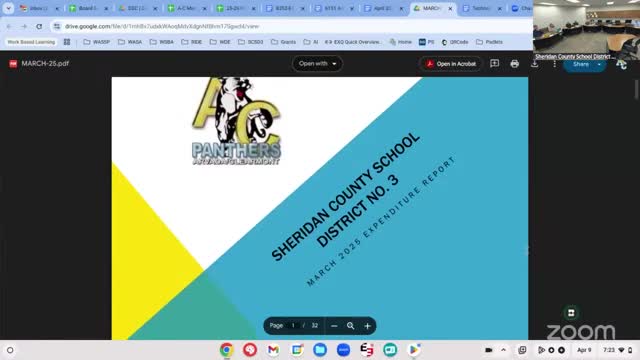
Summary
Business manager presented the March financial report showing about 55.7% of the general‑fund budget spent year‑to‑date and described moving major maintenance funds into the Wyoming government investment fund to generate monthly interest for student and program uses.
Sheridan County School District #3 reviewed March financials and a preliminary budget outlook at its April 14 meeting. The business manager reported that, as of March 31, the district had spent just over $2 million — approximately 55.7% of the general fund budget for the fiscal year — and provided line‑item breakdowns for instruction, instructional support, administration, maintenance and transportation.
Instructional expenses for the month were reported at $547,651, with the district showing approximately 38.62% of that instructional budget remaining (about $690,801). Instructional support and administration line items were reported with remaining budget percentages of about 55.3% and 28.08%, respectively, according to the report presented to trustees.
For March the transportation costs included a significant lease payment for a bus; the business manager said the monthly chart did not include one large purchase and that a purchase exceeding $5,000 (a bus lease payment) was on the board’s approval list. The lunch fund spent $14,439 during March and remained roughly 16.9% into its budget for the fiscal year, leaving about $20,000 on that fund’s budget as reported.
Business and maintenance staff told trustees they will begin transferring major‑maintenance balances from district checking to the Wyoming Government Investment Fund (WGIF), which the presentation indicated has generated roughly $1,200 per month on the holdings described during the meeting. Staff said the strategy is intended to earn interest on funds held for maintenance rather than leaving them idle in a low‑yield account.
On the capital side, the board discussed that prior transfers moved planned greenhouse funding into capital construction; the business manager said those dollars remain available in the capital construction account. Trustees asked for more detailed project planning for how to spend capital and major‑maintenance dollars and signaled they would discuss prioritization at the next budget meeting.
The board received a preliminary FY2025–26 budget worksheet, and staff noted uncertainty about some revenue streams (notably federal grant timing and state facility allocations). Trustees were told major maintenance funding is expected to increase but the facilities office had not yet provided line‑item breakout; administration said it will present updated numbers as they become available.
No formal budget adoption occurred at the meeting; trustees reviewed the report and discussed next steps for transfers, capital priorities and scheduling further budget review sessions.