Get Full Government Meeting Transcripts, Videos, & Alerts Forever!
Get email alerts on the Article 39 Funding topic
No spam. Unsubscribe anytime.
County and school leaders debate proposed Article 39 changes as bill advances in Raleigh
Summary
Local officials and school leaders discussed a state Senate proposal that would allow Article 39 sales-tax proceeds to be used for school operating expenses as well as capital projects, raising concerns about transparency, the distribution to charter schools and how any split would be decided by the county commissioners.
Buncombe County commissioners, district school leaders and staff spent much of their meeting reviewing a recently introduced state Senate bill that would change how Article 39 sales-tax revenue may be used locally.
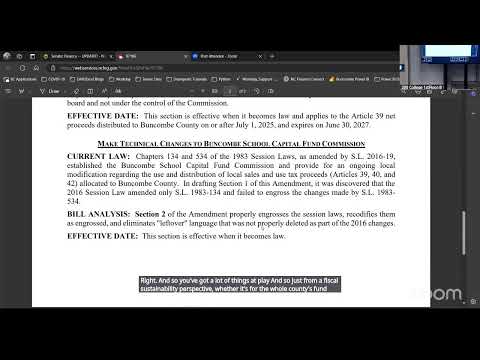
The bill as amended would allow up to 50% of the countys Article 39 allocation to be used for school operating and capital purposes. Amanda, chair of the Buncombe County Commission, told the group the language was first raised by the countys state delegation and that the change was presented quickly as a potential option to address post-storm shortfalls.
"We were tasked, though, and the reason that happened on February 21 was our local delegation wanted to get a placeholder quickly in order to help Buncombe County address the revenue challenges post Helene," Amanda said. "This was not an Amanda Edwards, Adriel Pinder, Tim Love request. This was nothing that we specifically asked for. It came up as part of our meeting with our local delegation."
Why it matters: Article 39 has been a predictable local revenue source for school capital projects. Allowing part of the pot for operating expenses would change how the commission and the two school systems plan spending. Several school-board members said they were surprised by the timing and by how the idea was communicated to districts.
School-board member Kim said she had received constituent calls and expressed frustration with the process used to surface the proposed language. "I am really disappointed in how this took place," Kim said. "When we said this, when we met together, city school board, county school board, county commissioners, that we're going to work together to make... we are letting people down." The comment reflected several speakers who asked for clearer, earlier coordination among the county, city and school districts.
Officials repeatedly emphasized the bill had not yet passed and that language was still changing in committees in Raleigh. Staff said updated draft language circulated to board chairs makes the split explicit: 50% for school purposes, with the ability to use the countys share for either school capital or school operating expenses.
Local implications and next steps: Presenters warned that using Article 39 funds for operating expenses would trigger statutory allocations to charter schools, reducing the net amount available to the countys two public school systems. A staff demonstration in the meeting showed that if $10 million were the countys allocation for the coming year, and the school share were split according to the draft formula, the amount remaining for capital would be limited after the charter-school allocation.
Superintendent-level speakers urged a broader review of financing tools if the two-year change became real. "If what we're looking at is two years without this particular funding dedicated to school capital, then we should broaden our view and look at other ways to move forward," said Dr. Johnson, suggesting the districts consider a voter-approved bond to fund large capital needs rather than relying solely on Article 39.
County staff said they would prepare scenario analyses for the commission and the school districts before the next meeting, including revenue and debt-service scenarios and options for PAYGO versus new debt issuance. The bill was reported to be moving through the Senate rules process; staff said they would continue to monitor developments in Raleigh and share updates with both school boards.
Ending: Commission and school officials agreed to reconvene the discussion at the next meeting once staff could present numerical scenarios and options. No formal vote on policy changes occurred; the bill remained subject to the General Assemblys process.