Get Full Government Meeting Transcripts, Videos, & Alerts Forever!
Get email alerts on the Education Funding topic
No spam. Unsubscribe anytime.
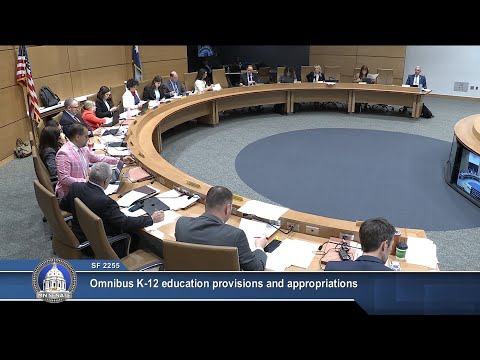
Minn. Senate Finance Committee advances education omnibus, splits on referendum renewal and aid cuts
Summary
The Minnesota Senate Finance Committee voted 7'to'6 on April 10 to advance Senate File 2250 to the Taxes Committee after adopting amendments that change charter-school aid, clarify how consolidated school boards can renew expiring referendums and make other technical and programmatic adjustments.
ST. PAUL, Minn. — The Minnesota Senate Finance Committee voted 7–6 on April 10 to send the chamber's education omnibus, Senate File 2250, to the Taxes Committee after adopting a string of amendments that rearrange funding for charters, clarify school referendum rules, and make other technical and programmatic changes.
The bill, which committee staff described as a package of technical corrections, program changes and funding adjustments, drew sustained debate on one provision that would let consolidated school boards renew expiring referendums for a renewal period no longer than the longest period authorized by any component district. That provision was split out for separate consideration and survived a roll-call challenge after several senators criticized it as changing voters' intent.
Why it matters: The omnibus measure alters how some school funding streams and program rules operate going forward. The committee approved a charter-school aid change that committee fiscal staff said will deliver roughly $20 million per biennium to charter schools and adopted multiple items intended to clarify implementation for programs such as the Read Act (literacy professional development), student support personnel aid, long-term facilities maintenance calculations and full-service community schools. Opponents warned some choices would shift costs or authority without fresh voter approval or would cut small, nonpublic programs that serve low-income families.
Details and debate
A16 amendment: technical package with a contested piece
Committee staff attorney Bjorn Arneson summarized the A16 amendment as a blend of technical fixes and policy clarifications. He told members the amendment "clarify[ies] the period of time that a consolidated school board can renew by board action an expiring referendum" and made other adjustments to formulas, Read Act allocations and student-support calculations.
When members asked to divide the amendment, senators removed lines 1.21'1.23 for separate consideration. Senator Crowen (as recorded) said of those lines: "what we're doing here today... is we're doing a bait and switch on the voters who approve these levies." Crowen argued voters who approved levies expected future renewals to go back to the ballot, especially in districts that hold school-board elections in odd-number years with lower turnout.
Other senators defended the change as consistent with the committee's earlier work. Senator Wessel (as recorded) asked for a roll call and said some districts were already considering moving elections to even years; other members said they supported restoring board renewal authority in a way that preserves notice to voters in future elections. On the carved-out lines the committee recorded a vote of 7 ayes and 6 nays; the overall divided A16 package was adopted by the committee before moving on to other amendments.
Charter school facilities aid (A32)
Senator Gustafson offered the A32 amendment to convert certain long-term facilities maintenance (LTFM) revenue for charter schools into additional general education revenue, calculated as $132 per adjusted pupil unit. Committee fiscal staff explained to members that the change would provide "approximately $20,000,000 per biennium" to charter schools and take effect for revenue in fiscal 2026 and later. Supporters said the change gives charter schools more operational flexibility because many charters cannot own buildings and therefore could not use LTFM in the same way as traditional districts. The amendment passed by roll call, 13'0'0ayes, 0'nays.
Full-service community schools and other program clarifications (A10, A5, A15)
The committee adopted a series of amendments clarifying program rules and priorities. Senator Uma Verbatim's A10 clarified prioritization for full-service community schools and relaxed some prescriptive language around leadership councils; members approved it 13'0'ayes, 0'nays. Senator Westland's A5 revised language on cardiac emergency response plans after stakeholder input; it passed 13'0'ayes, 0'nays. Senator Clark's A15 addressed paraprofessional assessment and cut scores to align Minnesota's practices with other states and the draft work group recommendations; the amendment was described by sponsors as meant to reduce hiring barriers for paraprofessionals.
Food service flexibility and facility expansion (A13)
Senator Cronin offered an amendment to let school food service funds be used for "facility expansion" (kitchen, serving area, lunchroom and food storage). Supporters said the change responds to increased demand resulting from expanded universal school meals and that some districts need extra space and equipment. Opponents urged districts to preserve surpluses for unforeseen federal changes; the committee adopted the amendment by roll call, 7'0'ayes and 6'nays.
Nonpublic aid and contested amendments (A20)
An amendment from Senator Lucero sought to restore nonpublic per-pupil assistance by offsetting it with unemployment-insurance changes for seasonal school workers; debate grew heated. Senator Maquade urged rejection, saying the proposal would harm hourly school workers who rely on summer UI. The Lucero amendment failed on a roll call, 6'0'ayes and 7'nays.
Teacher pensions and subsequent amendment attempts (A14, A19)
Several members sought to use general fund changes to address teacher pension disparities, particularly the Tier 2 funding shortfall that has prompted repeated advocacy from teachers and unions. Senator Cronin offered A14 to reduce the unreduced retirement age for teachers from 65 to 62 with 30 years of service; proponents framed it as a priority statement and a way to protect jobs by enabling retirements, opponents said pensions belong to the Pensions Committee and that the measure would need careful funding and actuarial study. A14 failed, 6'0'ayes to 7'0'nays. Another, smaller pension amendment (A19) patterned on an existing Senate file also failed, 6'0'ayes to 7'0'nays.
Withdrawn and financial-source amendments (A22)
Senator McQuaid briefly offered an amendment (A22) to repeal several business tax exemptions (including data centers, VIP seating for stadiums and some aviation equipment exemptions) as a revenue-offset to fund education priorities. After extended member discussion about downstream economic effects and which exemptions might unintentionally affect medevac or other services, the sponsor withdrew the amendment to allow further cross-committee conversations.
Final committee action
After adopting the listed amendments and several smaller technical changes, the Finance Committee voted to move SF2250 to the Taxes Committee by roll call. The committee report reflects a 7'0'to 6 vote to advance the bill. Committee staff and several members noted the package includes added formula aid in the general education formula and a set of targeted increases in special education cross-subsidy and English-learner support, as well as expanded implementation flexibility in a number of program areas.
What's next
The bill now moves to the Senate Taxes Committee for consideration. Members on both sides signaled they will continue to press for other priorities (teacher pensions, district disparity aid and data-center tax policy) in their respective committees and on the floor.
Quotes
"We're doing a bait and switch on the voters who approve these levies," Senator Crowen said during debate on the referendum-renewal language.
"This would provide an additional $132 per adjusted pupil unit... approximately $20,000,000 per biennium to charter schools," committee fiscal staff said when explaining A32.
Ending
Committee members said they would continue negotiations in their jurisdictions, in particular pensions and tax policy, as the omnibus heads to taxes and other committees. The committee record shows broad bipartisan interest in resolving teacher pension questions and in adjusting funding models for charters and meal programs, even as members differed sharply about the best offsets and trade-offs to make within a constrained budget.