Get Full Government Meeting Transcripts, Videos, & Alerts Forever!
Get email alerts on the Consolidated Plan topic
No spam. Unsubscribe anytime.
Riverbank reviews Stanislaus Urban County draft consolidated plan, highlights sewer and park ADA projects
Summary
City of Riverbank hosted a community meeting on the Stanislaus Urban County and HOME Consortium draft consolidated plan for fiscal years 2025–2029. Presenters described HUD funding programs, technical needs analysis, community survey results and local projects including Texas and Kansas Avenue sewer improvements and Pioneer Park ADA upgrades.
The City of Riverbank on April 4, 2025 hosted a community meeting on the Stanislaus Urban County and HOME Consortium draft consolidated plan for fiscal years 2025–2029, which is out for a 30‑day public review and is scheduled for submission to the U.S. Department of Housing and Urban Development in May 2025. Tammy Alcantor, Riverbank assistant city manager, opened the session and introduced the presenters.
The consolidated plan sets priorities for federal funding programs administered by HUD — principally the Community Development Block Grant (CDBG), HOME Investment Partnerships (HOME) program and Emergency Solutions Grants (ESG). Letty, a staff member who led the presentation, said, “The Consolidated Plan serves as a framework planning document for a community wide dialogue to identify the top housing needs, community development concerns for low and moderate income populations, and to set informed priorities for actions and use of funds.”
Why this matters: HUD entitlement funds and consortium HOME funds guide local spending on affordable housing, homelessness response, infrastructure and public services. The draft plan will inform how Stanislaus Urban County and consortium members allocate resources across Ceres, Hughson, Newman, Oakdale, Patterson, Riverbank, Turlock, Waterford and unincorporated Stanislaus County for the next five years.
Presentation highlights and technical findings
Presenters reviewed HUD definitions used in the plan. Letty noted that “HUD defines an affordable dwelling as one where a household pays no more than 30% of its income on housing,” and explained the difference between cost‑burdened households (more than 30% of income on housing) and severely cost‑burdened households (more than 50%). The technical analysis presented to meeting attendees shows the greatest housing stress among households at or below 50% of area median income (AMI), with particularly high rates of severe cost burden among households at or below 30% of AMI.
The consolidated plan effort, initiated in December, combines technical data and community outreach. A countywide community survey conducted from February through March 2025 received approximately 188 responses; the draft plan was posted for public review on April 4, 2025. Staff said final drafts will be brought to public hearings in May before submission to HUD.
Community priorities and needs
Survey and engagement results summarized at the meeting identified five crosscutting goal areas in the draft plan: support affordable housing and accessible housing options; address, prevent and mitigate homelessness; improve public infrastructure and facilities; provide and ensure access to essential public services; and ensure proper administration and compliance of federal funds.
Respondents prioritized services for seniors, families and people with disabilities and asked for more affordable homeownership options. Respondents also rated homelessness prevention and outreach highly: presenters said about 71% of survey respondents rated homelessness‑related actions as very or extremely important. Public services that ranked highest by importance included crime prevention, child abuse prevention, medical and dental services, senior services and drug‑abuse education.
Economic development and broadband needs were also emphasized. Presenters highlighted workforce development and education as central to regional economic strategy and showed median earnings rising with educational attainment, from roughly $27,000 for workers with less than a high school diploma to about $62,000 for four‑year college graduates (figures presented by the consultant reflect county medians).
Local projects affecting Riverbank
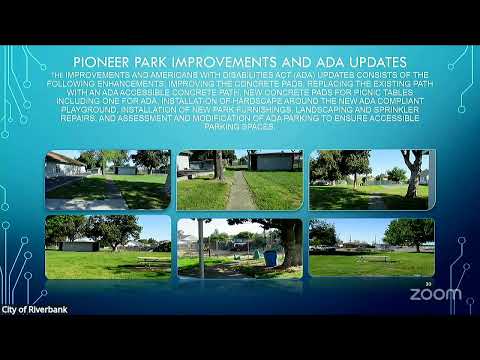
Riverbank staff reviewed projects proposed for Stanislaus Urban County CDBG funding that would affect the city. Two sewer improvement projects are listed for Texas Avenue and Kansas Avenue. Riverbank also proposed Pioneer Park improvements to meet Americans with Disabilities Act (ADA) standards; described elements include installing an ADA‑accessible concrete path, concrete picnic table pads (including at least one ADA‑compliant pad), hardscape around the playground, new park furnishings, landscaping and sprinkler repairs, and assessment/modifications to ensure accessible parking spaces.
Process and next steps
Staff emphasized that the draft consolidated plan is a planning document that will be finalized after the public comment period and additional community meetings. Tammy Alcantor invited public input and noted the recording would be posted to YouTube and that residents may submit questions or comments to city staff; she provided the city’s main line: (209) 863‑7122. No formal votes or agency decisions were taken at the meeting.
Speakers at the meeting encouraged additional engagement and said the county would update technical analyses to reflect outreach results before finalizing the plan. The City of Turlock, a distinct HUD entitlement jurisdiction, will separately report HOME activities undertaken with prior consortium funds as required by its annual action plan.
The presentation and draft plan are available on Stanislaus County’s website under the housing program; staff urged residents to review the draft and to submit comments during the 30‑day review period.