Get Full Government Meeting Transcripts, Videos, & Alerts Forever!
Get email alerts on the Childcare Cameras topic
No spam. Unsubscribe anytime.
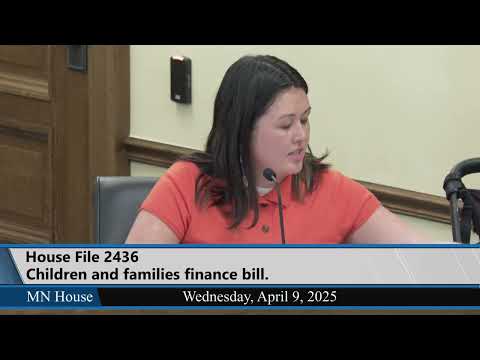
Children and Families Committee debates HF2436, rejects camera mandate on tied vote; adopts technical and funding amendments
Summary
The Minnesota House Children and Families Committee considered the omnibus House File 2436 on multiple amendments including a proposed mandate for cameras in child care centers. Key technical and funding amendments were adopted; the proposed camera mandate failed on a 7-7 tie and the bill was laid over for further work.
The House Children and Families Committee debated House File 2436, the omnibus bill, including a highly contested proposal to mandate in-room video cameras in child care centers and a series of amendments on funding and policy. Committee members adopted several technical and funding amendments but rejected the camera mandate on a 7-7 roll-call tie; the committee laid the bill over for further consideration at its next scheduled meeting.
The committee’s chair, Representative Nolan West, moved HF2436 and the DE1 amendment and then called amendments in sequence. Vice Chair Hansen moved the minutes for the committee’s previous meeting, which were adopted, before the committee began the substantive debate on HF2436.
The contested camera provision was considered through an amendment labeled A2 that would have restored a version of the bill including requirements for cameras in designated infant and toddler rooms and a 60-day retention standard for recorded footage (the underlying DE had earlier included a 60-day standard after cost review). Chair West said the measure was intended to strengthen accountability: “The ongoing expenses of $500 to $600 a year are something that I think is well worth the accountability and protection that our cameras provide.” He also noted the bill contains a grant program intended to offset one-time equipment costs for centers that need help.
Vice Chair Hansen and other members framed an alternative approach, proposing a task force (A19) to study technical, privacy, storage and civil‑liberties issues before imposing a mandate. Hansen said the task force was intended to “determine how we should…improve our childcare system and the licensing systems” and to include cybersecurity expertise and parents who had experienced maltreatment. That amendment failed on a voice vote after extended debate.
After extended discussion from members representing both urban and Greater Minnesota districts—who repeatedly raised concerns about implementation cost, privacy, data storage and uneven impacts on small family providers—the committee took a roll-call vote on A2. The roll call produced seven yes votes and seven no votes, so the amendment did not prevail. Representative West closed the A2 debate by saying he took members’ cost and data concerns seriously and planned to continue work on the language in the next meeting.
Several other amendments were adopted or disposed of during the session. Chair West’s technical amendment A13 was adopted by voice after Representative Katiza Wooten expressed support as a technical clean-up. Representative Nelson’s A14 amendment, adding language related to child support cost-of-living adjustments and incorporating a House file from Representative Peggy Scott, was adopted. The A20 amendment—crafted jointly by Chair West and Chair Katiza Wooten—tightened direction to the Department of Children, Youth and Families (CYF) for remaining IT modernization funds that were not related to the SSIS modernization; committee members said the A20 language aims to focus remaining monies in a $20,000,000 allotment from 2023 on implementation priorities.
Other offered amendments were withdrawn after discussion (A3 on BCA fingerprint retention, A4 delaying parts of the Minnesota African American Family Preservation Act rollout beyond 2027, A11 and A12 relating to SNAP outreach and related supports, A16 on subsidized childcare for childcare workers) or failed on voice vote (A6, a food‑bank targeted appropriation; A17, a youth‑led program insertion; A18, diaper distribution funding). Representative Jennifer Summerfeld of the Department of Children, Youth and Families told the committee the SSIS (Social Services Information System) modernization does not yet have a firm completion date: “We don't have an exact date…we don't have a full plan yet from the consultants…we should have more information for you once that consultant has finished their work.”
The committee concluded without final passage of HF2436 and laid the bill over for the committee’s next scheduled meeting to continue work on remaining policy and funding details. Chair West and Chair Katiza Wooten both indicated a willingness to continue negotiations on camera language, data-retention specifics and funding mechanisms to address member concerns, particularly around costs for smaller and family‑based providers.
Votes at a glance: - Motion to adopt minutes (04/08/2025): Adopted (voice vote). - Amendment A13 (technical fixes): Adopted (voice vote). - Amendment A14 (child support COLA language from Rep. Peggy Scott): Adopted (voice vote). - Amendment A20 (directs remaining non‑SSIS IT modernization funds from a 2023 $20 million allotment): Adopted (voice vote). - Amendments withdrawn after discussion: A3 (fingerprint retention; withdrawn), A4 (MAFPA timing; withdrawn), A11 (SNAP outreach; withdrawn), A12 (withdrawn), A16 (childcare worker subsidy; withdrawn). - Amendments defeated (voice): A6 (food bank allocation), A17 (youth program insertion), A18 (diaper distribution), A19 (task force on cameras/storage). - Amendment A2 (camera mandate / data-retention language restored): Roll-call tie, 7 yes — 7 no; not adopted.
The committee’s discussion repeatedly emphasized three points: protecting children and holding potential abusers accountable; avoiding unintended burdens that could force smaller, family‑based providers out of business; and ensuring the state’s SSIS modernization is sufficiently funded and functional to support any new regulatory requirements.
Next steps: HF2436 is laid over for continued committee consideration at the committee’s next scheduled meeting; sponsors said they will continue negotiations on camera-related language, grant support for implementation, and SSIS funding and timing.
Sources: committee testimony and roll‑call recorded on the HF2436 hearing transcript for the House Children and Families Committee; in‑committee remarks by Representative Nolan West (chair), Vice Chair Hansen, Chair Katiza Wooten, Representative Zalesnikar, Jennifer Summerfeld (Department of Children, Youth and Families) and others.