Get Full Government Meeting Transcripts, Videos, & Alerts Forever!
Get email alerts on the Wireless‑permit‑appeal topic
No spam. Unsubscribe anytime.
Commission Upholds Wireless Permit at 620 Costa Rica; Appeal Denied
Summary
The San Mateo Sustainability and Infrastructure Commission denied an appeal of a wireless‑permit approval for a Crown Castle facility at 620 Costa Rica, upholding staff's decision after hearing testimony from staff, the applicant and local residents.
The Sustainability and Infrastructure Commission on April 9 denied an appeal and upheld a director’s decision approving a wireless permit for a small‑cell facility at or near 620 Costa Rica, rejecting arguments from local homeowners and neighborhood advocates.
The commission’s decision preserves staff’s finding that the proposed installation complied with the city’s wireless design standards and federal limits on radiofrequency emissions. Staff and the applicant argued the selected pole was the least obtrusive technically feasible location after evaluating alternatives within the required 500‑foot search radius.
City senior engineer Jason Lehi presented staff’s review, telling the commission the application “was in conformance with the ordinance and design standards and within the FCC limits” and that the proposed pole was “the only feasible structure” after analysis of alternatives and PG&E safety constraints. Staff said the applicant requested and was granted three limited exceptions (structural certification documentation, overhead service drop, and shroud taper) needed to make the existing pole usable.
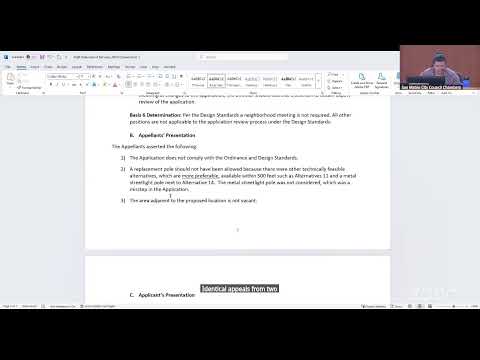
Homeowner John Hanlery and nearby residents objected to repeated applications for the same pole location and raised concerns about notice, proximity to driveways and the location being described as “near 620 Costa Rica” rather than at a precise address. Hanlery said he had received multiple application notices over time and asked the commission to reconsider approving a replacement pole after prior denials and a withdrawn application.
The applicant, represented by professional engineer Tyler Reester and counsel Liz Winsell, said the application complied with the municipal code and federal law and that staff’s technical review and the city’s RF consultant supported the 200‑foot technical objective used to evaluate feasible sites. Winsell also reminded the commission of federal preemption standards for wireless siting and argued denying the permit would “materially inhibit” the provider’s ability to improve service.
Commissioners asked detailed questions about the technical justification for a 200‑foot target radius, the PG&E clearance rules (CPUC General Order 95 and a PG&E pole‑siting standard cited by staff), and how pole‑replacement and limited‑exception decisions are weighed against the city’s preference for existing supports. Staff said their RF consultant and experience in similar reviews found the 200‑foot justification reasonable while noting that under ideal conditions some equipment can reach farther distances.
After discussion, the motion to deny the appeal and uphold the director’s decision carried. The vote as recorded in the hearing: Commissioner Robbins — yes; Vice Chair Michael — yes; Chair Narita — yes; Commissioner Lewinsky — yes; Commissioner Grant — no. The outcome was recorded as approved.
The commission also noted the procedural record: earlier applications for the same pole location had been withdrawn or denied, and staff reiterated that each application is reviewed separately. Staff and the applicant said the permit was deemed complete and compliant with the city’s 2021 wireless design standards and the applicable federal rules.
The commission directed staff to prepare the formal statement of decision reflecting the findings and vote; staff will circulate that written decision for the record.