Get Full Government Meeting Transcripts, Videos, & Alerts Forever!
Get email alerts on the School Construction topic
No spam. Unsubscribe anytime.
Middletown committee hears labor, noise and cost briefings as school construction moves toward bids
Summary
At its April 9 meeting, the Middletown Building Committee heard a presentation on using a project labor agreement, an acoustical study of rooftop equipment, and debated an alternate for a second elevator and generator upgrades. No formal decisions were made; the committee must act on alternates when bids and state funding info arrive.
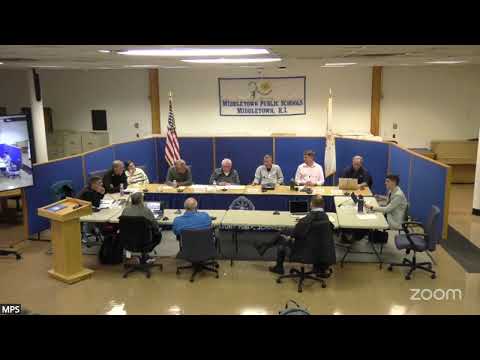
MIDDLETOWN, R.I. — The Middletown Building Committee on April 9 heard updates on labor planning, acoustics and construction alternates for the town’s combined middle-high school project and was briefed on bidding and schedule milestones ahead of May recommendation-to-award (RTA) decisions.
The committee received a presentation on project labor agreements (PLAs) from representatives connected to the Rhode Island Building Authority and labor groups and was told a PLA could reduce the risk of work stoppages and help secure skilled trades amid a tight construction labor market. Bill O'Gara, a presenter at the meeting, described a PLA as “a labor agreement in connection with a particular project that allows for and provides for essentially a guarantee of labor stability” and said that with a PLA “you essentially take the risk of labor disruption ... off the table.”
Why it matters: The town must decide soon whether to include PLA-related language in contract documents because proponents say it improves schedule certainty, staffing and apprenticeship opportunities, while opponents or skeptical members flagged potential cost impacts and asked for data. Committee members did not vote on a PLA at the meeting; staff said they would seek authorization to negotiate terms and bring final documents and cost information back with the upcoming bid packages.
Labor, cost and apprenticeships Greg, a building-trades representative who spoke for the unions, told the committee the regional union network and national affiliates could supply labor and that unions invest in training locally: “we invest, locally $6,000,000 a year in recruiting, and training and retraining our workforce.” He also described an apprenticeship appendix in the PLA intended to create on-site apprentice goals and to recruit local candidates from Middletown schools.
Committee members asked whether PLAs would price out nonunion contractors. Presenters said PLAs do not bar nonunion firms from bidding but that prevailing-wage public projects in the state often attract union subcontractors; one presenter noted that, for certain scopes, “the nonunion is the low bidder” in past examples, but that market makeup varies by project and trade. No formal authorization to adopt a PLA was recorded at the meeting; staff said the construction manager (Gilbane) would pursue negotiations if given authority and expected an agreement template could be completed rapidly once negotiated.
Acoustics and rooftop screening The committee also heard a sound study from acoustical consultant Aaron Farbo of Kavanaugh Tachi Associates on rooftop mechanical equipment. Farbo said the team placed two week-long monitors at representative neighbor locations and measured background levels as low as about 37 dBA during daytime and roughly 32 dBA at night. He noted Middletown’s zoning noise limits — 65 dBA daytime and 55 dBA nighttime — and said the design team set internal goals of roughly 5–10 dBA above measured ambient levels so neighbors are not subjected to a much higher baseline. “Based on the equipment and the sound levels … we determined that these are the estimated sound levels at the receivers,” Farbo said, and reported modeled equipment levels were below both the town limits and the project’s internal design goals.
Farbo and the architects concluded that, from an acoustic standpoint, rooftop noise controls such as barriers are not required. Committee members nonetheless flagged visual screening and structural framing for roof screens as separate issues; Gilbane provided a budget estimate for a visual roof screen structure that will arrive as part of the structural-steel and building-envelope bid packages.
Elevator alternate: accessibility, redundancy and cost The committee devoted significant discussion to an ad-alternate to add a second elevator in the middle-school wing. Gilbane’s ad-alternate estimate for the second elevator (alternate number 9) was cited at about $450,000; the estimate will be refined as bids return and as related concrete and finish work RTAs are submitted.
Supporters — including school administrators and several committee members — emphasized access and resiliency. Garde Middle School principal Jerry Haas and Superintendent Billy Niemeyer (speaking in his committee role) noted staff and students with temporary or permanent mobility needs and argued that a second elevator would reduce repeated long routes across the building and provide redundancy if one elevator fails. One committee member said, “If there's only 1 elevator, when that goes down, you're done,” framing redundancy as a resiliency and safety consideration.
Other members cautioned about cost and opportunity cost, noting $450,000 could be allocated to other alternates such as site or field work. Committee members agreed they would not make a final decision at the April meeting; they expect to accept or reject alternates when the RTAs and firm prices are presented at the next building-committee and school-committee review meetings.
Generator sizing and alternates The construction team reviewed an electrical alternate (add-alternate number 7) that would upsize the base-bid emergency generator from 550 kilowatts to 800 kilowatts and would include additional separate circuiting to supply the loads necessary to operate the building as a shelter. The team also discussed a possible 7a option that would add provisions (a docking/quick-disconnect and site provisions) for temporary portable generator hookup so a portable unit could be parked and connected quickly when needed. The architects noted the docking concept would require some base-bid revisions (additional feeders, panels and a manual transfer switch) and that a precise cost estimate was not available at the meeting.
Committee members said they were monitoring state legislative funding prospects that could cover a generator upgrade. Staff said the state legislative process may clarify available funds by late June; one member noted an August internal decision window for budgeting. No purchase decision was taken at the meeting; the committee discussed treating the larger generator as an alternate and retaining a 7a docking provision if the full-sized generator is unaffordable.
Bids, schedule and next steps Town staff and the design team reported the materials-testing RFP had been posted April 3 with proposals due April 25 and that Gilbane and the design team are conducting best-and-final reviews with concrete and other subcontractors this month. RIDE (Rhode Island Department of Education) comments were limited to confirming the project may be designed under the 2018 International Energy Conservation Code rather than the 2024 IECC; staff said they expect to submit the 60% construction documents depending on pending energy-assessment reports from Rhode Island Energy.
The committee was told recommendation-to-award packages (RTAs) for the elementary school complex and the middle-high school first-phase packages will arrive in May; an official ceremonial groundbreaking was tentatively scheduled for June 16 but committee members noted graduation events the weekend of June 14 could prompt a minor schedule shift.
No formal votes on PLAs, alternates or procurements were taken at the meeting. The committee approved meeting minutes from March 26 and adjourned; decisions on the second elevator and the roof-screen structural alternate were expected when firm bid prices and RTAs are available.
The building committee will reconvene to review RTAs and alternates; staff and the construction manager will return with negotiated PLA language if the committee authorizes negotiations and with updated cost figures for the elevator, generator and roof-screen options.