Get Full Government Meeting Transcripts, Videos, & Alerts Forever!
Get email alerts on the Port Master Plan topic
No spam. Unsubscribe anytime.
Consultants present Providence port master plan draft emphasizing resilience, jobs and tighter environmental oversight
Summary
Consultants for the Providence port master plan told a city committee the draft plan prioritizes flood resilience, brownfield remediation, workforce development, shore power and new governance structures; no final votes were taken and the plan will be refined before coming to the City Council.
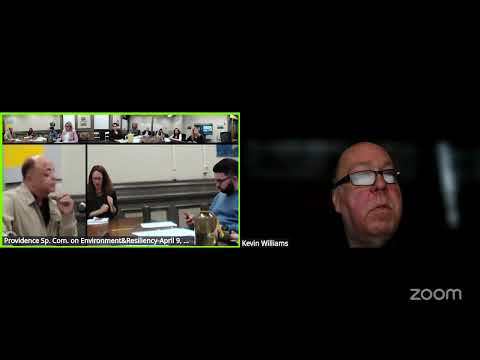
Consultants from GCA and GZA presented an update on the Providence port master planning process on April 9, outlining flood-risk modeling, land-use scenarios, environmental governance proposals and workforce strategies for the Port of Providence and adjacent industrial parcels.
The presentation summarized a multi-phase planning process that began in 2024, described a planning boundary coterminous with a University of Rhode Island flood-hazard analysis, and said modeling scenarios to 2050 assume about 2 feet of sea-level rise; consultants also ran a deterministic 1938-level storm scenario. The team identified up-to-15-foot inundation depths in low-lying areas, and two-to-six-foot depths in other locations under worst-case storms.
Why it matters: the waterfront area under study abuts South Providence and Washington Park neighborhoods and contains legacy industrial and maritime operations. The draft plan aims to reduce public-health impacts tied to air and noise emissions, create local jobs through higher-value maritime and blue-economy uses, and propose governance, monitoring and land-use tools that would give nearby communities more voice in port activities.
Key elements presented included: expanded community engagement and an advisory committee that has held multiple meetings; a combined land-use, environmental and infrastructure master plan; site-level and site-wide climate resilience measures (raised electrical/HVAC systems, dikes/barriers around vulnerable fuel tanks, detention/retention and permeable surfaces); phased port electrification and shore-power infrastructure for vessels; brownfield assessment and incremental remediation; environmental auditing and fence-line or in-fence monitoring; and a governance framework featuring a paid community liaison and ongoing reporting to the city.
Consultants identified potential economic pathways for the port: offshore wind manufacturing and lifecycle services (maintenance, recycling and staging), bulk goods and construction-material handling leveraging rail spur connectivity, cold-storage or value-added seafood processing (noting operational challenges), intermodal freight/logistics, and high-tech or blue-economy incubator space tied to local universities. They cautioned that political and market conditions (for example, the current political climate around offshore wind) affect timing, but argued a long-range view shows opportunity.
Speakers and engagement: Kevin Williams (principal in charge of planning practice, GCA) led the presentation; Kurt Spaulding (senior consultant, GZA) and a GCA vice president named Wayne participated. Council members and committee leadership asked questions about recent property transactions, zoning, enforcement and how the plan would translate into measurable projects. The consultants recommended near-term zoning text changes to restrict or condition certain uses, and longer-term tools such as an overlay district, a redevelopment plan and potential tax-increment financing to fund remediation and resilience.
Community concerns and monitoring: consultants and staff emphasized community requests recorded in advisory-committee and public meetings: stronger air- and noise-monitoring, transparent reporting of tenant activities, emergency response and spill-prevention planning (SPCC adherence), anti-displacement measures, better truck routing and wayfinding, and increased public waterfront access where practicable.
Next steps and schedule: the team said master-plan refinement will continue through May–July and that the plan will be presented to the City Council when ready. Consultants noted the Providence Port Day event planned for May (an all-day public event for community information and discussion) and recommended establishing a standing reporting mechanism (annual or biannual) to track implementation and public-data disclosure.
Procedural actions: the committee voted to enter the presentation into the record as an exhibit during the meeting (motion made and seconded; all in favor). The presentation itself did not create any regulatory change; specific zoning, regulatory or funding actions would require separate council review and formal approvals.
Ending: presenters said the draft will be refined with advisory-committee and public input and returned to the Council for consideration of land-use and governance recommendations.