Get Full Government Meeting Transcripts, Videos, & Alerts Forever!
Get email alerts on the City Finance topic
No spam. Unsubscribe anytime.
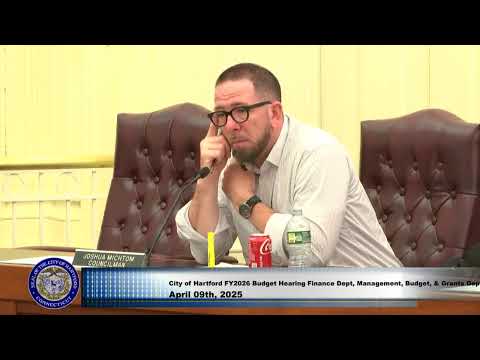
Hartford finance chief presents FY2026 budget, proposes tax-payment kiosks and staffing changes
Summary
CFO Lianne Rawls told the City Council’s budget hearing that the Finance Department seeks $4.727 million for FY2026, highlighted staffing turnover and vacancies, and proposed technology investments including a $24,000-per-year tax payment kiosk and an $8,000 annual e‑procurement increase.
Lianne Rawls, chief financial officer for Hartford, presented the Finance Department’s FY2026 recommended budget and described staffing, technology and collections initiatives at a City Council department budget hearing. The department’s FY2026 request for the finance function was listed in the presentation as $4,727,000, a 7.4% increase over FY2025.
Why it matters: The Finance Department manages tax collection, payroll and city contract compliance and oversees ARPA reporting and other federal grants. Changes to staffing, procurement software and taxpayer payment options affect city operations, vendor compliance and residents’ ability to pay taxes.
Rawls said the department has 51 full‑time positions and identified multiple vacancies. "With this budget, it is a total of 51 full time positions. Of those 51 positions, we have 5 vacancies. Actually, let me take that back. We have 4 vacancies... Totality, have 7 vacancies," she said, noting hires and pending acceptances to reduce vacancies. Rawls announced two personnel requests in the FY2026 budget: creation of a finance‑director position for succession planning ahead of her planned retirement at the end of FY2026, and an administrative assistant in procurement to handle RFP administrative work.
Rawls described operational counts and workloads handled by the department. She said the pre‑audit team processes more than 50,000 invoices annually and the payroll operation serves about 1,600 employees (including the Hartford Public Library and other city entities). The department reported managing $112,000,000 of American Rescue Plan Act (ARPA) funds and said it met federal obligation deadlines and has filed required reports.
On technology and payments, Rawls told council members the budget includes an $8,000 annual increase for e‑procurement and contract management software and a $24,000 annual cost per tax‑payment kiosk. "It's $24,000 annually per machine," she said, adding that the city expects benefits in convenience and increased on‑time payments but is continuing to evaluate locations and vendor options. Council members asked whether kiosks are one‑time or recurring costs and whether other Connecticut municipalities had experience; Rawls cited Manchester as an early user and said officials are exploring joint service arrangements with nearby jurisdictions.
Procurement and vendor diversity work received attention. Rawls highlighted supplier diversity training, a supplier diversity newsletter and radio outreach that the department said improved engagement with smaller contractors. The procurement division continues to work with corporation counsel on ordinance changes to update dollar thresholds and enforcement mechanisms for developer and contractor compliance.
On risk and safety, Rawls said the city paid about $130,000 out of risk and safety funds and used $250,000 in CIP funding to address OSHA citations at several firehouses; cited issues were closed with the state. The department also uses a vendor insurance‑tracking system (Gallagher Verify) and reported expanding safety and training programs (bloodborne pathogen, asbestos awareness, ladder safety, CPR/AED) to reduce claims.
Council members asked about succession planning, shared services with the Board of Education, kiosk maintenance and expected budgetary impacts. Rawls said the proposed finance‑director position is intended to allow overlap and training before her retirement, and that plans for shared services work are pending completion of an administration review (the Blue Ribbon Commission report) and further study.
The presentation concluded with a council question-and-answer period; additional follow‑up questions were to be submitted by email for department responses.
Looking ahead: Council members requested written follow‑ups on tax deed sale timing, ordinance changes for procurement and data on kiosks and e‑procurement performance before any final decisions are made.