Get Full Government Meeting Transcripts, Videos, & Alerts Forever!
Get email alerts on the Zoning Ordinance Rewrite topic
No spam. Unsubscribe anytime.
Leesburg BAR discusses zoning rewrite: paint palettes, submission timing, demolition rules and sustainability incentives
Summary
At a April 9 work session, the Leesburg Board of Architectural Review reviewed a draft zoning ordinance rewrite that would add exemptions for small exterior changes, propose a paint-color policy, tighten demolition-by-neglect language and introduce a points-based sustainability incentive tied to density, height and parking relief.
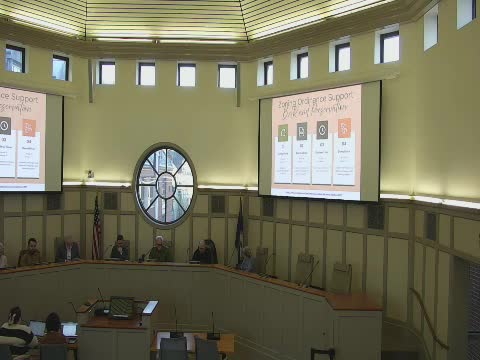
The Leesburg Board of Architectural Review (BAR) spent its April 9 work session reviewing a draft rewrite of the town's zoning overlay for the historic district that would add and clarify exemptions, set new submission expectations for larger projects, expand demolition-by-neglect language and introduce sustainability incentives tied to development approvals.
The changes under discussion ranged from small procedural edits — for example, exempting routine maintenance and small security cameras from a certificate of appropriateness (COA) — to larger procedural reforms, such as asking for a preliminary site plan for substantial commercial or multi‑unit projects before the BAR conducts architectural review.
Why it matters: the BAR and staff said the draft aims to reduce unnecessary administrative burden while protecting historic character. Board members expressed concern about enforcement, public perception when the BAR reviews projects before site plans are filed, and how incentives would be verified if adopted.
Exemptions and paint color policy
The draft would explicitly exempt a set of small items from COA review — examples discussed included doorbells, small security cameras and certain bollards — and would clarify whether sign rules that now apply outside the historic district also apply inside it. BAR members and staff debated a proposed paint-color policy that would let property owners use approved colors without a COA. Supporters said an adopted palette would reduce minor administrative reviews; skeptics said color judgments can be subjective and that staff still needs discretion to deny colors that are clearly inappropriate.
Board members favored keeping color-change reviews administrative rather than returning them to the full BAR. The group asked staff to draft a palette or guidance the public can use; staff agreed to research practical approaches used by vendors (for example, manufacturer color codes) and proposed a size threshold or maximum dimension for exempt security cameras so small devices could be administratively approved while larger fixtures would require review.
Submission timing, review windows and site-plan referrals
Members discussed the BAR's current 75-day review window and a perception that applicants sometimes seek architectural review before completing site-plan or legislative steps, which can create community confusion when media or residents interpret an administrative COA as approval of an entire development. To address that, the BAR debated requiring a preliminary site-plan submission for larger commercial or multi‑unit projects (or using acreage, building square footage and use type thresholds) so the BAR would have sufficient context (parking, setbacks, right of way) before doing architectural review.
Participants also proposed procedural changes: stop the review clock when applications are in the applicant's hands or when a site visit is required, and give the chair discretion to delay items the board considers not ready. Staff reported engineering had no strong objection to requiring an initial submission for larger projects, while noting that the town may face limits if state law restricts mandatory pre‑application meetings. Several members suggested the BAR ask consultants to survey other Virginia jurisdictions for models.
Demolition, deconstruction and documentation
Staff described current legal constraints under state code that limit a locality's ability to block demolition. The draft seeks to strengthen the ordinance by expanding the demolition‑by‑neglect definition (examples discussed: failing gutters, rusted roofs, unsecured openings, infestations) and by adding deconstruction incentives — such as credit for reusing historic materials — to encourage salvage rather than landfill disposal.
Board members also raised process gaps around documentation. When the BAR approves demolition or deconstruction, staff said applicants are already typically required to submit photographic documentation of a building's exterior, but the BAR asked staff to confirm current practices and explore triggers that would prompt staff inspections during in‑progress projects so historic fabric is recorded before it is removed.
Sustainability incentives and enforcement questions
The draft includes a points‑based incentive table (credits ranging 0.25–1.0, up to a proposed maximum of 4 points) tied to actions such as reuse of materials, dark‑sky lighting, solar panels and reuse of historic materials. Staff said the incentives would mainly be applied in multi‑unit or mixed‑use projects and could translate into discretionary benefits under legislative review: examples discussed were a density bonus (up to one additional dwelling unit per acre), an increase in allowable height by one story or 10 feet for non‑downtown mixed‑use projects (subject to the fire marshal), and a 10% reduction in minimum off‑street parking.
Board members supported expanding eligibility (for example, to mixed‑use buildings and commercial applicants) and adding deconstruction and documented landfill‑diversion as explicit creditable measures. Staff and members acknowledged verification is an implementation challenge: points require documentation and someone to review proof (staff suggested the town’s sustainability manager would review claims, and legislative approvals would be the enforceable vehicle for many incentives). Several members said incentives function best as proffers or conditions in a legislative approval rather than by right.
Enforcement and timelines for violations
The draft would allow staff and legal to attach specific completion timelines and abatement requirements as conditions of approval to avoid long‑running unresolved violations. Board members supported tighter timelines but urged staff to research norms in comparable Virginia jurisdictions and to propose reasonable default timeframes, with case‑by‑case extensions when justified. Staff noted current local caps on fines and that enforcement follows a legal process (notice, legal referral, possible court action), so clearer timelines would speed enforcement but not change the available legal remedies.
Next steps
Staff will prepare the BAR’s comments for submission to zoning and indicated the formal comment window ends roughly 60 days after the rewrite was published (staff identified May 6 as the target for formal BAR comments). The BAR requested that staff: draft a paint‑palette approach and a security‑camera size threshold; research other jurisdictions’ site‑plan referral models and demolition‑abatement timelines; confirm the town’s existing documentation requirements for demolition/deconstruction; and return with proposed language at the next meeting. A presenter who was unavailable on April 9 (Brian Boucher) is scheduled to appear in May.
The session opened and closed with routine procedural votes; no formal BAR vote on the zoning rewrite occurred at the April 9 work session.