Get Full Government Meeting Transcripts, Videos, & Alerts Forever!
Get email alerts on the Agriculture Budget topic
No spam. Unsubscribe anytime.
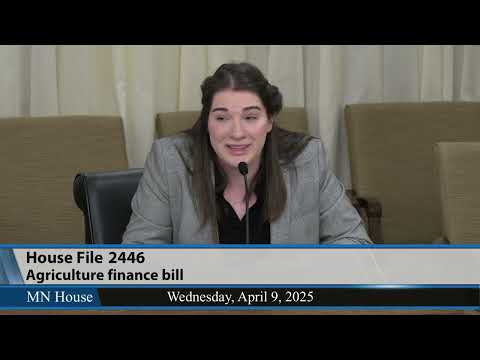
House file 2446 advances from Agriculture Committee after public testimony and technical amendments
Summary
The Agricultural Finance and Policy Committee adopted the DE4 amendment to House File 2446 and voted to re‑refer the bill to the House Ways and Means Committee after a hearing featuring state agency testimony, farmers, food‑bank leaders and industry representatives.
The Agricultural Finance and Policy Committee adopted the DE4 amendment to House File 2446 and voted to re‑refer the bill to the House Ways and Means Committee after a hearing that included public testimony from farmers, food‑bank leaders, industry representatives and state agency officials.
The committee, chaired by Chair Hansen, heard testimony supporting the bill’s operating adjustments for the Minnesota Department of Agriculture, increases to the agriculture emergency account and funding for meat inspection, farm safety and local food purchasing. Tom Peterson, Commissioner of the Minnesota Department of Agriculture, told the committee he “really appreciated the process” and said the bill includes several of the governor’s recommendations, including “operating adjustment to maintain services for MDA” and a “4,000,000 increase” to the agriculture emergency account.
The bill’s authors and supporters pointed to several provisions that backfill federal cuts and support agricultural infrastructure and markets. Hunter Peterson, public policy specialist for the Minnesota Farm Bureau Federation, said the DE4’s investments in the Board of Animal Health, the Ag Emergency Account and AgriProtect grants will “ensure Minnesota is positioned well to swiftly respond to these crises.” Stu Lohrey, government relations director for Minnesota Farmers Union, said the proposal expands markets, supports meat processing and funds farm safety and mental‑health programs.
Food‑bank leaders urged maintaining or increasing funds for state programs that buy Minnesota food for hunger relief. Vicky (Vicky) Witherspoon, executive director of Channel 1 Regional Food Bank, said the Farm to Food Shelf program helped food banks purchase “4,200,000 pounds of produce, 155,000 pounds of protein, and almost 300,000 gallons of milk” last year and warned that federal cancellations of meat and dairy deliveries have increased demand for state support. Susie Belter, executive director of North Country Food Bank, said her agency’s distributions rose nearly 20% last year and that program funding routinely runs out “a little more than halfway through the year.”
Several witnesses and committee members asked for adjustments or raised concerns. Testifiers and member comments highlighted: an increase in the farmland down payment assistance grant from $15,000 to $20,000 and repeated requests to extend the program’s six‑month spending window (testimony urged up to a year for grantees to secure financing); the proposed reduction to the soil health financial assistance program; and cuts to some dairy and green‑fertilizer initiatives noted by Farm Bureau testimony.
Committee members debated a statutory change in the DE4 that would broaden who may mix and load restricted‑use pesticides without holding an applicator certification. Representative Gottfried warned that “most of these accidents ... happen during the mixing and loading” phase and said the certification requirement is a worker protection. Representative Nelson responded that the bill references federal requirements (Code of Federal Regulations, title 40) for handlers and training standards, distinguishing a certified applicator from a handler who must receive training under federal rules.
A provision that drew industry attention would fund a $100,000 study related to incorrect utility locating marks. Amber Backus, representing USIC, questioned why the Department of Agriculture would oversee that study and whether the Minnesota Office of Pipeline Safety (MINOPS) would be a more appropriate lead given that agency’s excavation reporting and damage data.
The committee adopted two technical amendments before approving the DE4 as amended: A2 (adds a representative of a major wastewater facility to a related study) and A3 (clarifications and technical corrections recommended by department staff, including clarifying language on depredation account coverage and availability of Agri appropriations). Both amendments were adopted by voice vote. Representative Anderson moved that House File 2446, as amended and with the DE4, be re‑referred to the Ways and Means Committee; that motion carried by voice vote.
The committee directed nonpartisan staff to make technical corrections to conform to the committee’s intent and noted the possibility of reconvening if emergent issues (for example, avian influenza outbreaks) require updates from the department.
Votes at a glance: the committee approved the April 7 minutes, adopted A2 and A3 technical amendments, adopted the DE4 amendment to House File 2446, and approved sending the bill to Ways and Means. These actions were carried by voice vote; no roll‑call tallies were recorded in the transcript.
The bill now moves to Ways and Means. Committee members signaled willingness to continue negotiations—Representative Anderson and Representative Frederick indicated they would work on extending the farmland down payment spending window as the bill advances.