Get Full Government Meeting Transcripts, Videos, & Alerts Forever!
Get email alerts on the Human Services Budget topic
No spam. Unsubscribe anytime.
House committee reviews Human Services DE1 omnibus bill as providers warn of service cuts
Summary
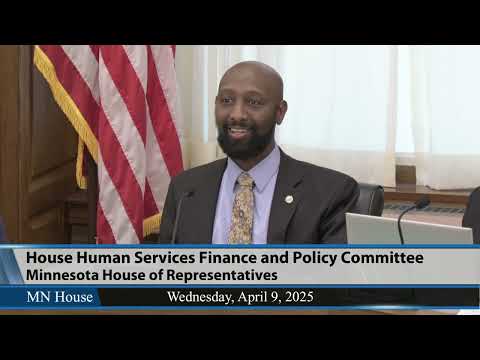
The House Human Services Finance and Policy Committee reviewed the DE1 version of House File 2,434 — the human services omnibus bill — in a public walkthrough and heard more than 40 public testimony speakers about proposed changes to nursing facility payments, disability waiver rates and behavioral health funding.
The House Human Services Finance and Policy Committee held a public walkthrough of the DE1 amendment to House File 2,434, the human services omnibus bill, including a line-by-line spreadsheet review and extensive public testimony. Committee co-chairs opened the meeting and nonpartisan staff presented the committee "spreadsheet" showing the House position and its changes from the governor's budget.
Why it matters: The DE1 document reconfigures Medicaid and Department of Human Services (DHS) spending across nursing facility payments, disability waiver services, behavioral health funding, housing supports and Direct Care and Treatment (DCT). Advocates, county officials and providers warned multiple proposed changes — including rate caps, removal of an "absence and utilization" factor and new county cost-sharing for certain rate exceptions — would reduce provider revenue, shift costs to counties and risk access to services for seniors, people with disabilities and people experiencing homelessness.
Committee discussion and staff walkthrough
Chair Schumacher moved the DE1 amendment onto the committee's docket and described the compressed timeline for this budget phase, saying, "We got 6 days to put an entire budget together. We were given an historic cut" and noting the amendment represented a first-phase direction rather than a final course. Nonpartisan fiscal staff then guided members through the official spreadsheet packet. Staff flagged a -$300,000,000 change in the House biennial column for 2026–27 and -$1,000,000,000 for 2028–29, and walked members through department-level line items covering DHS program integrity, nursing facility payment changes, investments in Community First Services and Supports (CFSS), and multiple house-file-specific provisions carried in the DE1.
Key provisions summarized by staff include: - Nursing facility changes: a surcharge fee increase and related shifts in the external fixed-cost payment rate; partial adoption of the governor's recommendation to phase in the PDPM case-mix classification system for nursing facilities; temporary rate adjustments tied to workforce standards established by the Nursing Home Workforce Standards Board. - Disability waiver system (DWRS/DWRS-related) changes: proposals to modify nursing-facility level-of-care criteria, add a county share for some waiver exceptions, remove the "absence and utilization" factor from certain rate calculations (which providers say functions as a practical revenue holdback for unbillable days), and cap future inflationary adjustments at 4% for some payments. - Behavioral health and substance use disorder (SUD) changes: rate adjustments based on a recent study, limits on Behavioral Health Fund eligibility to 60 consecutive days in some instances, new certification and oversight for recovery residences, and transition language for Tribal and direct payments for culturally specific providers. - Direct Care and Treatment (DCT) and PRTF items: funding for DCT IT/EHR projects, work-group language for locked PRTF services, and proposals affecting county shares of certain institutional costs. - Housing and homelessness: proposals temporarily increasing some housing support supplementary service rates, establishing emergency shelter facility grants and directing DHS to evaluate housing support background study requirements; the DE1 also contains language that would repeal certain statutory subdivisions for supplemental housing support that many supportive-housing providers said would jeopardize existing programs.
Public testimony and reactions
More than 40 people testified during the hearing. DHS Temporary Commissioner Shereen Gandhi said the bill contains "responsible reforms to address the projected budget shortfall and investments to improve people's lives," and noted the inclusion of several governor-prioritized items such as fraud-detection investments, funding for HIV prevention, and community first services and supports. Marshall Smith, CEO for Direct Care and Treatment, thanked the committee for the operating adjustment and funding for DCT's electronic health record work.
Provider organizations, counties and advocacy groups urged changes or raised concerns: - Disability-service providers and associations (ARM, MORE, Living All Disability Services, Residential Services Inc., and others) said removal of the "absence and utilization" factor would amount to a roughly 4% rate cut for many providers, worsen an already critical workforce shortage, and risk program closures and longer wait lists. - County officials and county associations warned that several provisions would shift substantial costs to counties (including increased county shares for certain institutional care and the proposed county share of some waiver rate exceptions) and could raise local property taxes. - Behavioral health and SUD providers urged explicit funding for high-intensity residential SUD services, and raised concerns about the proposed 60-consecutive-day limit on Behavioral Health Fund eligibility and the impact of eliminating freestanding room-and-board as a service category before alternative housing supports are fully established. - Supportive housing and homelessness service providers urged preservation or clarifying language for the housing-support supplemental services rate, warning the statutory changes as drafted could close existing programs that serve people experiencing long-term or high-barrier homelessness.
Formal motions and next steps
The committee approved the minutes from the April 8, 2025 meeting by voice vote after Representative Frederick moved adoption. Chair Schumacher moved the DE1 amendment onto the committee agenda for walkthrough and future amendment consideration; no final committee vote on the DE1 amendment occurred in this session. Committee chairs set an amendments deadline for 5 p.m. the same day and indicated further member discussion will occur the next day.
What remains unresolved
Several substantive policy and fiscal items were flagged as either under negotiation or requiring further work: the technical details and timelines for implementing nursing home workforce standards funding, the mechanics and guardrails for a proposed county share of waiver rate exceptions, the method and timing to transition recovery residences oversight and funding, and whether proposed cuts or rate changes will be offset by other appropriations before final action. Providers and counties asked for additional guardrails, transition funding, or phased implementation to avoid immediate service disruptions.
The committee's DE1 walkthrough brought into focus the competing priorities in a constrained biennial budget: targeted investments in program integrity and behavioral health, alongside proposed provider rate and administrative changes that stakeholders said would materially affect capacity and access for vulnerable Minnesotans. The bill will return to the committee later for member amendments and further deliberations.