Get Full Government Meeting Transcripts, Videos, & Alerts Forever!
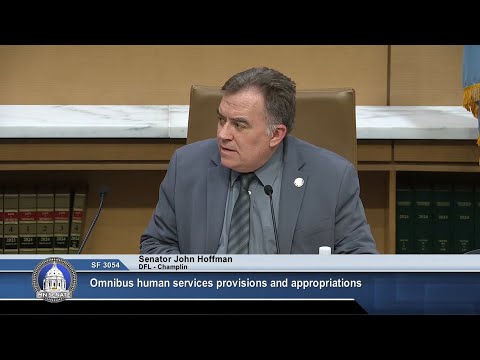
Senate Human Services committee advances SF3054 after daylong markup, adopts series of amendments
Summary
The Minnesota Senate Human Services Finance and Policy Committee on April 9 advanced Senate File 3054, the chamber’s human services omnibus bill, adopting a range of technical and policy amendments and sending the measure to the Senate Finance Committee for fiscal reconciliation.
ST. PAUL, Minn. — The Senate Human Services Finance and Policy Committee on Wednesday advanced Senate File 3054, the chamber’s human services omnibus bill, after several hours of testimony and a daylong series of technical and policy votes that added, removed or clarified program language and spending directions.
The committee began with a presentation from Shereen Gandhi, serving as temporary commissioner of the Minnesota Department of Human Services, who told members, “I’m pleased to see that your proposed bill includes both responsible reforms to address the projected budget shortfall, as well as investments that will improve people’s lives.” The panel heard more than two dozen testifiers representing providers, unions, county governments and advocacy groups before adopting a slate of amendments and re‑referring the omnibus to the Senate Finance Committee for fiscal reconciliation.
Why it matters: SF3054 contains a broad set of human services policy changes and budget language affecting Medicaid‑funded programs, disability waivers, nursing facility reimbursement, behavioral health access and local county cost shares. Committee discussion and public testimony repeatedly focused on the potential effects of rate changes and county cost shifts on vulnerable Minnesotans, workforce stability at long‑term care providers, and the trade‑offs the Legislature faces amid a projected state budget gap.
What the committee did and heard
- Department priorities and program changes: Commissioner Gandhi described the department’s priorities reflected in the bill, including funding to expand Community First Services and Supports (CFSS), implementation funding for a self‑directed workforce contract negotiated with SEIU Healthcare Minnesota, nursing home workforce standards implementation, and changes to waiver rate frameworks intended to use data to align reimbursement with costs. Gandhi also noted the department will continue to analyze the bill and provide technical feedback as it moves through the process.
- Key themes from testifiers: Providers and advocates largely praised some provisions while warning about others. Josh Berg, representing Trellis and Juniper partners, thanked the committee for including planning and infrastructure funding for community‑based social care and said the bill “is definitely a great place to start” but urged against delaying waiver reimagine. Mark Cullen of Trellis and dozens of coalition partners said early pilots in other states show potential savings, estimating a statewide demonstration could yield tens of millions in reduced medical costs. Providers serving people with disabilities raised concerns about changes to the Disability Waiver Rate System (DWRS), proposed limits on rate exceptions, and a proposed reduction in day‑service absence/utilization factors that some said equates to a 5–6 percent rate cut for day services.
- Counties and local government: County officials, including Stearns County Commissioner Terrell Clark and Stacy Hennen of Western Prairie Human Services, thanked the committee for some policy changes (for example, Min‑Choices reassessment streamlining) but warned that other provisions in the bill would shift costs to counties and ultimately raise property taxes for local residents. Clark said the bill’s shifts would “force counties like mine to, again, go to local taxpayers and increase their property taxes.”
- Nursing homes and long‑term care: Long‑term care associations and nursing home operators warned that proposed caps and new upper‑limit formulas would create substantial cuts to care‑related per diems and could threaten facility viability. Kyle Burnt of the Long Term Care Imperative said the committee’s draft reduces nursing facility funding by roughly $192 million, and testified that the combination of wage mandates, caps and rate timing creates serious short‑term cashflow and solvency risks for providers.
- Behavioral health and SUD providers: High‑intensity residential substance use disorder providers urged sustained or increased reimbursement, saying their current Medicaid rates leave programs operating with a shortfall. Lou Zeidner (Eosys/Meridian Behavioral Health) said the gap between cost and Medicaid reimbursement was currently about $60 per patient day for certain high‑needs residential SUD services.
- Program integrity and fraud detection: Several senators asked Commissioner Gandhi about whether the department could adopt new technologies, including AI/machine learning, to detect program fraud more effectively. Gandhi said the department sees “great opportunity with technology” but that the omnibus draft did not include additional funding for such technology.
Votes at a glance:
- A8 (replaced A1; appropriations article added): Adopted. Motion to withdraw A1 and offer A8 carried; committee adopted A8. (Mover: Chair Hoffman; outcome: approved) - A2 (technical fixes): Adopted. (technical change; outcome: approved) - A15 (base‑writer transparency language): Adopted. (Mover: Senator Abler; outcome: approved) - A32 (repealer and transfer language; cancels appropriation for safe recovery sites and cancels provider premium appropriation): Adopted. (outcome: approved) - A4 (Ware amendment — allows self‑direction of home care nursing under waiver reimagine): Adopted. (Mover: Senator Abler; outcome: approved) - A20 (disproportionate share study placeholder): Adopted. (Mover: Senator Abler; outcome: approved) - A26 (civil commitment working group extension & duties): Adopted. (outcome: approved) - A6 (local supportive housing for SUD in Otter Tail County; technical/targeted appropriation): Adopted. (Mover: Senator Utke/Otke;…
Already have an account? Log in
Subscribe to keep reading
Unlock the rest of this article — and every article on Citizen Portal.
- Unlimited articles
- AI-powered breakdowns of topics, speakers, decisions, and budgets
- Instant alerts when your location has a new meeting
- Follow topics and more locations
- 1,000 AI Insights / month, plus AI Chat