Get Full Government Meeting Transcripts, Videos, & Alerts Forever!
Get email alerts on the Human Services Omnibus topic
No spam. Unsubscribe anytime.
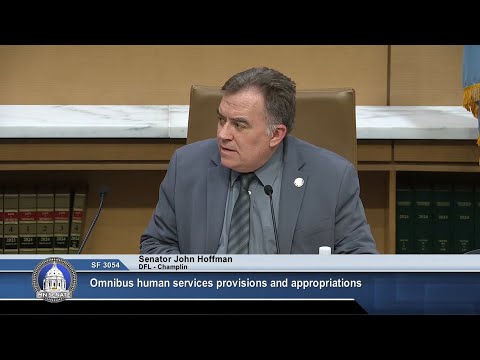
Senate Human Services committee advances SF3054 after daylong markup, adopts series of amendments
Summary
The Minnesota Senate Human Services Finance and Policy Committee on April 9 advanced Senate File 3054, the chamber’s human services omnibus bill, adopting a range of technical and policy amendments and sending the measure to the Senate Finance Committee for fiscal reconciliation.
ST. PAUL, Minn. — The Senate Human Services Finance and Policy Committee on Wednesday advanced Senate File 3054, the chamber’s human services omnibus bill, after several hours of testimony and a daylong series of technical and policy votes that added, removed or clarified program language and spending directions.
The committee began with a presentation from Shereen Gandhi, serving as temporary commissioner of the Minnesota Department of Human Services, who told members, “I’m pleased to see that your proposed bill includes both responsible reforms to address the projected budget shortfall, as well as investments that will improve people’s lives.” The panel heard more than two dozen testifiers representing providers, unions, county governments and advocacy groups before adopting a slate of amendments and re‑referring the omnibus to the Senate Finance Committee for fiscal reconciliation.
Why it matters: SF3054 contains a broad set of human services policy changes and budget language affecting Medicaid‑funded programs, disability waivers, nursing facility reimbursement, behavioral health access and local county cost shares. Committee discussion and public testimony repeatedly focused on the potential effects of rate changes and county cost shifts on vulnerable Minnesotans, workforce stability at long‑term care providers, and the trade‑offs the Legislature faces amid a projected state budget gap.
What the committee did and heard
- Department priorities and program changes: Commissioner Gandhi described the department’s priorities reflected in the bill, including funding to expand Community First Services and Supports (CFSS), implementation funding for a self‑directed workforce contract negotiated with SEIU Healthcare Minnesota, nursing home workforce standards implementation, and changes to waiver rate frameworks intended to use data to align reimbursement with costs. Gandhi also noted the department will continue to analyze the bill and provide technical feedback as it moves through the process.
- Key themes from testifiers: Providers and advocates largely praised some provisions while warning about others. Josh Berg, representing Trellis and Juniper partners, thanked the committee for including planning and infrastructure funding for community‑based social care and said the bill “is definitely a great place to start” but urged against delaying waiver reimagine. Mark Cullen of Trellis and dozens of coalition partners said early pilots in other states show potential savings, estimating a statewide demonstration could yield tens of millions in reduced medical costs. Providers serving people with disabilities raised concerns about changes to the Disability Waiver Rate System (DWRS), proposed limits on rate exceptions, and a proposed reduction in day‑service absence/utilization factors that some said equates to a 5–6 percent rate cut for day services.
- Counties and local government: County officials, including Stearns County Commissioner Terrell Clark and Stacy Hennen of Western Prairie Human Services, thanked the committee for some policy changes (for example, Min‑Choices reassessment streamlining) but warned that other provisions in the bill would shift costs to counties and ultimately raise property taxes for local residents. Clark said the bill’s shifts would “force counties like mine to, again, go to local taxpayers and increase their property taxes.”
- Nursing homes and long‑term care: Long‑term care associations and nursing home operators warned that proposed caps and new upper‑limit formulas would create substantial cuts to care‑related per diems and could threaten facility viability. Kyle Burnt of the Long Term Care Imperative said the committee’s draft reduces nursing facility funding by roughly $192 million, and testified that the combination of wage mandates, caps and rate timing creates serious short‑term cashflow and solvency risks for providers.
- Behavioral health and SUD providers: High‑intensity residential substance use disorder providers urged sustained or increased reimbursement, saying their current Medicaid rates leave programs operating with a shortfall. Lou Zeidner (Eosys/Meridian Behavioral Health) said the gap between cost and Medicaid reimbursement was currently about $60 per patient day for certain high‑needs residential SUD services.
- Program integrity and fraud detection: Several senators asked Commissioner Gandhi about whether the department could adopt new technologies, including AI/machine learning, to detect program fraud more effectively. Gandhi said the department sees “great opportunity with technology” but that the omnibus draft did not include additional funding for such technology.
Votes at a glance:
- A8 (replaced A1; appropriations article added): Adopted. Motion to withdraw A1 and offer A8 carried; committee adopted A8. (Mover: Chair Hoffman; outcome: approved) - A2 (technical fixes): Adopted. (technical change; outcome: approved) - A15 (base‑writer transparency language): Adopted. (Mover: Senator Abler; outcome: approved) - A32 (repealer and transfer language; cancels appropriation for safe recovery sites and cancels provider premium appropriation): Adopted. (outcome: approved) - A4 (Ware amendment — allows self‑direction of home care nursing under waiver reimagine): Adopted. (Mover: Senator Abler; outcome: approved) - A20 (disproportionate share study placeholder): Adopted. (Mover: Senator Abler; outcome: approved) - A26 (civil commitment working group extension & duties): Adopted. (outcome: approved) - A6 (local supportive housing for SUD in Otter Tail County; technical/targeted appropriation): Adopted. (Mover: Senator Utke/Otke; outcome: approved) - A19 (tightened documentation requirements for rate exceptions): Adopted. (outcome: approved) - A34 / A16 / other small appropriations and technical amendments: Several smaller amendments were considered, some adopted and some withdrawn; the committee adopted a set of targeted appropriations (see provenance and actions below). - Final motion: The committee adopted a motion to re‑refer SF3054 to the Senate Finance Committee for fiscal reconciliation and technical equalization. (Mover: Senator Fata; outcome: approved)
The committee’s roll calls were voice votes in most cases; the transcript records “all those in favor say aye… opposed same sign” for many amendments rather than recorded roll‑call tallies.
Major unresolved issues and reporter’s notes
- County cost shifts and local tax impacts: Multiple county officials and providers warned that shifting costs from state to counties would have immediate property tax consequences. The committee retained some of the proposal’s county cost share changes while rejecting larger proposals that would have pushed more costs to counties.
- Timing and implementation risk for wage mandates: Several witnesses noted that wage increases required by the Nursing Home Workforce Standards Board are often implemented first by provider hiring decisions, with reimbursement adjustments lagging 18–21 months later. Providers told the committee that caps or delayed rate changes could force facilities to borrow, reallocate reserves or cut services to meet immediate payroll needs.
- Program integrity funding: Committee members from both parties pressed the department on missing funding for advanced fraud‑detection technology. DHS said there is strong potential value in AI and machine learning tools but that the omnibus draft does not fund them.
- Federal approvals and interactions: Committee members and staff flagged that some program changes (for example, CFSS, DHS waiver changes and certain eligibility shifts) may require federal approval from CMS before changes could take effect. DHS told the committee it would pursue federal approvals where required.
What’s next
Committee leadership re‑referred the bill to Senate Finance for fiscal reconciliation and instructed staff to prepare updated fiscal targets and technical fixes based on the amendments adopted. Members said they plan to continue negotiations with the House and the governor’s office during conference and to refine fiscal notes and implementation language before final passage.
Quotes (attributed)
- Shereen Gandhi, Temporary Commissioner, Minnesota Department of Human Services: “I’m pleased to see that your proposed bill includes both responsible reforms to address the projected budget shortfall, as well as investments that will improve people’s lives.”
- Senator Paul Abler, Committee Member: “If we talk about cutting services to the most vulnerable people in the state of Minnesota… Those are life altering decisions.”
- Josh Berg, Trellis/Juniper partner: “Senate file 554 will be a legacy bill that will be looked back on and acknowledged as a catalyst for new and innovative approaches to how we serve older adults throughout Minnesota.”
- Victor Solberg, SEIU home care worker: “This contract will make things better. I’m excited about the $1,200 bonus that will be able to help with medical expenses.”
Speakers (attribution whitelist)
- Shereen Gandhi — Temporary Commissioner, Minnesota Department of Human Services (government: state agency) - Chair Hoffman — Chair, Senate Human Services Finance and Policy Committee (government: legislature) - Senator Abler — State Senator, committee member (government) - Senator Rasmussen — State Senator, committee member (government) - Senator Utke — State Senator, committee member (government) - Josh Berg — Representative, Trellis/Juniper and nonprofit (nonprofit) - Mark Cullen — Vice President, Trellis (nonprofit) - Brian Zervas — Executive Director, MARC (behavioral health / nonprofit) - Laurie Schluttenhofer — Opportunity Partners (nonprofit) - Victor Solberg — Home care worker, SEIU Healthcare Minnesota and Iowa (labor / worker) - Robert Freeman — Vice President of Public Policy, Alzheimer’s Association Minnesota‑North Dakota (nonprofit) - Dr. Lou Zeidner — CEO, Eosys (formerly Meridian Behavioral Health) (business/health provider) - Danny Ackerd — Minnesota Hospital Association (business/association) - Terrell Clark — Stearns County Commissioner (local government) - Stacy Hennen — Executive Director, Western Prairie Human Services (county/local provider) - John Sonnagard — Board member, Residential Providers Association of Minnesota (provider association) - Olga Shevoleva — Metropolitan Community Services (provider alliance) - Phoebe Tripp — Executive Director, Clare Housing (nonprofit housing provider) - Sean Burke — O’Connell Consulting / Minnesota Consortium of Citizens with Disabilities (advocacy) - Sarah Grafstrom — Association of Residential Materials (ARM) (provider association)
Authorities referenced (explicitly from the record)
- statute: "Chapter 611 (civil commitment)" — referenced in discussion of voluntary admissions and county obligations - policy: "Disability Waiver Rate System (DWRS)" — changes to rate formulas and exceptions - policy: "Minnesota Medical Assistance (MA) program" — program references for coverage/eligibility - policy: "Nursing Home Workforce Standards Board rules" — minimum wage and staffing standard implementation discussed - other: "Senate File 3054" — human services omnibus bill under markup
Actions (formal motions / outcomes captured in the transcript)
- {"kind":"motion","identifiers":{"agenda_item_id":"A8"},"motion":"Withdraw A1 and replace with A8 (appropriations included)","mover":"Chair Hoffman","second":"not specified","vote_record":[],"tally":{},"outcome":"approved","notes":"A8 adopted by voice vote"}
- {"kind":"motion","identifiers":{"agenda_item_id":"A2"},"motion":"Technical corrections to A8 (A2)","mover":"not specified","second":"not specified","vote_record":[],"tally":{},"outcome":"approved","notes":"A2 adopted by voice vote"}
- {"kind":"motion","identifiers":{"agenda_item_id":"A15"},"motion":"Adopt A15 (base‑writer / transparency) ","mover":"Senator Abler","second":"not specified","vote_record":[],"tally":{},"outcome":"approved","notes":"A15 adopted by voice vote"}
- {"kind":"motion","identifiers":{"agenda_item_id":"A32"},"motion":"Adopt A32 (repealer: cancels provider premium appropriation; transfers)","mover":"Senator Rafferson","second":"not specified","vote_record":[],"tally":{},"outcome":"approved","notes":"A32 adopted by voice vote"}
- {"kind":"motion","identifiers":{"agenda_item_id":"A4"},"motion":"Adopt A4 (allow self‑direction of home care nursing under waiver reimagine)","mover":"Senator Abler","second":"not specified","vote_record":[],"tally":{},"outcome":"approved","notes":"A4 (Ware amendment) adopted"}
- {"kind":"motion","identifiers":{"agenda_item_id":"A20"},"motion":"Adopt A20 (disproportionate share study placeholder)","mover":"Senator Abler","second":"not specified","vote_record":[],"tally":{},"outcome":"approved","notes":"A20 adopted"}
- {"kind":"motion","identifiers":{"agenda_item_id":"A26"},"motion":"Adopt A26 (extend/expand duties of civil commitment reform task force)","mover":"Senator Abler","second":"not specified","vote_record":[],"tally":{},"outcome":"approved","notes":"A26 adopted"}
- {"kind":"motion","identifiers":{"agenda_item_id":"A6"},"motion":"Adopt A6 (supportive housing expansion for SUD in Otter Tail County)","mover":"Senator Utke","second":"not specified","vote_record":[],"tally":{},"outcome":"approved","notes":"A6 adopted"}
- {"kind":"motion","identifiers":{"agenda_item_id":"A19"},"motion":"Adopt A19 (rate exception documentation / fairness clarifications)","mover":"Senator Utke","second":"not specified","vote_record":[],"tally":{},"outcome":"approved","notes":"A19 adopted"}
- {"kind":"motion","identifiers":{"agenda_item_id":"final"},"motion":"Re‑refer SF3054 to Senate Finance Committee for fiscal reconciliation and technical equalization","mover":"Senator Fata","second":"not specified","vote_record":[],"tally":{},"outcome":"approved","notes":"Motion carried by voice vote, bill sent to Finance"}
Discussion vs. decision
- Discussion points included program funding trade‑offs, county cost shifts, nursing home rate caps and timing, behavioral health fund administration, fraud‑detection technology, and the effect of DWRS changes on providers and recipients. - Directions/assignments: Committee instructed staff to prepare updated fiscal targets and technical edits and re‑referred the measure to the Finance Committee for fiscal equalization. - Formal actions: Multiple technical and policy amendments were approved by voice vote; final action re‑referred SF3054 to Finance.
Clarifying details (extracted from testimony)
- "County shifts" figure cited in committee testimony: $460,000,000 (Senator Abler referenced larger shifts in other proposals; numbers differ among proposals and were described as "notable" in testimony). (source: Commissioner and Senator Abler comments) - EIDBI investment referenced by Senator Abler: $24,000,000 (committee testimony) - Potential preliminary savings example cited by Trellis: applying a North Carolina pilot’s $85 per member per month to ~124,000 older Minnesotans could yield roughly $126,480,000 in first‑year savings (speaker provided illustrative calculation) - SUD high‑intensity residential gap: roughly $60 per patient day shortfall cited by a provider executive (Lou Zeidner) - Nursing home workforce standards board: referenced $19/hr industry wide minimum wage in 2026 and additional step increases for CNAs/LPNs in testimony about wage standards implementation (witness testimony referencing board rules)
Proper names (normalized)
[{"name":"Minnesota Department of Human Services","type":"agency"},{"name":"Governor Tim Walz","type":"person"},{"name":"Lieutenant Governor Peggy Flanagan","type":"person"},{"name":"SEIU Healthcare Minnesota","type":"organization"},{"name":"Trellis","type":"organization"},{"name":"Juniper","type":"program"},{"name":"Opportunity Partners","type":"organization"},{"name":"Occupational Providers Association of Minnesota (RPMN)","type":"organization"},{"name":"Eosys (formerly Meridian Behavioral Health)","type":"organization"},{"name":"Anoka Metro Regional Treatment Center (DCT)","type":"facility"},{"name":"Clare Housing","type":"organization"},{"name":"Residential Providers Association of Minnesota","type":"organization"},{"name":"Minnesota Consortium of Citizens with Disabilities (CCD)","type":"organization"}]
Community relevance
- Geographies: Minnesota statewide with emphasis on Greater Minnesota, Stearns County, Traverse County, Grant County, Pope County, Anoka/Anoka Metro region - Funding sources mentioned: State general fund, Medical Assistance (Medicaid/MA), behavioral health grants, county property tax revenues - Impact groups: older adults, people with disabilities, nursing facility residents, people with substance use disorders, home care workers, counties/taxpayers
Meeting context
- Engagement level: high — multiple hours of testimony, dozens of testifiers, and many amendments discussed; committee transcript indicates roughly 200 minutes of proceedings - Implementation risk: medium to high — several provisions will need administrative rulemaking, federal CMS approvals, or additional fiscal offsets to implement without harming provider solvency - History: Committee and witnesses referenced prior sessions and previous legislation (waiver reimagine, nursing workforce board rules, earlier appropriations and pilots)
Searchable tags
["SF3054","human services","Medicaid","DWRS","nursing homes","behavioral health","county cost shifts","fraud detection","home care nursing","CFSS"]
Provenance (evidence spans from committee transcript)
{"transcript_segments":[{"block_id":"transcript_block_0001","local_start":0,"local_end":140,"evidence_excerpt":"services committee, Wednesday, April ninth. It is our, discussion and markup. Members, you should have in front of you, senate file 3 0 5 4","reason_code":"topicintro"},{"block_id":"transcript_block_0120","local_start":11920,"local_end":12032,"evidence_excerpt":"With that, all those in favor say aye. Aye. Oppose same sign. Thank you. We are adjourned.","reason_code":"topicfinish"}]}
Salience
{"overall":0.85,"overall_justification":"The bill is the chamber’s human services omnibus and affects Medicaid, disability waivers, nursing home reimbursement, behavioral health and county budgets; it has wide policy and budgetary impact for Minnesota.","impact_scope":"state","impact_scope_justification":"Changes affect statewide programs, providers and county budgets.","attention_level":"high","attention_level_justification":"Broad budget implications and vocal stakeholder engagement; will draw continued media and legislative attention.","novelty":0.4,"novelty_justification":"Many changes are fiscal trade‑offs rather than brand‑new policy concepts; some new technical fixes and language clarifications were adopted.","timeliness_urgency":0.9,"timeliness_urgency_justification":"The bill addresses an immediate budget gap for the biennium and must be reconciled before final adoption.","legal_significance":0.6,"legal_significance_justification":"Alters statutory program eligibility language and tasks a task force; some changes may require federal approvals.","budgetary_significance":0.8,"budgetary_significance_justification":"Includes appropriations, program cuts and cost shifts that materially affect the biennial budget and county fiscal exposure.","public_safety_risk":0.3,"public_safety_risk_justification":"Indirect public‑safety implications exist for behavioral health and nursing facility capacity but immediate risk is limited to service availability concerns.","environmental_impact":0.01,"environmental_impact_justification":"Not applicable.","affected_population_estimate":124000,"affected_population_estimate_justification":"Speakers used the population of older Minnesotans in certain products (~124,000) as an illustrative example for potential savings; many program changes affect multiple thousands statewide.","affected_population_confidence":0.5,"affected_population_confidence_justification":"Estimate drawn from testimony examples rather than a complete fiscal model.","budget_total_usd":192000000.0,"budget_total_usd_justification":"Witnesses and provider groups cited a potential aggregate effect on nursing facility funding of roughly $192 million in the committee draft; numbers vary across versions.","decision_deadline":"2025-05-??","decision_deadline_justification":"Bill must be reconciled during the session/conference process; exact final deadline depends on the legislature calendar.","policy_stage":"committee","policy_stage_justification":"The bill was marked up and re‑referred to the Finance Committee for fiscal reconciliation.","follow_up_priority":1,"follow_up_priority_justification":"High fiscal and programmatic consequences require monitoring in Finance and conference committee.","fact_check_risk":0.3,"fact_check_risk_justification":"Many numeric claims were made by witnesses (savings estimates, cut totals, county shift amounts) that require verification against official fiscal notes.","uncertainty":0.6,"uncertainty_justification":"Multiple moving pieces, pending fiscal notes, and possible federal approvals create implementation uncertainty.","source_diversity":0.8,"source_diversity_justification":"Testimony included state agency, provider associations, unions, county officers and advocacy groups.","stakeholder_balance":0.6,"stakeholder_balance_justification":"The committee heard viewpoints from government, counties, providers, labor, and advocates though providers and county representatives dominated public testimony.","alert_flags":["large_budget","public_safety","equity"]}
Engagement forecast
{"newsworthiness":{"national":0.10,"regional":0.35,"local":0.85,"justification":"Primarily a state/local matter with significant local impact; limited national interest except on issues like Medicaid cuts or large precedent policy changes."},"notify_recommendation":{"audience":"state","reason":"High state budget impact and multiple constituencies affected (counties, providers, people on waivers); recommend notifying state policy and local government reporters."},"notify_thresholds":{"local_min":0.5,"regional_min":0.7,"national_min":0.9},"predicted_interest":{"national":0.10,"regional":0.35,"local":0.85,"justification":"Local/regional outlets and policy reporters will have most interest."},"predicted_click_through":0.18,"predicted_read_time_minutes":3.5,"predicted_shares":40}
Graph signals
{"jurisdictions":["US-MN"],"ontology_topics":["health care","human services","budget","housing","behavioral health"],"naics_codes":[],"sdg_tags":[],"entities":[{"id":"dhs","name":"Minnesota Department of Human Services","type":"agency"}],"events":[]}