Get Full Government Meeting Transcripts, Videos, & Alerts Forever!
Get email alerts on the Transportation Omnibus Sf2082 topic
No spam. Unsubscribe anytime.
Senate committee hears testimony on transportation omnibus bill; restores limited rail funding and reduces bridge barrier allocation
Summary
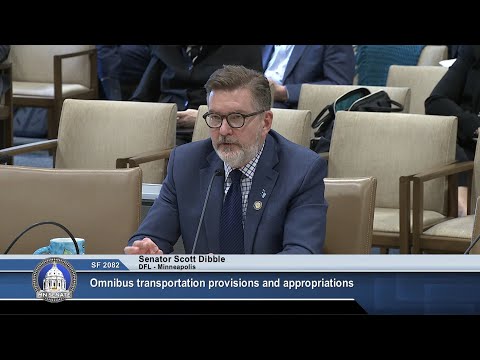
The Minnesota Senate Transportation Committee met April 9, 2025, to hear testimony and consider Senate File 2082, the transportation omnibus bill; witnesses from MnDOT, DPS, local governments and advocacy groups addressed funding, safety and delivery; the committee adopted several amendments, restored partial funding for the Northern Lights Express on a 6-5 roll call and reduced the Washington Avenue Bridge barrier appropriation to $9 million.
ST. PAUL, Minn. — The Minnesota Senate Transportation Committee met April 9, 2025, in Room 1100 of the State Senate Building to hear testimony on Senate File 2082, the transportation omnibus bill, and to consider technical and policy amendments. Witnesses from the Minnesota Department of Transportation and the Department of Public Safety, transit agencies, cities and several advocacy groups spoke on funding choices, safety programs and project delivery. After public testimony and debate the committee adopted multiple amendments, voted in favor of one roll-call amendment to partially restore passenger-rail funding, reduced the Washington Avenue Bridge barrier appropriation and laid the bill on the table as amended for further work.
The omnibus bill would add operating adjustments for state agencies, authorize trunk-highway bonding and change several revenue and appropriation provisions that affect highway, transit and airport programs. Committee members heard consistent themes from agency witnesses about balancing capital investments with operations and maintenance and from the public about suicide-prevention barriers and passenger-rail priorities.
“The bill provides important investments to help construct, operate, and maintain Minnesota's transportation system in challenging times,” Minnesota Department of Transportation Commissioner Nancy Daubenberger told the committee. She said the department appreciated inclusion of many MnDOT initiatives, including operating adjustments and a proposed $100 million trunk-highway bonding authorization, but raised concerns that redirecting identified efficiency savings into the Corridors of Commerce program “effectively reduces the existing state road construction program by about $90,000,000 per year.” She also said roughly $15,000,000 of the identified efficiencies comes from operations and maintenance and that shifting those dollars could reduce services MnDOT now provides.
Cassandra O’Hearn, deputy commissioner of the Department of Public Safety, told senators the agency’s top priority was the operating adjustment. “It pays salaries, rent, IT costs, and was proposed as a measured request,” she said, and thanked the committee for including the governor’s recommended adjustment. O’Hearn also urged the committee to reconsider adding increased statutory penalties for high-speed driving and asked lawmakers to consider funding for a new state patrol headquarters.
Public and stakeholder testimony emphasized safety, transit and project-delivery concerns. Eric Michie, CEO of SAVE (Suicide Awareness Voices of Education), thanked the committee for a provision that funds barriers on the Washington Avenue Bridge and described barriers as “an extraordinary investment in saving lives.” MJ Weiss Blair, who identified herself as a parent who lost a child at the bridge, urged members to act: “It is now our collective obligation to take action to solve this problem,” she said.
Multiple speakers, including transit advocates and local officials, urged the committee to preserve funding for transit operations and passenger rail. Several witnesses — including Move Minnesota and residents — voiced concern about a proposed cancellation of state match dollars for the Northern Lights Express (NLX) passenger-rail project. Opponents of the cut argued the state would lose momentum and federal opportunities if the match dollars were rescinded; MnDOT said it was coordinating with the Federal Railroad Administration and had an active grant application.
The committee considered and adopted numerous amendments during the meeting. Technical and noncontroversial fixes (A26, A30, A35) were adopted by voice. The committee adopted amendments to maintain and expand microtransit and advisory-council authorities (A15, A27) and adopted a staff-written technical amendment clarifying transfers and appropriations. Senator Dibble offered an amendment that reduced the appropriation for Washington Avenue Bridge barrier work from $15,000,000 to $9,000,000 (A14); the chair said the $9,000,000 figure reflected updated project estimates and coverage for temporary barriers while permanent work is completed, and the amendment was adopted by the committee. Another amendment (A38) removed an e-bike rebate provision from the omnibus so it could be considered separately in tax committee hearings; A38 was adopted.
Senator McKeown offered an amendment (A28) to restore a portion of the prior appropriation for the Northern Lights Express and to add a small amount for corridor development for a separate Big Sky/North Coast passenger-rail corridor. The committee adopted that amendment on a roll-call vote: the clerk announced 6 ayes and 5 noes and the motion carried. The committee record lists the vote tally as 6-5; the clerk announced the result and the motion was adopted. The committee also laid Senate File 2082, as amended, on the table and scheduled a brief reconvening at 5:30 p.m. Thursday to finish work.
Committee members and witnesses stressed limits on local authority and the effect of transfers on other programs. MnDOT noted the omnibus includes no changes to aircraft registration rates and said it estimates significant airport funding needs statewide. Multiple witnesses requested clearer transparency for how identified efficiency savings would be applied.
The committee’s action kept the bill alive with several policy shifts: reduced dedicated funding for certain transit and highway accounts in later years, a reallocation of some efficiency savings to the Corridors of Commerce program, a lower appropriation for the Washington Avenue Bridge safety project than earlier drafts, and a partial restoration of Northern Lights Express matching funds. Committee members said they would continue work on outstanding details when they reconvened.
The committee record shows the session recessed after the bill was formally laid on the table; senators instructed members to return for a 5:30 p.m. continuation. No final passage vote on the omnibus occurred at the hearing. The text and adopted amendments will be subject to additional committee and floor action in coming days.
Key quotes from the record:
“The bill provides important investments to help construct, operate, and maintain Minnesota's transportation system in challenging times.” — Nancy Daubenberger, Commissioner, Minnesota Department of Transportation.
“Top priority for the department was our operating adjustment. It pays salaries, rent, IT costs, and was proposed as a measured request.” — Cassandra O’Hearn, Deputy Commissioner, Minnesota Department of Public Safety.
“We are very grateful for including in this bill $15,000,000 for permanent and temporary barriers on the Washington Avenue Bridge.” — Eric Michie, CEO, SAVE (Suicide Awareness Voices of Education).
“It is now our collective obligation to take action to solve this problem.” — MJ Weiss Blair, family member and advocate for Washington Avenue Bridge safety.
The committee will reconvene at 5:30 p.m. Thursday to continue markup of Senate File 2082.