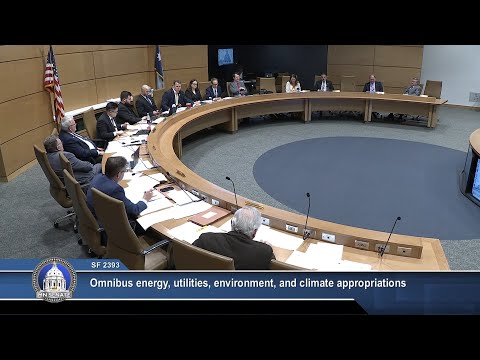
Senate committee forwards omnibus energy bill after hours of amendments; key data center, low‑income and solar provisions debated
Loading...
Summary
The Minnesota Senate Energy, Utilities, Environment and Climate Committee on April 9 debated dozens of amendments to the omnibus energy and finance bill, Senate File 2393, adopting several technical and procedural changes while rejecting multiple proposed guardrails for data centers, backup generation and distributed solar; the committee voted 9–2 to send the bill, as amended, to the Finance Committee.
The Minnesota Senate Energy, Utilities, Environment and Climate Committee on April 9, 2025, debated the omnibus energy policy and finance bill (Senate File 2393) for roughly three hours and voted to send the bill, as amended, to the Senate Finance Committee.
Why it matters: The omnibus bill touches multiple policy areas — from protections for low‑income energy assistance recipients to definitions of eligible renewable resources, rules for backup generation at data centers, and changes to distributed generation programs such as net metering and community solar. Lawmakers and stakeholders said the bill’s provisions will affect rural electric cooperatives, municipal utilities, low‑income households and future data‑center investment in Minnesota.
The committee convened at about 12:35 p.m. Chair Senator France presided; a quorum was present. Committee staff and members walked through scores of member amendments. Mr. Mueller, committee staff, explained several technical changes and appropriations during the hearing.
Low‑income assistance: A technical, definitional amendment offered by Senator Scott Dibble was adopted. The A4 amendment removes automatic links between state program eligibility and federal definitions for programs such as LIHEAP (Low Income Home Energy Assistance Program) and HUD thresholds so that Minnesota programs retain eligibility criteria if federal programs or staffing change. Senator Dibble described the amendment as “providing definitions for qualification for programs that exist in Minnesota already.” The chair indicated he intended to support A4; the amendment was adopted by the committee.
Data centers and backup generation: Committee members engaged in extended debate over several amendments that would alter how backup generation, certificate of need exemptions, siting and other rules apply to data centers. Senator Tom B. (chief author on related data center language, referred to in committee as Senator Matthews) said stakeholders were continuing negotiations and that some language in the omnibus was intentionally partial to allow further work.
Key data‑center items debated but not adopted included: - Site‑specific or zoning limits requiring data centers be sited in industrial districts (A5, not adopted). - Limiting a certificate‑of‑need exemption to a specific Becker site (A6, not adopted). - Strict limits on diesel backup generator hours (A7 proposed a 50‑hour annual cap unless the grid is down; not adopted). - Tying certificate‑of‑need exemptions to guaranteed job counts or wages (A9, not adopted). - A 1,500‑foot setback from residences for data‑center construction (A19, not adopted).
Committee debate repeatedly returned to whether the Public Utilities Commission (PUC) and local zoning should retain roles in siting and emergency determinations. Senator McEwen and others argued for clearer emergency‑use language; Senator Matthews said Minnesota rules (members cited the 7,007 series of rules during the hearing) contain limiting language and that stakeholder work was ongoing. Most data‑center amendments offered on the floor failed; the chair and several members repeatedly said they planned additional negotiation outside the hearing.
Large hydro: Chair France proposed and briefly obtained adoption of an amendment (A8) that would have removed a proposed change to the statutory definition of “large hydro.” That A8 vote was initially recorded in committee as adopted (a 6–5 roll call). Senator Hoffman later moved to reconsider; on the revote the A8 amendment failed (5–6), so the original statutory language remained in the bill.
Backup generation policy and B100: The bill includes a provision referred to in committee as “B100,” described by the chair as a position favored by some Minnesota members and stakeholders to allow cleaner backup/peaking generation for reliability when other power is unavailable. Committee members asked about an existing Pollution Control Agency 400‑hour per year cap and how the bill’s provisions would interact with that limit; the chair and several members said the intent was to allow limited backup while encouraging cleaner options.
Distributed generation, net metering and community solar: Committee members debated multiple amendments affecting distributed solar programs, net metering compensation and the community solar garden program. Highlights: - A15 (eliminate the bill’s net‑metering changes) was offered by Senator Dibble and not adopted; the chair framed the bill as targeting overbuilding and preserving ability for customers to size arrays for on‑site use. - A17 (clarify that grandfathering applies to interconnection application date, not operation date) was adopted to protect projects already in process from sudden rule changes. - A23 (permit meter aggregation for multi‑meter customers so farm and multi‑meter operations receive correct bill credits) was adopted. - A14 (remove the bill’s sunset of the community solar garden program) was offered by Senator Jeong and not adopted after division.
Renewable Development Account (RDA) and returns to ratepayers: Senator Green offered an amendment (A25) that would have redirected some RDA balances back to ratepayers as credits; the amendment was debated at length. Committee staff advised the group that removing section 8 of the amendment (an explicit general‑fund backfill) would avoid an immediate general‑fund cost; committee members modified the amendment orally to remove the appropriation language and then adopted A25 as amended. Senator Green said the account balance figures discussed in committee were approximate.
Other energy‑source and REC debates: Multiple offers to remove or limit biomass or refuse‑derived fuel from renewable or carbon‑free counting (A24, A21, and related amendments) were discussed and ultimately not adopted; proponents argued the PUC docket considering which fuels should count is the appropriate forum for those technical decisions. Senator Dibble and others urged caution before carving exceptions into the state’s carbon‑free or renewable definitions.
Process and disposition: After debate and roll calls on several items, the committee approved a motion (roll call) to recommend Senate File 2393, as amended, be sent to the Committee on Finance with staff empowered to make technical changes. The final committee roll call on that motion was 9 yes, 2 no. Chair France adjourned the committee at the end of the hearing.
Votes at a glance (key amendments and final vote) - A10 (technical/MMB transfer language) — offered by Senator Klein; adopted (voice vote). - A4 (delink LIHEAP/HUD definitions; preserve state eligibility definitions) — offered by Senator Dibble; adopted (voice vote). - A27 (extend appropriation to 6/30/2026 for the tribal/advocacy council on energy; $300,000 previously appropriated) — offered by Senator Hoffman; adopted (voice vote). - A8 (remove change to large‑hydro definition) — initially adopted by roll call (6–5), later reconsidered and on revote failed (5–6); net outcome: not adopted. - A5 (require data centers be sited in industrial districts) — offered by Senator McEwen; not adopted (division/failed). - A6 (limit certificate‑of‑need exemption to Becker site) — offered by Senator McEwen; not adopted. - A7 (limit diesel backup to 50 hours/year except outages; PUC review for cost‑saving use) — offered by Senator McEwen; not adopted (division). - A9 (tie certificate‑of‑need exemption to minimum job guarantees) — offered by Senator McEwen; not adopted. - A19 (prohibit data centers within 1,500 feet of residences) — offered by Senator Dibble; not adopted. - A21 (biodiesel carve‑in/out language) — offered by Senator Dibble; not adopted. - A24 (remove biomass/refuse‑derived fuel from eligible resources) — withdrawn and later reoffered; not adopted. - A23 (allow meter aggregation for multi‑meter customers) — offered by Senator Dibble; adopted. - A17 (grandfather by interconnection application date, not operation) — offered by Senator Dibble; adopted. - A25 (redirect RDA balances to ratepayer credits, as amended orally to remove a specific general‑fund appropriation) — offered by Senator Green; adopted as amended (roll call after oral amendment). - A13 (allow certain forest residues to be used) — offered by Senator Rehrig; adopted (roll call). - A11 (exclude co‑ops/munis from 2040 mandate) — offered by Senator Gruenhagen; not adopted (roll call). - A12 (clarify the 100% by 2040 requirement does not apply to out‑of‑state generation) — offered by Senator Matthews; not adopted (roll call). - A14 (preserve community solar garden program / remove sunset) — offered by Senator Jeong; not adopted (division). - Final disposition: Committee recommended Senate File 2393 as amended be sent to the Committee on Finance with staff empowered to make technical changes — passed on roll call, 9 yes, 2 no.
What’s next: The bill will advance to the Senate Finance Committee for further consideration. Committee members said several issues raised in the hearing — data‑center siting and certificate‑of‑need language, backup generation limits, community solar timing and federal funds, and which fuels count as carbon‑free — will require additional negotiation among authors, the PUC and stakeholders.
Ending: After the final vote the chair adjourned the committee.