Get Full Government Meeting Transcripts, Videos, & Alerts Forever!
Get email alerts on the Jobs Omnibus Sf1832 topic
No spam. Unsubscribe anytime.
Senate jobs omnibus (SF1832) advanced from committee with technical fixes, smaller pilots and funding adjustments
Summary
The Senate Committee on Jobs and Economic Development on April 9 marked up Senate File 1832, the jobs omnibus, adopting technical fixes, restoring previously allocated funds and approving smaller pilot grants for a licensure-prep program. The bill was recommended to Finance as amended.
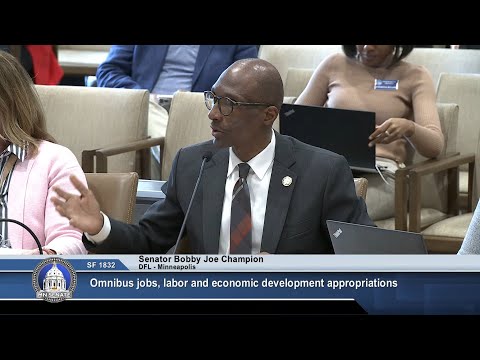
The Senate Committee on Jobs and Economic Development on Wednesday, April 9, voted to recommend passage of Senate File 1832, the jobs omnibus bill, sending it to the Finance Committee after adopting a series of technical changes, funding restorations and pilot program modifications.
The markup produced several adopted changes the committee described as technical and fiscal cleanups, including an amendment to lower the community wealth-building loan minimum from $50,000 to $10,000 and an inserted instruction to the Department of Employment and Economic Development (DEED) regarding relocation grants for butcher shops. The committee also adopted a delayed-enactment amendment to push a new provision on plant-based products out to July 1, 2027.
Why it matters: SF1832 packages multiple workforce and economic development items that will shape how state workforce funds are allocated and how pilot programs are structured. The committee’s actions determine which provisions move to floor-level negotiation and which require further fiscal committee work.
Most important outcomes
- A10 (technical package): Adopted. Committee staff said the A10 amendment corrected technical language to align the bill text with the change-only spreadsheet, clarified reporting exemptions for specific workforce recipients (including a University of Minnesota hospitality program), and restored language for multiple small appropriations.
- Community wealth loan minimum: The committee lowered the minimum loan amount for the community wealth-building program from $50,000 to $10,000 as part of the A10 package.
- Relocation grants for butcher shops: Language directing DEED about relocation grants for butcher shops was added in A10.
- Prepare Minnesota (licensure/test-prep) pilot: The committee considered a larger funding request but accepted a $250,000 pilot amendment (A9) that narrows the pilot’s scope to one University of Minnesota campus, one Minnesota State campus and dislocated workers, and requires reporting on exam types and counts. Senator Jenise Gustafson, who sponsored the Prepare Minnesota proposal, said the program is intended to reduce financial barriers to professional licensure testing, noting, “These tests are expensive. Sometimes you have to take several of them.”
- Funding restorations (A11/A12): The committee adopted amendments to restore money that members said had been previously allocated; DEED’s government relations director, Devon Bowdre, told the committee that the relevant 21st Century Fund balance was “somewhere in the range of $75,000,000.” Committee members said those allocations will be revisited in Finance for final funding sources.
- Plant-based products enactment delay (E3): Adopted; the committee kept the bill language but delayed the effective date to July 1, 2027 to allow additional stakeholder work.
Votes at a glance
- A10 (technical/clarifying amendment): adopted (voice vote). - A4 (require paid family and medical leave call-center staffing on Jan. 1): failed (roll-call; committee reported tally: 4 no, 3 yes). - A8 (Prepare Minnesota, larger funding request): failed (4-4 tie). - A9 (Prepare Minnesota, $250,000 pilot with reporting): adopted (voice vote after oral amendments and an added reporting requirement). - A11 (restore prior allocation): adopted (voice vote). - A12 (restore prior allocation): adopted (voice vote). - E3 (delay enactment for plant-based products): adopted (voice vote). - A14 (require call center staffing Dec. 15–Jan. 1 — amendment to a call-center staffing amendment): failed on roll call (4–4 tie). - Final: Committee recommended SF1832, as amended, to pass and be re-referred to the Committee on Finance (voice vote).
Discussion and context
Members described many of the changes as technical and aimed at matching bill text to the department and fiscal spreadsheets. Nonpartisan staff and DEED staff answered questions about appropriations and statutory versus direct appropriations; committee fiscal staff (Miss Noldner) explained that the change-only spreadsheet records differences against the February forecast and that some funding in the bill relies on existing statutory appropriations rather than new direct appropriations.
Committee leadership repeatedly said that where a fund was used as a placeholder in committee, the final funding source would be resolved in Finance. Senator Sarah Champion, who led the markup in committee, said after the vote, “the bill will now move from here to Finance.”
What’s next
SF1832 will move to the Senate Finance Committee for consideration of fiscal adjustments and final funding sources. Several members said they expect additional cleanup language and potential funding-source changes during finance and conference negotiations.
Ending note
Committee members agreed the bill contains programs they viewed as supportive of workforce development but noted that finance committee work will be required to finalize precise fund sources and some statutory language.