Get Full Government Meeting Transcripts, Videos, & Alerts Forever!
Get email alerts on the Public Meetings Law topic
No spam. Unsubscribe anytime.
Benton County planning commissioners receive training on public‑meetings law, conflicts and quasi‑judicial process
Summary
At a work session the Benton County Planning Commission heard a training presentation from attorney Ross Williamson and County Counsel Vance Koning covering the 2023 changes to Oregon's public meetings law (House Bill 2805), conflict‑of‑interest rules, ex parte contacts and the quasi‑judicial decision process.
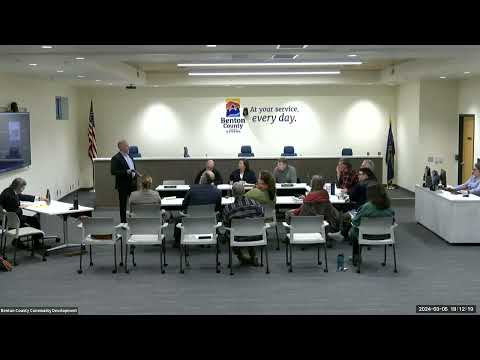
BENTON COUNTY — At a work session of the Benton County Planning Commission, commissioners spent more than two hours in a training session on public‑meetings rules, conflict‑of‑interest law and the quasi‑judicial procedure they apply when deciding land‑use applications. Ross Williamson, an attorney with the Local Government Law Group in Eugene, led the session with frequent legal clarifications from County Counsel Vance Koning and procedural context from Community Development Director Darren Nichols.
The session focused on House Bill 2805, passed by the Oregon Legislature in 2023, which codified statutory definitions for "convening" and "deliberation" in the state's public‑meetings law (sometimes called the "sunshine law"). Williamson summarized the intent behind those changes and warned against informal serial communications among members that could be treated as a meeting. "Government was supposed to take place in the sunshine," Williamson said, describing the statutory effort to make exchanges such as emails, texts or intermediary communications subject to meeting rules when they amount to deliberation.
Williamson and Koning reviewed three statutory exceptions to the meeting definition that can be lawful: communications that are purely factual or educational and involve no deliberation; gatherings about topics that are not reasonably foreseen to come before the governing body; and administrative, non‑substantive communications such as scheduling. They also described the new training and complaint process that the Oregon Government Ethics Commission (OGEC) will administer under HB 2805.
The presenters walked commissioners through conflict‑of‑interest rules that apply to officials, relatives and businesses with which an official is associated. Williamson distinguished an "actual" conflict (an action before the commission that will result in a predictable financial benefit or detriment to an official, relative or associated business) from a "potential" conflict (a matter that could result in a financial effect but where the outcome is not determinative). He advised commissioners to raise questions to counsel and staff ahead of meetings and, when an actual conflict exists, to state its nature on the record before abstaining from deliberation or vote.
The training also addressed ex parte contacts (oral, written or visual communications outside the public record) and site visits. Williamson and Koning told commissioners that any non‑record information they receive about an application should be disclosed at the meeting to give parties an opportunity to rebut it. They warned that deliberations after a record is closed are a particularly high‑risk period for acquiring impermissible ex parte information.
On quasi‑judicial land‑use matters, the speakers described the formal evidentiary hearing process, the requirement that decisions be supported by substantial evidence in the record, and the county timeline (counties generally operate under a 150‑day decision clock after an application is deemed complete). Williamson explained the risk that failure to reach a written final decision within statutory timeframes can give an applicant the option of seeking a writ in circuit court. "If Benton County failed to reach a final decision ... the applicant has the right to go to the court, file a petition for a writ of mandamus," he said.
Nichols and Williamson urged commissioners to work closely with staff when complex evidence arrives late and to rely on staff drafts of findings and conditions so the final written decision ties evidence to code criteria. Patrick Windgard, field representative at the state Department of Land Conservation and Development (DLCD), attended the session and later described DLCD technical‑assistance resources available to counties.
The training closed with routine meeting housekeeping and encouragement from the presenters for commissioners to consult counsel or staff when in doubt. Williamson and Koning repeatedly urged public, on‑the‑record discussion of commission business to avoid the transparency and complaint risks that HB 2805 seeks to address.
The commission then recessed the work session and moved on to its regular meeting agenda.