Get Full Government Meeting Transcripts, Videos, & Alerts Forever!
Get email alerts on the Drinking Water topic
No spam. Unsubscribe anytime.
Benton County health staff outline expanded domestic well-testing program and warn of rising nitrates
Summary
County environmental health staff told the Planning Commission that a new domestic-well testing program funded through state partnerships will begin soon and that nitrate levels in parts of the Southern Willamette Valley groundwater management area are a continuing concern.
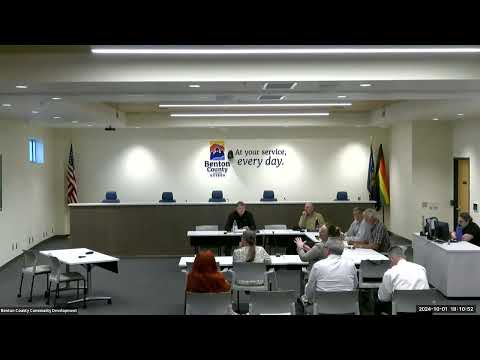
Scott Kruger, Benton County Environmental Health Program Manager, told the Benton County Planning Commission that the county is ramping up a domestic well-safety program in partnership with Oregon State University and the Oregon Health Authority that will start testing hundreds of private wells for bacteria, nitrates and arsenic.
Kruger said the county expects funding to reach roughly 400 homes once contracts are complete. He told commissioners the program follows smaller grants the county used to fund testing of about 100 homes in prior rounds through grants of roughly $3,000–$5,000.
“The nice thing you can do is you can do it double fast,” Kruger said of the posted recordings and materials; later he described himself succinctly as “I’m the water guy,” reflecting his role as the county delegate for the Oregon Health Authority’s drinking water services.
Why this matters: groundwater in much of Benton County is served by private wells and small public systems; Kruger told the commission the county’s portion of the Southern Willamette Valley Groundwater Management Area has recurring nitrate concentrations above background and, in a few cases, above federal limits.
Key facts presented - Program scale and funding: Kruger said prior grant rounds allowed testing of about 100 homes; the new, larger domestic-well safety program coordinated with Oregon State University is expected to reach about 400 homes once contracts are signed and funding is finalized. - System counts: Kruger said Benton County oversees roughly 62 regulated public water systems (soon to be 63) serving about 4,300 people outside larger cities; the Oregon Health Authority retains oversight of larger surface-water systems and municipalities. - Contaminants monitored: testing will target total coliform (bacteria), nitrate and arsenic; Kruger said some systems also report sodium or salinity because of local geology and proximity to coastal deposits. - Nitrate trend and health threshold: Kruger said the EPA/State maximum contaminant level (MCL) for nitrate is 10 mg/L. He described recurring nitrate readings in the 7–9 mg/L range for some private wells and noted a few isolated tests that exceeded the MCL (for example, a school system previously tested near 11.5 mg/L and later reduced to about 2–3 mg/L after treatment was installed). - Mitigation options: Kruger described point-of-use and point-of-entry options, including reverse-osmosis systems and ion-exchange units; he noted treatment is effective but can be costly and requires long-term maintenance. - Public access to system data: Kruger demonstrated the Safe Drinking Water Information System / data-online pages for Oregon public water systems and said each regulated system posts monitoring results and notices, including boil-water advisories after pressure events or pipe breaks.
What commissioners asked and staff clarified Commissioners and attendees asked about saltwater intrusion, regional groundwater monitoring, mitigation options for homeowners and how the county coordinates with state programs. Kruger said salt or sodium can be detected in some pockets (he cited local examples such as parts of Kings Valley and a small subdivision near a substation). He said the county does not inspect state-regulated surface systems (those remain under Oregon Health Authority inspection) but that his office inspects the small systems and follows up on bacterial or nitrate exceedances.
Limitations and next steps Kruger said the expanded domestic-well testing program is awaiting contract finalization and that some mitigation—particularly point-of-use treatment—remains costly for private homeowners. He suggested outreach and tutorials to help residents and realtors navigate public testing data.
Ending Kruger encouraged residents, realtors and commissioners to contact his office for tutorials on the state drinking-water pages and for help interpreting test results. He said the county will notify residents when the larger domestic-well testing program begins.