Get Full Government Meeting Transcripts, Videos, & Alerts Forever!
Get email alerts on the Healthcare For Uninsured topic
No spam. Unsubscribe anytime.
Montgomery Cares cited as a 20‑year model for county-funded care as Prince George’s task force weighs options
Summary
At a virtual meeting of the Prince George’s County Health Assurance Task Force, public‑health and community clinic leaders described Montgomery Cares — Montgomery County’s 20‑year-old program for uninsured adults — and said it offers a replicable public–nonprofit model if Prince George’s secures stable funding and administrative capacity.
At a virtual meeting of the Prince George’s County Health Assurance Task Force, public‑health and community clinic leaders described Montgomery Cares — Montgomery County’s 20‑year-old program for uninsured adults — and said it offers a replicable public–nonprofit model if Prince George’s secures stable funding and administrative capacity.
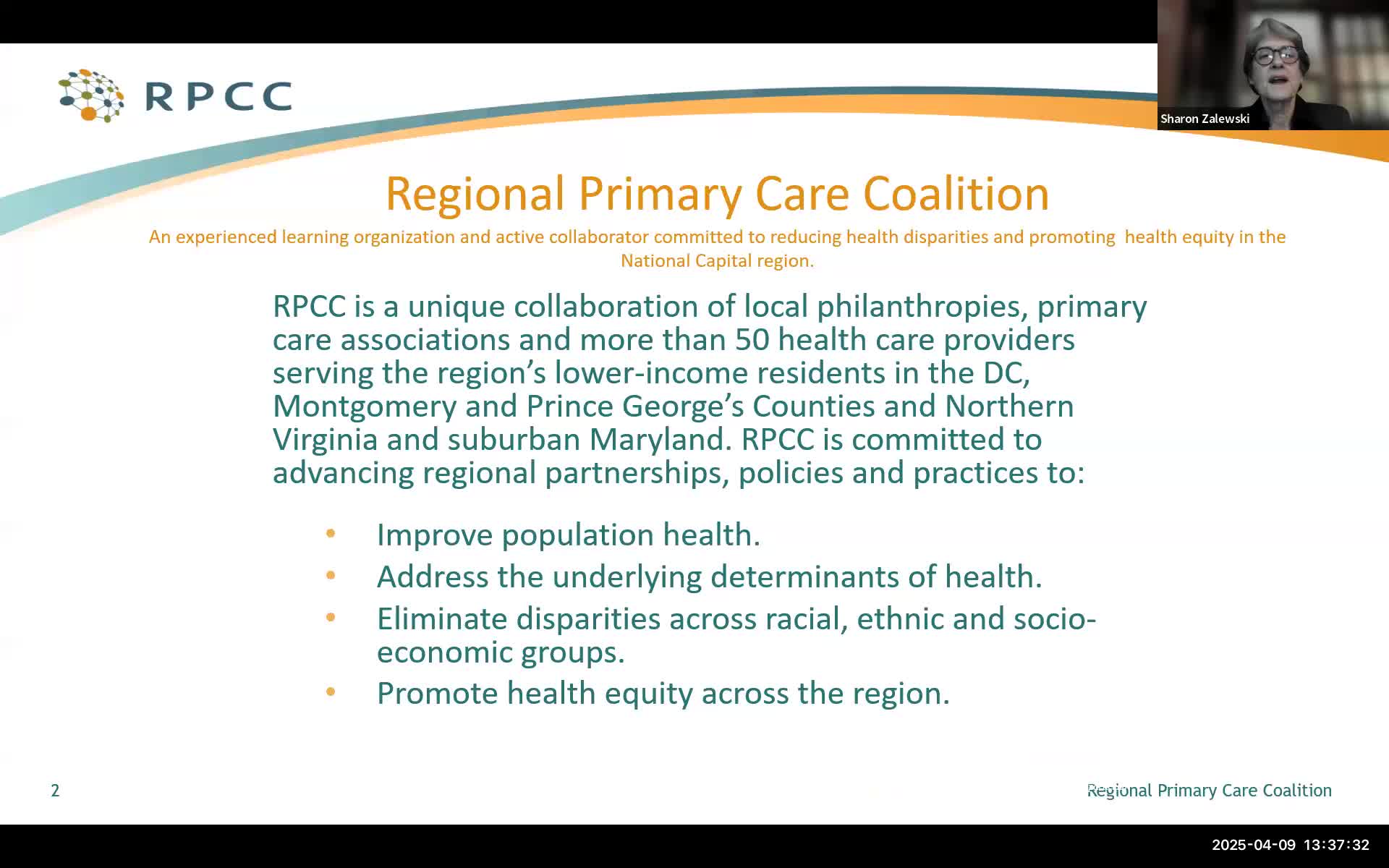
“Not one size does not fit all in terms of programs for the uninsured,” Sharon Zalewski, executive director of the Regional Primary Care Coalition, told the task force as she outlined differences between the two counties’ health systems and budgets. Zalewski noted that Prince George’s County’s overall budget is about $5.8 billion compared with Montgomery County’s $7.7 billion and said Prince George’s currently allocates a smaller share of its budget to health and human services.
Montgomery Cares, Leslie Graham, president and CEO of the Primary Care Coalition (PCC), said, “is a program… it is only for adults age 18 and older.” Graham described Montgomery Cares as a county‑funded program that operates as a public–nonprofit partnership in which Montgomery County provides core general‑fund support and PCC provides centralized program management, grants development, claims processing and other shared services for participating nonprofit clinics.
Why it matters: Montgomery Cares is financed out of county general funds, supplemented by state grants and other funding the PCC raises. That combination supports subsidized clinic visits, specialty referrals, a centralized prescription assistance program (MedBank), behavioral‑health integration and data and quality work. Task force members said Prince George’s is working to align funding and administration of care for underinsured and uninsured residents and that Montgomery Cares offers operational lessons.
How Montgomery Cares works: Graham said the Montgomery Cares primary‑care network currently includes 12 nonprofit provider organizations with more than 25 locations; only three of the 12 are federally qualified health centers (FQHCs). Eligibility is determined at the clinic: adults 18 and older, Montgomery County residency, household income under 250% of the federal poverty level and uninsured. Clinics may charge a copay, up to $35, but are not required to charge the full amount.
The county currently pays a per‑encounter subsidy of $102.50 under Montgomery Cares. Graham said that rate “is currently only covering about 45% of an average visit cost,” and that the county and PCC have been working to increase it. PCC also runs a prescription assistance program that brings roughly $6–8 million a year in donated brand‑name medicines and about $1.4 million in generic purchasing to participating clinics.
Scope and performance: PCC presented utilization data showing earlier peaks of nearly 30,000 unique patients and roughly 85,000 visits before the Affordable Care Act and Medicaid expansion reduced enrollment. In recent years the program has resumed growth: fiscal‑year 2024 recorded about 70,000 visits and 25,000 unique patients; PCC projected roughly 76,000 encounters for FY25 and has asked the county for a supplemental to cover the additional encounters beyond the budgeted 72,000.
Funding and governance: Graham and Zalewski emphasized that Montgomery County’s Montgomery Cares funding comes from the county’s general fund and that PCC uses that base to leverage state grants, pro bono specialty care and philanthropic dollars. Graham said the public–nonprofit split that was intended early in the program — about 70% county funding and 30% nonprofit contributions — has shifted and requires periodic adjustments.
What the task force heard about outreach and enrollment: PCC staff said the program is not an insurance product and does not formally “enroll” patients; clinics determine eligibility at the point of service based on required documents and perform periodic audit samples. Outreach is primarily clinic‑based and community word‑of‑mouth, supplemented by minority health initiative offices, health fairs and 311 referrals. A University of Chicago NORC network adequacy study cited by PCC found the program reaches most of the population likely to be eligible and estimated about 30,000 Montgomery County residents would be eligible under the stated rules.
Questions and cautions: Prince George’s task force members raised funding and administrative capacity as primary barriers to adopting a similar model. “The problem will always continue to be the funding,” said Dr. Diane Young, division director for family health services at the Prince George’s County Health Department. Task force members asked PCC for line‑by‑line budget comparisons and for written recommendations on which Montgomery Cares elements could transfer to Prince George’s.
Formal action: The task force approved the March minutes with a requested correction to a line about a Mary’s Center site count. A motion to approve the minutes was seconded and the chair reported the motion carried.
Next steps: Task force members asked PCC and county staff to provide more detailed budgeting information and program line items for the next meeting, and PCC agreed to share contact information for follow‑up. The task force will review written follow‑up materials, including the Montgomery Cares budget breakdown and PCC’s recommendations, at a subsequent meeting.
Notes on attribution and scope: The article draws only on statements made during the task‑force meeting and does not attribute program elements to sources outside the meeting. Details such as precise county budget line numbers were described by presenters as estimates or general fund totals and PCC offered to provide line‑by‑line figures on request.