Get Full Government Meeting Transcripts, Videos, & Alerts Forever!
Get email alerts on the School Waste Reduction topic
No spam. Unsubscribe anytime.
AISD outlines districtwide zero-waste plan, cites 23% diversion rate and staffing shortfall
Summary
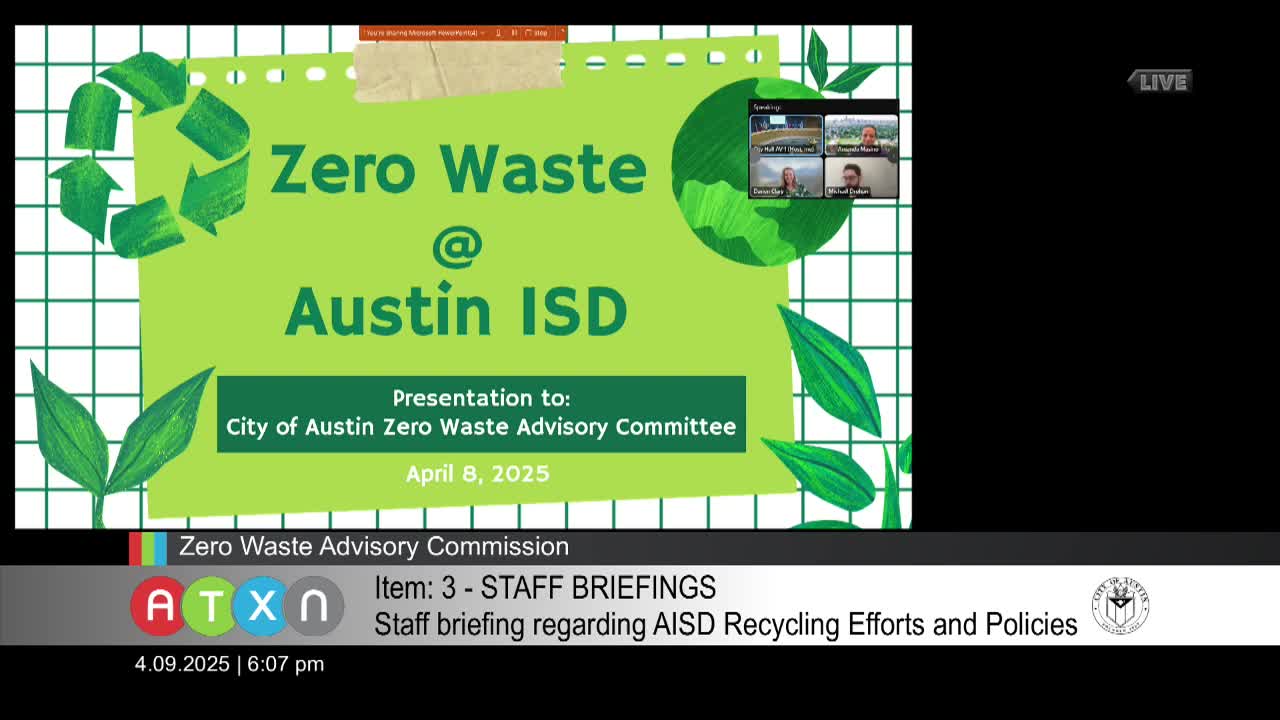
Austin Independent School District presented its zero-waste framework to the Austin Resource Recovery Commission, describing infrastructure, classroom programs and partnerships while warning that loss of a dedicated staff position and inconsistent campus implementation have reduced diversion rates to about 23%.
Darian, director of sustainability for the Austin Independent School District, gave the commission a districtwide briefing on AISD's recycling, composting and landfill-diversion efforts, saying the program covers infrastructure, curriculum and partnerships across all campuses.
The presentation summarized two decades of sustainability work at AISD, described the district's 0-waste signage and collection standards, and identified staffing and funding as the largest obstacles to expanding diversion. "We have composting, recycling, and landfill dumpsters at every single school," Darian said, adding that the district uses bilingual signs aligned with the city's color scheme so students can sort waste in cafeterias.
The presentation matters because AISD serves thousands of students and can integrate waste diversion into classroom learning while also generating measurable diversion benefits. District staff described operational rules for new construction, such as requiring ground-level dumpster access and keeping compost dumpsters within 50 feet of cafeterias to reduce manual lifting injuries. Darian said the district relies on diversion data provided by its hauler, Texas Disposal Systems, and that the district maintains a public-facing toolkit and training options for custodial and food services staff.
District officials traced sustainability policy to a 2004 construction policy and subsequent actions: a 2010 resolution and a 2011 policy, formation of an Environmental Stewardship Advisory Committee in 2013, green-building requirements tied to the 2016 bond and integration into the 2017 facilities plan, and implementation tied to the 2022 bond passed by voters. Darian said those policies feed operational procedures that emphasize "source reduction, reuse, recycling, and composting."
On staffing and funding, Darian said AISD previously had a full-time zero-waste specialist funded externally; that external funding came from Texas Disposal Systems. The district later lost the position during budget cuts and has been unable to maintain a permanent, dedicated district-level zero-waste staff member. "It really makes a big difference to have somebody who can really put their full attention at a district level on it," Darian said.
Commissioners asked about concrete numbers and operations. Commissioner Gerald Hann asked about the source of the earlier external funding; Darian confirmed that Texas Disposal Systems funded the initial full-time position. Commissioner Michael asked about the current district diversion rate; Darian said, "Right now, we're at about 23%." Darian added that diversion had been higher before COVID and fell when staffing and on-site sorting attention declined.
The presentation highlighted classroom and outreach work: an eight-module sustainable-schools course developed with EcoRise, a blended teacher-facing module to incorporate school-specific waste data, teacher and custodial trainings (offered in English and Spanish), volunteer waste-sorting days timed to Earth Month, and field trips to see hauling and composting facilities. Darian described a planned spring "golden trash can" award to recognize top-performing campuses and said the district marketplace and warehouse surplus sales give retired materials a second life.
The commission did not take formal action on the presentation. Commissioners thanked AISD staff and encouraged continued partnership and possible funding conversations with outside partners. Darian said the district was exploring pilot funding discussions with partners but had no committed replacement funding for the dedicated staff position at the time of the presentation.
Looking ahead, the district flagged gaps in continuous training, data completeness, and staffing as the key barriers to increasing diversion across its roughly 113 schools and an enrollment the presenter described as "about 73,000 students" with "10,000 teachers and staff." The district also emphasized that operational standards for new construction (ramps instead of stairs, dumpster access for people of all heights) are meant to reduce injury risk and improve sorting outcomes.
AISD materials, signage and a toolkit are available online; the presenter provided QR codes and said the district maintains a dashboard of diversion data provided by its hauling partner.