Get Full Government Meeting Transcripts, Videos, & Alerts Forever!
Get email alerts on the Student Discipline Policy topic
No spam. Unsubscribe anytime.
Public hearing on HCPSS Policy 9,400 draws students, advocates and clinical staff divided over restraint and exclusion rules
Summary
Dozens of students, school psychologists and disability advocates testified at a public hearing on draft Policy 9,400 (Student Behavior Intervention). Speakers praised limits on physical restraint but warned the draft lacks plain‑language protections, parent consent clarity, and stronger complaint procedures.
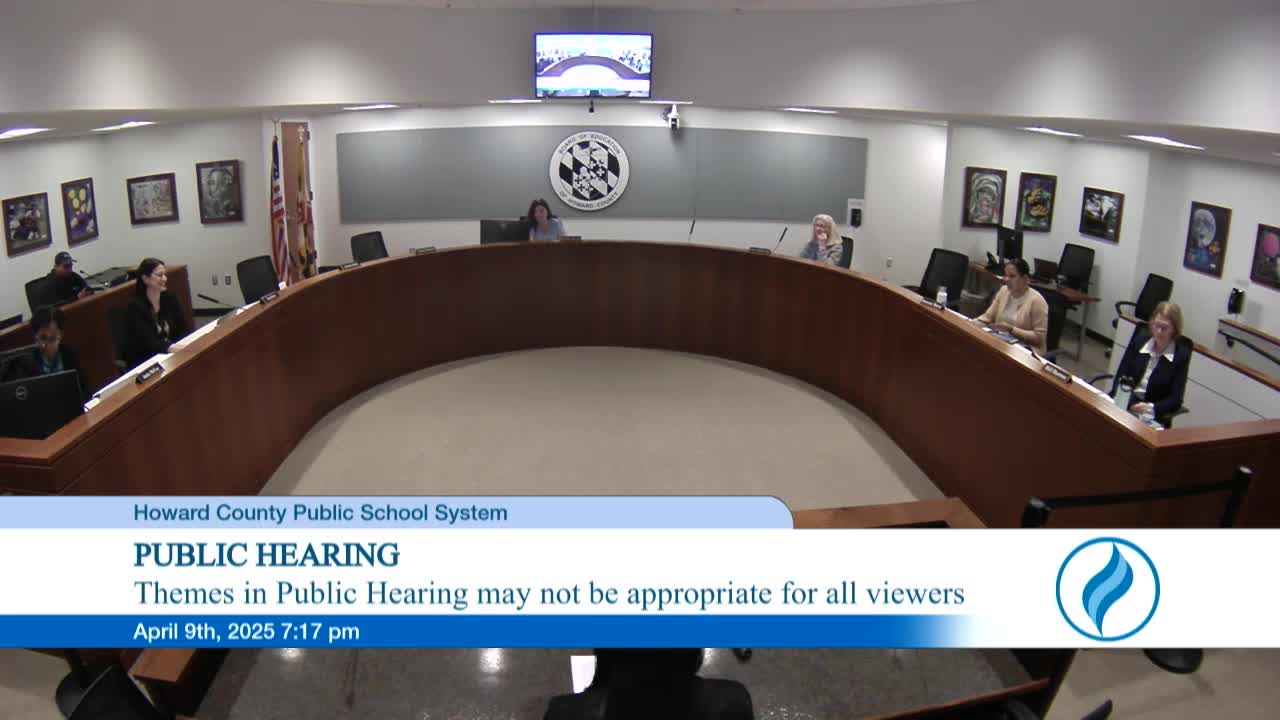
Howard County Public Schools held a public hearing Wednesday on proposed revisions to Policy 9,400 (Student Behavior Intervention), drawing testimony from students, parents, school psychologists and disability advocates with sharply divided views on restraint, seclusion and discipline.
Several student speakers and school psychologists urged the board to adopt the revised policy, arguing it clarifies that physical restraint and exclusion must be used only in exigent circumstances and that positive behavior supports should be prioritized. “Policy 9,400…defines the process by which HCPSS promotes positive behavior interventions,” student speaker Tessa On said in support, adding that the draft’s limits on mechanical and corporal punishment align with national guidance.
Other witnesses — including disability rights advocates and parents — urged the board to reject the current draft and demanded stronger, clearer protections. Jeanne Marie Leosakis (speaking for disability advocates) told the board the document “bears no resemblance to the draft we worked on in good faith and is entirely unacceptable” and criticized the policy for removing explicit parental consent language and for relying on external guides rather than plain‑language, locally‑maintained procedures. “This policy draft is a disservice to parents of your most vulnerable students and I urge you to reject it,” she said.
School psychologists described the volume of work created by behavior plans, functional behavior assessments (FBAs), data collection and crisis response. Two psychologists detailed the hours required to create and monitor FBA/BIPs, train staff, and respond to crises, and asked the district to recognize that specialized skills and time are required for compliant implementation.
Other youth speakers warned that the policy does not make parents promptly aware of exclusionary placements; one student said, “The adults in our buildings are becoming police officers in our minds,” calling for clearer steps that prioritize de‑escalation and family notification.
Board members did not take final action on Policy 9,400 at the hearing; staff said the draft will be revised in light of testimony, and a public comment period and further stakeholder meetings are expected before the board considers final adoption.